
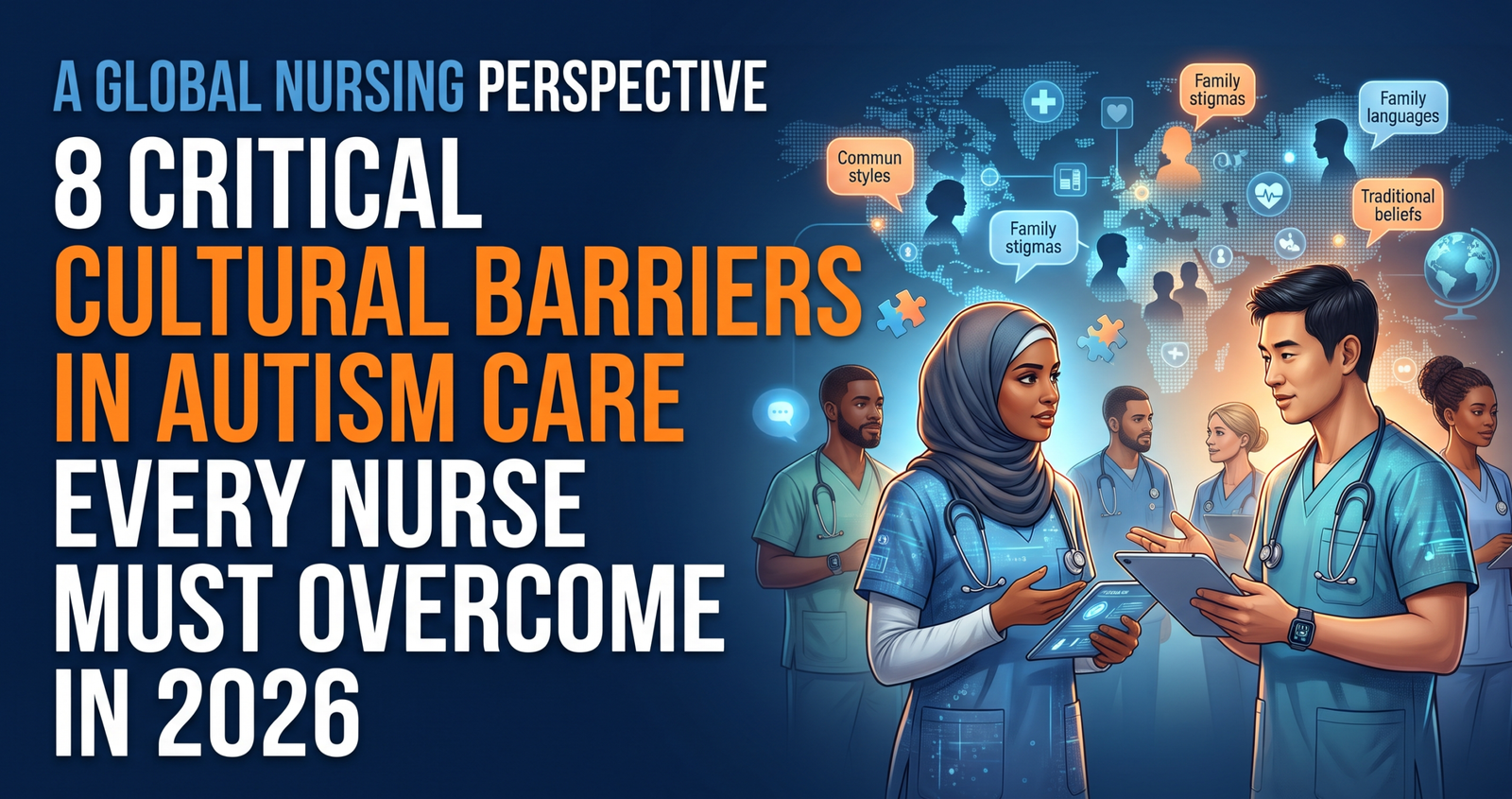
Explore 8 Critical Cultural Barriers in Autism Care Every Nurse Must Overcome in 2026: A Global Nursing Perspective. Eight essential cultural obstacles in autism care from a worldwide nursing angle in 2026. Evidence-primarily based totally techniques for nurses, educators & researchers worldwide.
A Global Nursing Perspective: 8 Critical Cultural Barriers in Autism Care Every Nurse Must Overcome in 2026
Introduction
Autism Spectrum Disorder (ASD) affects an expected 1 in one hundred kids worldwide but get right of entry to well-timed analysis and first-class care stays deeply unequal throughout cultures and countries. Cultural beliefs, language differences, social stigma, and systemic healthcare gaps preserve to postpone identity and intervention for hundreds of thousands of kids globally.
For nurses — who function frontline healthcare companies throughout each vicinity of the world — knowledge cultural obstacles is not always optional; it is miles an expert and moral imperative. This publish examines the maximum urgent cultural demanding situations in worldwide autism care and descriptions how nursing training and culturally capable exercise can start to bridge those essential gaps.
Understanding the Global Landscape of Autism Diagnosis Disparities
Autism does now no longer discriminate with the aid of using geography; however, get right of entry to its analysis really does. A comparative evaluates posted in PMC located that the common postpone among preliminary parental issues and a proper ASD analysis span almost 32 months globally — a troubling hole that widens in addition in low- and middle-profits countries (LMICs). In high-profits countries consisting of the US and Canada, attention campaigns, developmental surveillance protocols, and professional get right of entry to have extensively decreased diagnostic wait times. Yet in massive components of Africa, Southeast Asia, the Middle East, and South America, kids with autism regularly pass undiagnosed for years — or are in no way recognized at all.
A 2024 scoping evaluate posted with inside the Journal of Advanced Nursing (Greenwood et al.) found out that 85% of studies on autistic sufferers` health center studies come from the United States and Canada, with certainly no illustration from Africa, the Middle East, and South America. This profound studies hole manner that nursing interventions were advanced predominantly inside Western, high-useful resource frameworks that don’t replicate the realities of the bulk of the world’s population. For worldwide nursing exercise to be sincerely equitable, it must account for the numerous cultural, economic, and systemic environments wherein sufferers live.
A 2025 cross-sectional look at from PMC inspecting nurses’ knowledge of ASD throughout numerous worldwide settings located giant variability in nurses’ understanding approximately autism, especially concerning identity, behavioral interventions, and conversation techniques in culturally numerous or useful resource-constrained contexts. These understanding gaps are not a mirrored image of expert inadequacy — they are the fabricated from structures which have traditionally under prioritized cultural competence education in nursing training.
Stigma and Cultural Misconceptions: The Invisible Barrier
Stigma stays the maximum effective and pervasive cultural barrier to autism care globally. In many groups throughout South Asia, sub-Saharan Africa, Latin America, and the Middle East, autism is not always understood as a neurodevelopmental situation. Instead, its miles regularly interpreted via spiritual, moral, or supernatural frameworks. Families in those areas can also additionally characteristic a child`s developmental variations to ancestral punishment, evil spirits, non-public sin, or a loss of parental virtue. These deeply held ideals, even as deserving of respectful acknowledgment, regularly lead households to are seeking for religion healers or conventional treatments lengthy earlier than — or as a substitute of — enticing with healthcare systems.
A 2024 Frontiers in Child and Adolescent Psychiatry article specially pronounced those conventional ideals and misconceptions in Southeast Asian LMICs lead households to worry social ostracism and network judgment, inflicting them to keep away from in search of formal diagnoses. The worry of being labeled “cursed” or stigmatized inside one’s network creates an effective disincentive to are seeking for help. This stigma does now no longer most effective influence the child — its locations a huge emotional burden on parents, siblings, and prolonged own circle of relatives’ individuals who can also additionally actively cover a kid’s situation to guard their own circle of relatives’ social standing.
Nurses running inside or along those groups need to method stigma with empathy and cultural humility as opposed to judgment. Leininger’s Transcultural Nursing Theory gives a foundational framework here, emphasizing the significance of information fitness behaviors in the patient’s very own cultural worldview earlier than implementing biomedical fashions of care. Practically, this indicates nurses need to interact network leaders, non-secular figures, and relied on own circle of relative’s individuals as companions in autism awareness — now no longer deal with them as barriers to overcome.
Language and Communication Barriers in ASD Assessment
Accurate autism analysis relies upon closely on nuanced behavioral commentary and caregiver reporting. Both of those methods grow to be appreciably compromised while language boundaries exist among the nurse or clinician and the own circle of relatives. Standard autism screening tools — which include the Modified Checklist for Autism in Toddlers (M-CHAT) and the Autism Diagnostic Observation Schedule (ADOS) — have been initially advanced and tested in English-speaking, Western populations. Their translation and cultural variation for various linguistic and social contexts stays incomplete in lots of components of the world.
A 2026 scoping evaluation with inside the Journal of Autism and Developmental Disorders (Montiel-Nava et al.) highlighted that autism interventions are predominantly advanced in high-earnings international locations, extensively restricting get entry to for households in LMICs because of systemic, cultural, and logistical boundaries. The identical evaluation emphasized that powerful cultural variation calls for now no longer best language translation however additionally content material amendment to mirror nearby values, shipping approach adjustments, and integration of network-particular ideals and caregiving norms. Without this variation, even well-intentioned nursing exams hazard generating misguided effects or alienating the households they are intended to support.
For nurses in multicultural city settings — including the ones determined throughout South Asia, the Gulf States, and immigrant groups in Europe and North America — language concordance with sufferers is similarly crucial. A PMC evaluation on racial and ethnic disparities in ASD analysis determined that using bicultural and bilingual staff, the usage of depended on network brokers, and incorporating own circle of relative’s navigators are most of the only techniques for constructing agree with and enhancing diagnostic accuracy in minority and immigrant populations. These are not simply administrative solutions; they are scientific necessities.
Resource Scarcity and Healthcare System Barriers
Cultural boundaries in autism care cannot be separated from the structural realities of healthcare structures in LMICs. A PMC conceptual framework takes a look at on cultural and contextual elements in worldwide autism care determined that provider provision in lots of LMICs is significantly hampered with the aid of using a loss of educated personnel — with maximum of those international locations reporting crucial shortages in psychiatrists, nurses, and psychosocial care providers. Nearly 1/2 of the world`s populace lives in international locations with fewer than one psychiatrist in keeping with 100,000 persons (WHO, 2014), making network-primarily based totally nursing the maximum viable — and regularly best — pathway to autism identity and early intervention.
In many low-earnings international locations, healthcare discourse and studies investment have traditionally targeted on infectious diseases, leaving intellectual and behavioral fitness situations like ASD significantly under resourced. A 2022 mandoline looks at on ASD analysis throughout earnings stages mentioned that the relative loss of ASD recognition in LMICs is compounded with the aid of using inadequate knowledge, bad recognition of diagnostic tools, and confined authority’s investment. These systemic gaps immediately affect nursing practice: nurses who have by no means acquired schooling in developmental screening cannot perceive autism, regardless of how inclined or devoted they are.
This truth underscores the pressing want for task-transferring fashions in worldwide nursing — techniques that area network nurses on the middle of developmental surveillance, early identity, and own circle of relative’s support. Organizations including the WHO and UNICEF have increasingly endorsed for schooling network medical experts and number one care nurses in autism screening as a cost-powerful, culturally grounded approach for last those worldwide gaps.
The Role of Culturally Competent Nursing in Improving ASD Outcomes
Culturally capable nursing is not always uniqueness ability — it is far from a foundational trendy of practice, with inside the context of autism care. According to Nursing CE Central (2025), nursing specialists can meaningfully deal with ASD care disparities with the aid of using being vigilant, displaying empathy, and advocating for equitable, inclusive take care of people and households from underserved populations. This consists of figuring out early symptoms and symptoms of autism while recurring well-baby visits, connecting households with suitable assessment resources, and turning in care that aligns with the own circle of relative’s cultural values and conversation preferences.
Campinha-Bacote’s Model of Cultural Competence in Healthcare Delivery gives nurses a sensible framework for this work, figuring out five middle constructs: cultural awareness, cultural knowledge, cultural ability, cultural encounters, and cultural desire. Applied to autism care, this version asks nurses now no longer handiest to study various cultural ideals however to actively are seeking encounters with underserved communities, increase ability in cross-cultural conversation, and preserve a true motivation to offer equitable care. These are learnable, trainable competencies — and their integration into nursing curricula globally is each possible and urgently needed.
Beyond character practice, nurses have an effective advocacy position in shaping institutional and coverage responses to cultural obstacles in ASD care. Advocating for multilingual affected person training materials, culturally tailored screening tools, various scientific staff, network outreach packages, and investment for autism studies in LMICs are all with inside the expert scope of nursing leadership. Nurses who recognize the cultural dimensions of autism care are higher located to be marketers of systemic change, now no longer simply character caregivers.
Nursing Education Strategies for Building Global Cultural Competence in ASD Care
Preparing nurses to navigate cultural obstacles in autism care calls for intentional reform in nursing training at each degree. Nursing faculties and persevering with training packages ought to move past surface-degree range schooling to offer deep, contextual studying approximately how tradition shapes the perception, recognition, and control of neurodevelopmental conditions. This consists of case-primarily based very studying drawn from various worldwide contexts, simulation physical activities concerning cross-cultural own circle of relative’s conversation and supervised scientific placements in multicultural or underserved settings.
International nursing organizations — inclusive of the International Council of Nurses (ICN) and the American Nurses Association (ANA) — have an increasing number of known as for the mixing of worldwide fitness capabilities into nursing curricula. These capabilities consist of the cap potential to apprehend and cope with fitness disparities, speak efficiently throughout language and cultural limitations, suggest for susceptible populations, and follow culturally tailored evidence-primarily based totally interventions. For nursing college students focusing on pediatrics, psychiatry, or network fitness, autism care must be a central, now no longer peripheral, aspect of cultural competence training.
Mentorship and persevering with expert improvement are similarly important. Experienced nurses who have labored in numerous cultural settings convey worthwhile realistic expertise that cannot be completely captured in textbooks. Creating based mentorship programs, magazine golf equipment centered on international ASD research, and global nursing exchanges can considerably boost up the improvement of cultural competence throughout the nursing workforce. Ultimately, a globally knowledgeable nurse is an extra powerful nurse — for each patient, irrespective of background.
Conclusion
Cultural limitations in autism care constitute one of the maximum pressings — and maximum solvable — demanding situations in international nursing today. From stigma and religious misconceptions to language gaps, diagnostic device limitations, and healthcare useful resource scarcity, the barriers that save you kids global from receiving well-timed autism analysis and suitable care are complicated however now no longer insurmountable. Nurses, as the biggest and maximum globally dispensed healthcare workforce, are uniquely placed to steer the transformation of autism care throughout cultures.
By grounding exercise in frameworks like Leininger`s Transcultural Nursing Theory and Campinha-Bacote’s Cultural Competence Model, and via way of means of advocating for systemic reforms in schooling and policy, nurses can start to dismantle those limitations one network at a time. For nursing college students, educators, researchers, and clinicians, this is not always only an expert responsibility — it is miles a profound humanitarian calling.
FAQs
FAQ 1: Why is autism often diagnosed later in low- and middle-income countries compared to high-income countries?
Delayed prognosis in LMICs outcomes from inadequate healthcare infrastructure, loss of educated professionals, poorly tailored screening tools, and stigma that daunts households from in search of formal evaluation. These elements together create considerable diagnostic delays, which could exceed years.
FAQ 2: How does cultural stigma influence autism care effects globally?
Stigma leads households to hide a child`s symptoms, are seeking non-medical interventions, and postpone expert engagement — all of which put off early intervention. Since early intervention is the maximum evidence-supported method for enhancing ASD effects, stigma at once contributes to poorer long-time period developmental outcomes.
FAQ 3: What nursing theories manual culturally capable autism care?
Madeleine Leininger’s Transcultural Nursing Theory and Josepha Campinha-Bacote’s Cultural Competence Model are the maximum extensively carried out frameworks. Both emphasize expertise the patient’s cultural worldview, growing cross-cultural communique skills, and maintaining an expert dedication to equitable, individualized care.
FAQ 4: What sensible steps can nurses take to lessen cultural limitations in autism care?
Nurses can use culturally tailored screening tools, paintings with network agents and bilingual staff, construct accept as true with via steady own circle of relative’s engagement, endorse for inclusive institutional policies, and pursue persevering with schooling in international fitness and neurodevelopmental care to reinforce their cultural competence practice.
Read More:
https://nurseseducator.com/didactic-and-dialectic-teaching-rationale-for-team-based-learning/
https://nurseseducator.com/high-fidelity-simulation-use-in-nursing-education/
First NCLEX Exam Center In Pakistan From Lahore (Mall of Lahore) to the Global Nursing
Categories of Journals: W, X, Y and Z Category Journal In Nursing Education
AI in Healthcare Content Creation: A Double-Edged Sword and Scary
Social Links:
https://www.facebook.com/nurseseducator/
https://www.instagram.com/nurseseducator/
https://www.pinterest.com/NursesEducator/
https://www.linkedin.com/company/nurseseducator/
https://www.linkedin.com/in/afzalaldin/
https://www.researchgate.net/profile/Afza-Lal-Din
https://scholar.google.com/citations?hl=en&user=F0XY9vQAAAAJ
https://orcid.org/0000-0001-6976-9158