
Discover 7 Evidence Based Nursing Screening Tools and Interventions for Anxiety Disorders in Autism 2026 Guide. 7 evidence-primarily based totally nursing screening equipment and interventions for tension problems in autism in 2025. Essential manual for nurses, students, and educators.
2026 Guide 7 Evidence Based Nursing Screening Tools and Interventions for Anxiety Disorders in Autism
Introduction
Anxiety problems are a few of the maximum frequent and clinically sizable co-taking place situations in people with autism spectrum disorder (ASD). Research posted in Autism Research continuously shows that as much as 50% of autistic people meet diagnostic standards for as a minimum one-tension disorder, making it a vital situation in nursing practice. Despite this excessive prevalence, tension in autism is regularly under detected because of overlapping symptom presentations. Nurses occupy a frontline function in screening, assessment, and care coordination, making their position critical in turning in timely, person-targeted interventions that meaningfully enhance affected person outcomes.
Understanding the Link between Autism and Anxiety Disorders
Autism Spectrum Disorder is a neurodevelopmental situation characterized via way of means of variations in social communication, sensory processing, and behavioral flexibility. These middle functions create a biologically and psychologically fertile floor for tension to emerge and persist throughout the lifespan. According to the Journal of Autism and Developmental Disorders (2024), intolerance of uncertainty (IU) has been recognized as one of the most powerful direct correlates of hysteria in autistic people, with a meta-evaluation of sixteen research reporting a big high-quality correlation of point sixty-two among IU and tension severity.
Sensory hypersensitive reaction is every other compounding factor. The International Journal of Advance Research in Nursing (2025) highlights that spotting sensory responses to light, sound, touch, or motion allows individualized care planning — and that environmental adjustments constitute a number one nursing intervention strategy. When sensory overload is unaddressed, it regularly escalates into generalized tension, panic responses, and behavioral dysregulation. Nurses who recognize this neurobiological interaction are a way higher ready to layout centered screening protocols and holistic care plans.
The diagnostic complexity cannot be overstated. Autistic people may also gift tension via behavioral signs, which includes elevated repetitive behaviors, meltdowns, withdrawal, or somatic complaints, instead of via the verbal self-file that conventional tension tests depend upon. This symptom masking — now and again called “camouflaging” — needs that nurses follow autism-tailored screening units instead of general general-populace equipment.
Key Nursing Screening Tools for Anxiety in Autism (2025 Evidence Base)
Selecting validated, autism-appropriate screening instruments is the cornerstone of effective nursing assessment. Several tools have demonstrated strong psychometric properties specifically within ASD populations, and nurses should be familiar with their clinical applications.
1. Screen for Child Anxiety-Related Emotional Disorders (SCARED):
The SCARED is a 41-object discern- and self-file questionnaire proven to be used in kids and youth elderly 8–18 years. Research posted in Frontiers in Psychiatry confirms it demonstrates sensitivity in detecting tension in autistic populations. The SCARED does now no longer perceive OCD or trauma-associated tension, which nurses must be aware while carrying out complete assessments. Its power lies in shooting generalized tension, panic, social phobia, and separation tension dimensions.
2. Spence Children`s Anxiety Scale (SCAS):
The SCAS is a 44-object scale assessing six tension domains, with each discern and baby variations available. A PubMed-listed look at observed that the SCAS confirmed first-rate inner consistency and fair-to-desirable discern-baby settlement in ASD samples, making it a dependable alternative in pediatric nursing settings.
3. Anxiety Scale for Children with Autism Spectrum Disorder (ASC-ASD):
This is one of the first tension measures evolved especially for autistic populations. A 2024 look at posted in MDPI assessed the ASC-ASD’s validity in kids elderly 8–12 years, confirming its superiority over fashionable-populace scales in shooting autism-particular tension displays together with sensory-associated fear and uncertainty distress.
4. Generalized Anxiety Disorder Scale (GAD-7):
While evolved for fashionable populations, the GAD-7 is one of the maximums extensively used and proven gadgets in medical settings. A December 2024 systematic overview in PubMed showed the GAD-7’s robust software in habitual intellectual fitness screening. For autistic youth and adults with good enough verbal capacity, it presents a brief, realistic supplementary degree that integrates properly into nursing workflows.
5. Achenbach System of Empirically Based Assessment (ASEBA) / Child Behavior Checklist (CBCL):
The CBCL’s anxious/depressed syndrome scale tested the very best correlation with SCARED ratings in ASD samples in keeping with Frontiers in Psychiatry research. Nurses in developmental pediatric clinics and psychiatric nursing settings to represent internalizing symptoms often utilize the CBCL and its grownup counterpart (ASR).
6. Pediatric Anxiety Rating Scale (PARS):
The PARS is a clinician-administered device that gives systematic severity rankings throughout a couple of tension domains. It’s based layout makes it especially perfect to be used with the aid of using superior exercise nurses and nurse practitioners carrying out complete psychiatric assessments.
7. Observational and Behavioral Nursing Assessment:
Beyond formal gadgets, nurses must appoint based behavioral remark as a screening strategy. According to the CDC’s Clinical Screening for ASD guidelines, screening equipment need to be complemented with the aid of using medical judgment, and a wonderful screening result must continually be accompanied with the aid of using an intensive multidisciplinary assessment. Nurses file behavioral markers together with modifications in repetitive behaviors, sleep disruption, urge for food modifications and avoidance styles as a part of holistic tension screening.
Evidence-Based Nursing Interventions for Anxiety in Autism
Once tension is recognized thru systematic screening, nurses put in force or coordinate more than a few evidence-primarily based totally interventions tailor-made to the autistic individual`s profile. The National Council of State Boards of Nursing (NCSNB, 2024) suggested that 68% of recent graduate nurse’s experience underprepared to control sufferers with ASD — underscoring the pressing want for specialized schooling and protocol-pushed exercise.
Adapted Cognitive Behavioral Therapy (CBT):
CBT is the maximum broadly researched mental intervention for tension in autism. A ScienceDirect analysis (2024) emphasizes that trendy CBT should be tailored to fulfill the desires of autistic youth, together with visible helps, sensory considerations, and integration of the individual’s unique pursuits to decorate engagement and motivation. Active own circle of relative’s involvement is critical — caregiver participation strengthens remedy generalization from health facility to domestic environments. Nurses play a key position in psycho education, reinforcing CBT talents for the duration of healthcare encounters and coordinating with psychologists who supply remedy.
Sensory-Based Interventions:
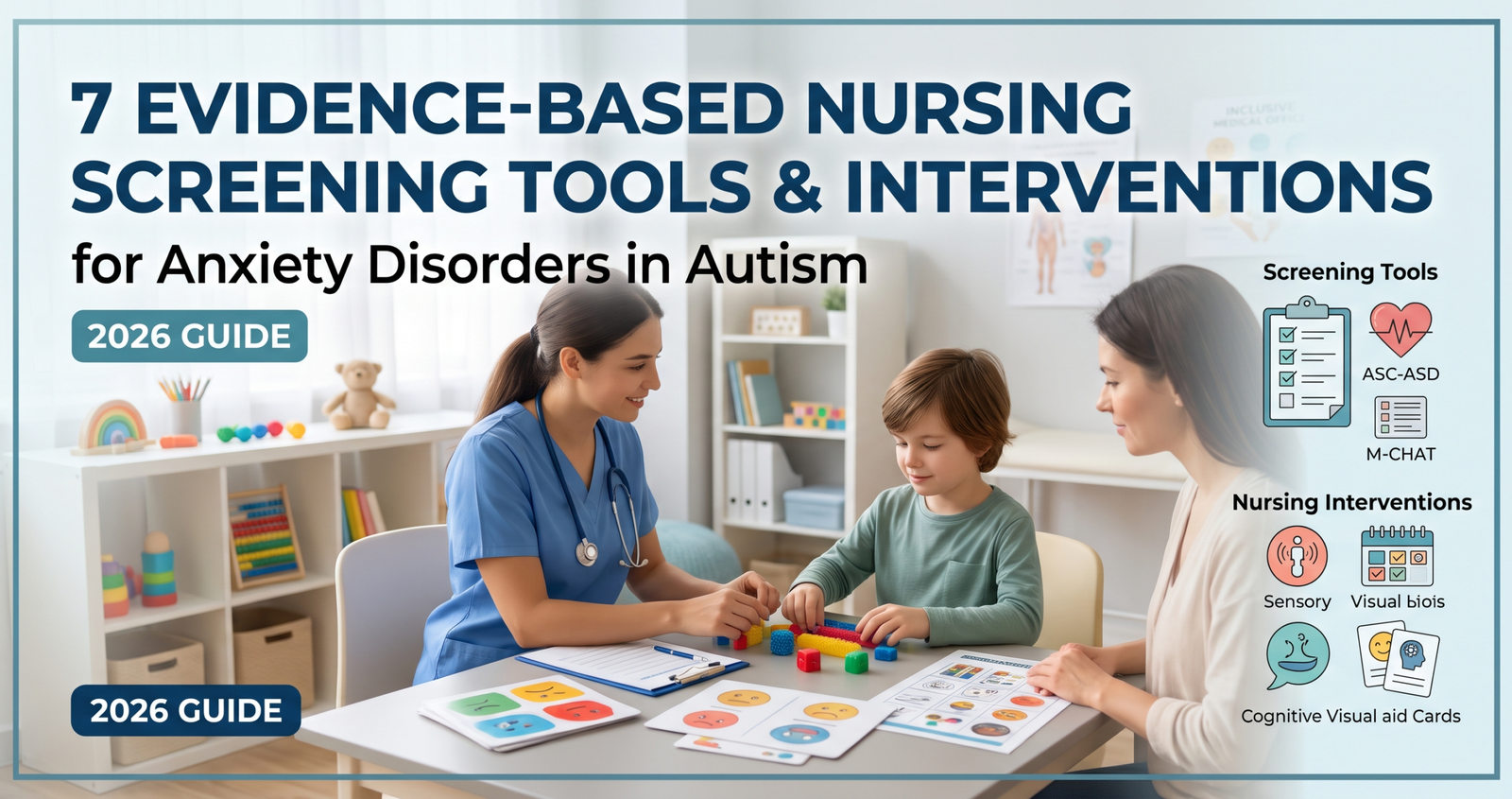
Sensory integration remedy and sensory modulation techniques are most of the maximum nurse-deployable interventions for tension control in ASD. A 2025 systematic overview in Frontiers in Pediatrics, the use of the Johns Hopkins Nursing Evidence-Based Practice Model as its framework, showed sensory-primarily based totally interventions (SBIs) enhance practical results in youngsters with developmental disorders. Practical nursing programs consist of environmental modification — adjusting lights levels, lowering auditory stimulation, and supplying sensory aids consisting of weighted blankets — techniques at once supported via way of means of the nursing literature (International Journal of Advance Research in Nursing, 2025).
Structured Predictability and Routine Reinforcement:
Intolerance of uncertainty is the most powerful neuropsychological motive force of hysteria in autism. Nursing interventions that set up clear, predictable care routines — strengthen instruction for procedures, visible schedules, and social narratives — at once goal this mechanism. These interventions require minimum assets but produce significant discounts in anticipatory tension for the duration of medical encounters.
Pharmacological Support and Medication Monitoring:
While now no longer first-line, selective serotonin reuptake inhibitors (SSRIs) and anti-tension medicines are now and again prescribed in autism-associated tension control. According to NCBI Bookshelf’s Comprehensive Autism Care Demonstration (2025), SSRIs and anti-tension medicines are used to deal with autism-associated symptoms, although they may be now no longer especially accredited for ASD. Nurses are liable for tracking healing response, facet effects, behavioral changes, and making sure remedy adherence — a critical issue of safe, collaborative psychiatric care.
Family-Centered Care and Psych education:
A cornerstone of nursing exercise in ASD care is empowering families. Nurses supply based psych education approximately tension triggers, early caution signs, de-escalation techniques, and while to searching for emergency support. Research helps that parent-mediated interventions substantially lessen tension in younger autistic youngsters, with high-quality results maintained at follow-up (Journal of Autism and Developmental Disorders, 2024).
Multidisciplinary Team Coordination: Anxiety control in autism calls for seamless collaboration amongst nurses, nurse practitioners, occupational therapists, speech-language pathologists, psychologists, and number one care providers. PMC research (2025) confirms that speech-language pathologists and multidisciplinary groups cope with the conversation and behavioral wishes of autistic people during high-tension medical situations, which include essential care emergencies.
Challenges in Nursing Practice and the Path Forward
Despite developing awareness, giant gaps continue to be. Studies referenced in Nurse Education Today display that BSN applications commit a median of best 2.4 hours to autism-unique content — a placing deficit given the medical complexity of hysteria co-morbidity in ASD populations. Nurses in all settings, from pediatric number one care to person psychiatric units, must endorse for multiplied persevering with education, autism-competency training, and implementation of demonstrated screening protocols.
Digital fitness innovations, along with AI-powered behavioral tracking equipment, are rising as supplementary aids for early tension detection, as mentioned in nursing journals in 2026 — however human medical judgment and healing relationships continue to be irreplaceable.
Conclusion
Anxiety problems constitute one of the maximum urgent co-morbidities in autism spectrum disorder, affecting as much as 1/2 of all autistic people throughout the lifespan. Nurses are strategically located as first responders in tension identity and control — supplied they are prepared with demonstrated, autism-tailored screening equipment which include the SCARED, ASC-ASD, SCAS, and GAD-7.
Evidence-primarily based totally interventions starting from tailored CBT, sensory-primarily based totally techniques to established environmental changes, and own circle of relative’s psycho education shape the medical spine of nursing exercise on this area.
The key takeaway for nurses, students, researchers, and educators is clear: tension in autism is not always a secondary concern — its miles a number one medical precedence that needs specialized knowledge, systematic screening, and individualized, compassionate care. Investing in autism-unique nursing competency is not always optional; it is miles an expert and moral duty that at once improves the great of existence of autistic people and their families.
FAQs
FAQ 1: What makes anxiety screening in autism different from standard anxiety screening?
Autistic people might not verbally specifically tension in normal ways, as a substitute displaying it via behavioral changes, extended repetitive actions, or somatic complaints. Standard general-populace equipment can also additionally leave out autism-precise presentations, making autism-tailored devices just like the ASC-ASD clinically essential.
FAQ 2: Which nursing screening device is pleasant for assessing tension in autistic children?
The Anxiety Scale for Children with Autism Spectrum Disorder (ASC-ASD) became particularly evolved for autistic populations and has tested advanced validity over general-populace scales. The SCARED and SCAS are well-confirmed supplementary alternatives used extensively in medical and studies settings.
FAQ 3: How can nurses put into effect CBT for tension in autistic sufferers?
Nurses commonly aid CBT via psycho education, reinforcing talents throughout care interactions, and coordinating with educated psychologists. Adaptations for autism encompass incorporating visible supports, predictable consultation structures, and the patient`s unique pastimes to enhance engagement.
FAQ 4: What environmental changes can nurses make to lessen tension in autistic sufferers throughout medical visits?
Nurses can lessen tension through dimming lighting, minimizing unexpected loud sounds, presenting sensory aids like weighted blankets, supplying enhance instruction via visible schedules, and speaking procedural steps clearly — all supported through present day nursing proof from the International Journal of Advance Research in Nursing (2025).
Read More:
https://nurseseducator.com/didactic-and-dialectic-teaching-rationale-for-team-based-learning/
https://nurseseducator.com/high-fidelity-simulation-use-in-nursing-education/
First NCLEX Exam Center In Pakistan From Lahore (Mall of Lahore) to the Global Nursing
Categories of Journals: W, X, Y and Z Category Journal In Nursing Education
AI in Healthcare Content Creation: A Double-Edged Sword and Scary
Social Links:
https://www.facebook.com/nurseseducator/
https://www.instagram.com/nurseseducator/
https://www.pinterest.com/NursesEducator/
https://www.linkedin.com/company/nurseseducator/
https://www.linkedin.com/in/afzalaldin/
https://www.researchgate.net/profile/Afza-Lal-Din
https://scholar.google.com/citations?hl=en&user=F0XY9vQAAAAJ
https://orcid.org/0000-0001-6976-9158