
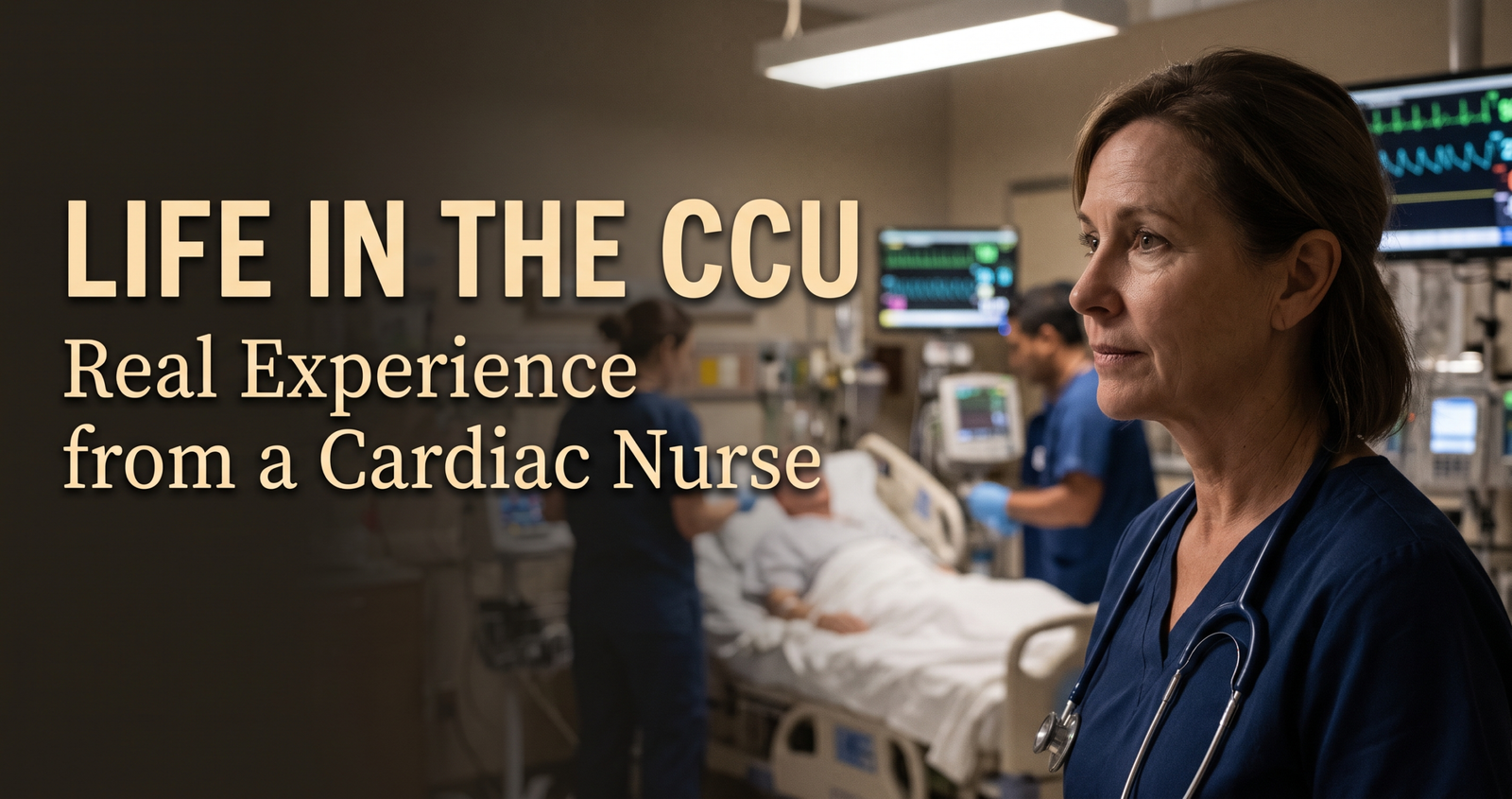
Explore Life in the CCU: Real Experience from a Cardiac Nurse. Life with inside the CCU via a cardiac nurse`s eyes: shifts, alarms, competencies, emotional challenges, and recommendation for college kids dreaming of important care.
Real Experience from a Cardiac Nurse: Life in the CCU
Introduction
The first issue you be aware in a cardiac care unit is the sound. Monitors beep in constant rhythms, and each nurse listens for the only beat that sounds incorrect. Life withinside the CCU is fast, humbling, and deeply meaningful, and its adjustments the way you consider the human coronary heart.
In this article, a cardiac nurse’s angle walks you via an average shift, the competencies that matter, and the emotional aspect of the job. Moreover, you’ll locate realistic recommendation in case you wish to paintings in important care someday.
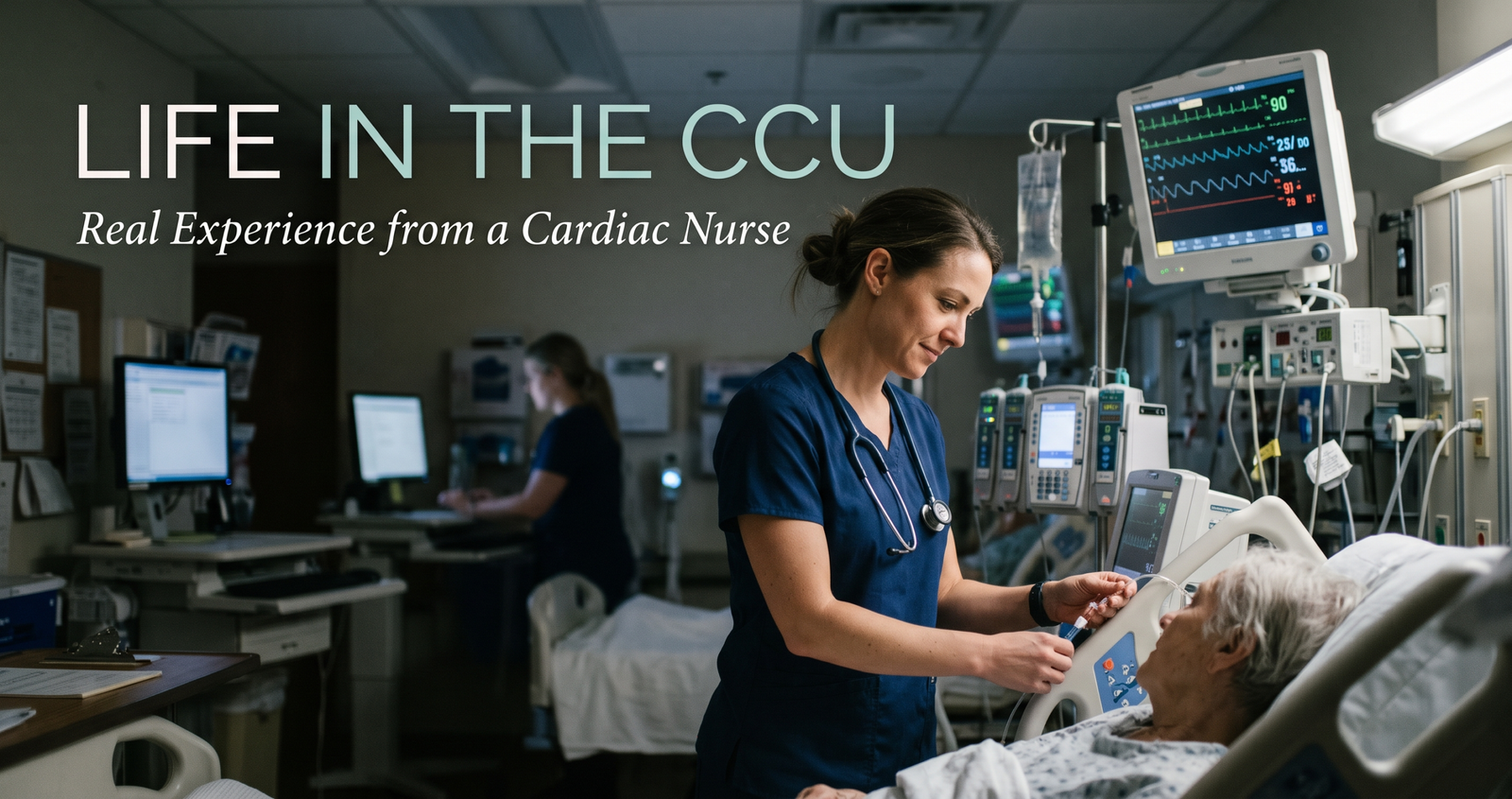
The first thing you notice in a Coronary Care Unit is the sound. Monitors beep in different tones, infusion pumps alarm, and somewhere a ventilator breathes for a patient who cannot. After years at the bedside, I can tell from the pitch of an alarm whether I need to walk or run.
The CCU is a specialized critical care unit for patients with serious heart conditions. We care for people after heart attacks, with dangerous arrhythmias, in acute heart failure, and in cardiogenic shock. Every patient is on continuous cardiac monitoring, and many are only hours away from a procedure or just back from one.
In this post, I want to share what CCU nursing actually looks like from the inside. It is not the version from television. It is the real one: the routines, the skills, the hard days, and the reasons many of us would not trade this work for anything.
What the CCU Really Is
The Patients You Will Meet
The cardiac care unit (CCU) seems after sufferers with critical coronary heart conditions. These encompass acute myocardial infarction, decompensated coronary heart failure, risky dysrhythmias, and restoration after cardiac procedures. As a result, many sufferers arrive worried and unstable, and you meet them on several of their toughest days.
Nurses on this unit generally take care of most effective one or sufferers at a time. That small ratio permits close, non-stop monitoring.
Why It Feels Different from Other Units
On a trendy ward, you test sufferers at set intervals. In the CCU, however, you watch them nearly continuously via ECG, arterial lines, and infusion pumps. Therefore, you discover ways to study trends, now no longer simply unmarried numbers.
A Day withinside the Life: Inside a CCU Shift
The Handoff and First Assessment
A shift starts off evolved with an in-depth handoff masking rhythm, drips, lines, labs, and the plan for the day. Next comes a head-to-toe evaluation and a cautious test of each device. In addition, you affirm alarm limits, in view that an incorrect placing can cover danger.
(Composite scene: a morning handoff in which a small in a single day upward push in a patient’s coronary heart fee seems to be an early signal of bleeding.) Moments like this educate you that small adjustments deserve respect.
Managing Drips and Titrations
Many CCU sufferers acquire vasoactive infusions consisting of vasopressors, inotropes, or antiarrhythmics. You alter those doses consistent with blood stress, coronary heart rate, and the provider`s orders. Furthermore, you double-look at concentrations and pump settings with a 2d nurse.
Precision subjects right here due to the fact a tiny dosing mistakes can swing a affected person’s blood stress quickly.
When an Alarm Becomes an Emergency
Most alarms are false, due to free leads or affected person movement. Even so, you should have a take a observe the affected person first, due to the fact the reveal can deceive you. Then you verify the rhythm and respond.
(Composite scene: an unexpected ventricular rhythm, a name for help, and a group that movements with out wasted phrases.) In the one’s minutes, education replaces panic, and each function is clear.
A Typical Shift in the CCU
No two shifts are the same, but most follow a rhythm. Here is how a day usually unfolds for me.
- Handover. The shift starts at the bedside, not at the nursing station. I review each patient’s rhythm, vital signs, drips, lines, recent labs, and any events from the last shift.
- The first assessment. Within the first hour I complete a head-to-toe assessment. I check heart and lung sounds, peripheral pulses, the femoral or radial access site after angiography, fluid balance, and pain.
- Medications and infusions. Many CCU drugs are high-alert: heparin, nitroglycerin, amiodarone, inotropes, and insulin. I double-check doses, titrate to targets, and watch closely for side effects like bleeding or hypotension.
- Rounds with the team. Cardiologists, residents, nurses, and pharmacists discuss each patient together. The nurse’s voice matters here, because we are the ones who saw what happened overnight.
- The unexpected. A new admission arrives from the emergency department with chest pain and ST elevation. A stable patient suddenly goes into ventricular tachycardia. The plan for the day changes in seconds.
- Documentation and education. Between tasks, I chart and teach. Patients need to understand their medicines, their diet, and the warning signs before discharge.
- Handover again. At the end of the shift, I pass on everything the next nurse needs to keep my patients safe.
A CCU nurse usually cares for one or two patients at a time. That ratio exists for a reason: these patients can change quickly, and someone needs to be watching.
Skills That Make a Strong CCU Nurse
Clinical Knowledge
You want strong understanding of ECG interpretation, hemodynamic, cardiac medications, and lab values. Key behaviour encompasses checking potassium and magnesium, reviewing troponin trends, and understanding antidotes for not unusual place drugs. In addition, expertise the “why” at the back of every order allows you communicate up whilst some thing appears off.
Critical Thinking and Prioritization
You continuously ask what may want to move incorrect next. For example, a affected person on a brand new antiarrhythmic might also additionally broaden bradycardia, so that you put together for that earlier than it happens. Consequently, anticipation turns into one in every of your most powerful tools.
Communication and Teamwork
CCU nurse’s paintings carefully with cardiologists, intensivists, pharmacists, respiration therapists, and families. Clear, concise reporting is vital, and a based device consisting of SBAR continues messages focused. Likewise, you learn how to explain complex plans in easy phrases to apprehensive relatives.
The Emotional Side of Cardiac Nursing
Facing Fear and Loss
Not every affected man or woman recovers, and loss is part of these paintings. Some days you have fun an affected man or woman on foot out the door, on the equal time as on others you comfort a grieving own circle of relatives. Therefore, emotional resilience is as important as clinical skill.
Protecting Your Own Wellbeing
Burnout is actual in crucial care, so construct healthful conduct early. Talk with depended on colleagues, debrief after hard events, and use help offerings while needed. Moreover, rest, exercise, and time far from paintings aren’t luxuries however essentials.
The Moments That Keep You Going
Small wins preserve nurses over time. An affected person breathes less difficult after a diuretic, an own circle of relatives hears correct news, or a pupil ultimately knows a rhythm. These moments remind you why you selected this path.
How to Prepare for a CCU Career
Build a Strong Foundation
Start with strong clinical-surgical or telemetry experience, due to the fact many CCUs decide on nurses who’ve laboured in acute care first. Study ECGs consistently and study pharmacology through drug class. Additionally, don’t forget certifications inclusive of ACLS, and later the CCRN credential.
Find Mentors and Keep Learning
Seek out skilled nurses who’re inclined to teach. Ask questions, shadow while possible, and overview instances after every shift. Over time, consistent mastering turns uncertainty into confidence.
Lessons for New CCU Nurses
If you are a student or a new graduate thinking about cardiac critical care, here is what I wish someone had told me on day one.
- Master the ECG early. Practice rhythm strips every day until sinus rhythm, AF, VT, VF, and heart blocks are instantly familiar.
- Know your drugs. For every cardiac medication, learn its action, usual dose, what to monitor, and when to hold it.
- Trust your instincts and speak up. If a patient “just doesn’t look right,” tell the doctor. Early escalation saves lives.
- Treat the patient, not the monitor. Check the patient first when an alarm sounds. A loose lead and a lethal rhythm can look the same on screen.
- Ask questions without embarrassment. Every experienced CCU nurse was once new. Good units welcome questions.
- Get certified. Basic Life Support and ACLS are essential, and a cardiac or critical care certification builds both knowledge and confidence.
- Look after yourself. Long shifts and emotional strain lead to burnout. Rest, eat properly, and use your support network.
Conclusion
Life withinside the CCU asks a lot, but it offers lower back in meaning, growth, and connection. You discover ways to study the heart`s electric language, to behave flippantly beneath pressure, and to take care of human beings at their maximum vulnerable. If you sense attracted to crucial care, construct your foundation, locate mentors, and defend your well-being alongside the way.
If this text stimulated you, percentage it with a fellow nursing pupil, go away a remark together along with your personal crucial care story, and discover greater nursing profession sources on our platform.
FAQs
What is life in the CCU like for nurses?
Life withinside the CCU entails near tracking of significantly sick cardiac sufferers, common assessments, and cautious control of infusions. Nurses commonly take care of one or sufferers at a time. The paintings are severe however gives robust teamwork and learning.
What does a CCU nurse do?
A CCU nurse video display units’ rhythm and hemodynamic, administers excessive-hazard medications, and responds to emergencies. They additionally train sufferers and households and coordinate care with the healthcare team. Quick, correct judgment is primary to the role.
How do I emerge as a CCU nurse?
Most nurses first benefit enjoy in medical-surgical, telemetry, or step-down units. Then they whole unit-precise schooling and might earn ACLS and CCRN certifications. Mentorship and regular look at velocity the transition.
Is operating withinside the CCU traumatic?
Yes, it may be traumatic due to excessive acuity, emergencies, and emotional loss. However, robust teamwork, debriefing, and self-care behaviour assist nurse’s cope. Many discover the paintings deeply rewarding.
Read More:
https://nurseseducator.com/didactic-and-dialectic-teaching-rationale-for-team-based-learning/
https://nurseseducator.com/high-fidelity-simulation-use-in-nursing-education/
First NCLEX Exam Center In Pakistan From Lahore (Mall of Lahore) to the Global Nursing
Categories of Journals: W, X, Y and Z Category Journal In Nursing Education
AI in Healthcare Content Creation: A Double-Edged Sword and Scary
Social Links:
https://www.facebook.com/nurseseducator/
https://www.instagram.com/nurseseducator/
https://www.pinterest.com/NursesEducator/
https://www.linkedin.com/company/nurseseducator/
https://www.linkedin.com/in/afzalaldin/
https://www.researchgate.net/profile/Afza-Lal-Din
https://scholar.google.com/citations?hl=en&user=F0XY9vQAAAAJ
https://orcid.org/0000-0001-6976-9158