
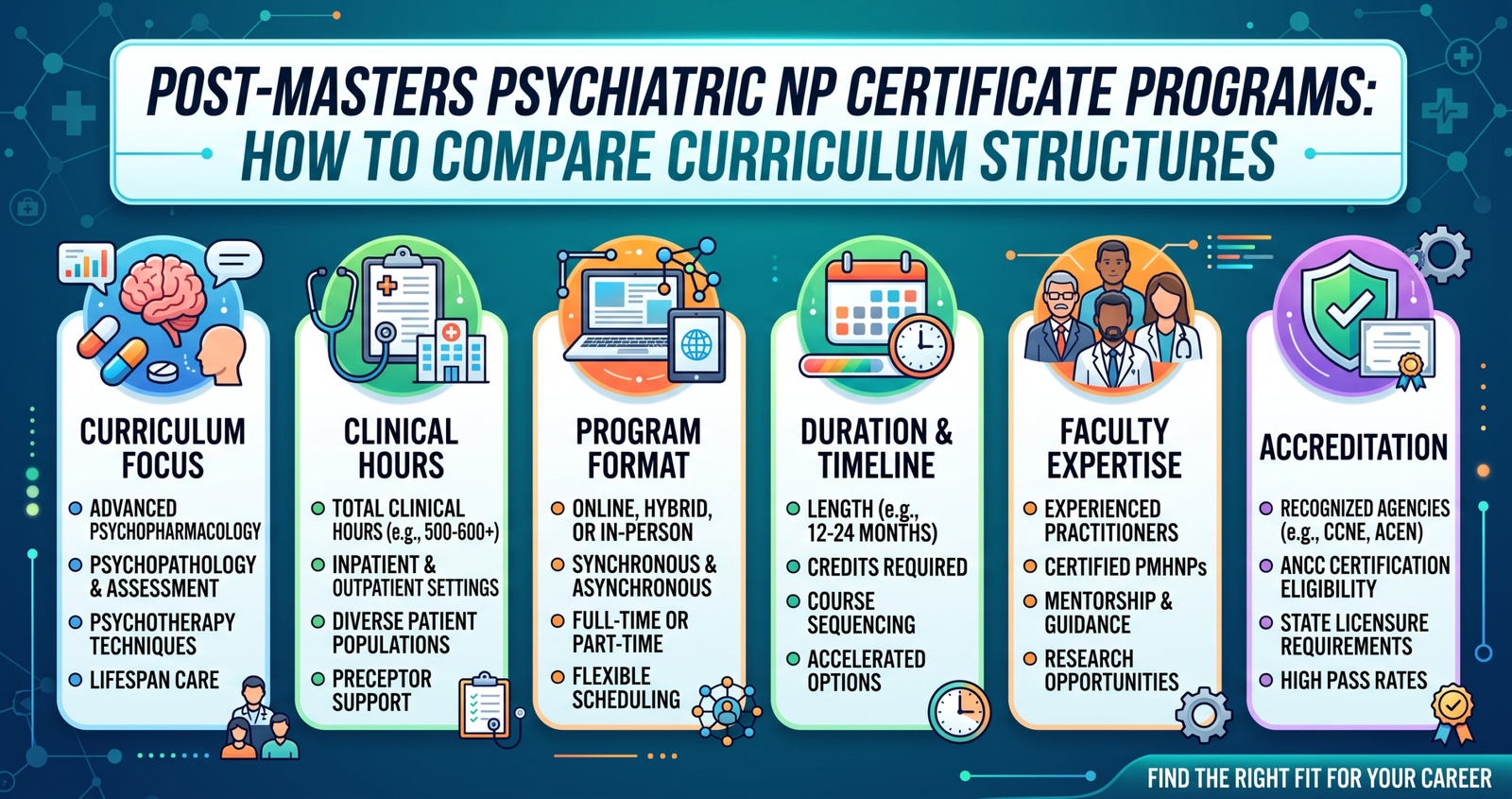
Compare Post-Masters Psychiatric NP Certificate Programs: How to Compare Curriculum Structures. post-master’s psychiatric NP certificate programs: curriculum, clinical hours, timelines and how to choose the right PMHNP route.
How to Compare Curriculum Structures: Post-Masters Psychiatric NP Certificate Programs
Introduction
Last year a former student emailed me a spreadsheet of eight post-master’s psychiatric NP certificate programs. One required 24 credits, another 38, and she couldn’t tell which was real and which was padded. Neither was, necessarily. Programs credit your prior master’s work differently, structure clinical hours differently and sequence content differently. This guide explains how these programs are built and what to ask before you apply, so you don’t pay for coursework you don’t need.
Quick Answer
A post-master’s psychiatric NP certificate is a gap-based program. What you take depends on what your earlier master’s already covered, so the credit total on a website tells you very little. Core content nearly always includes psychopharmacology, psychiatric assessment, psychotherapy and supervised clinical practice. Before enrolling, get a written gap analysis and written confirmation that you’ll be eligible for PMHNP certification.
What These Programs Are and Who They Fit
These programs let a nurse who already holds a master’s degree become a psychiatric-mental health nurse practitioner without repeating a full degree. You complete the specialty content you’re missing, finish supervised clinical hours and become eligible for national certification.
They fit certified NPs in other population foci, such as family or adult-gerontology, who are already managing mental health conditions and want formal preparation. They also suit MSN-prepared nurses in education, leadership or informatics who want to move into clinical work. If you’re a family NP who has spent years prescribing antidepressants in primary care and quietly wondering whether you’re doing it right, this is probably your route. I’ve taught people in exactly that spot.
Requirements and How the Process Works
Expect to hold an active RN license and a master’s degree or higher from a CCNE- or ACEN-accredited school. Most programs also want transcripts, references, a personal statement and, for existing NPs, proof of current certification. Check each school, because requirements vary.
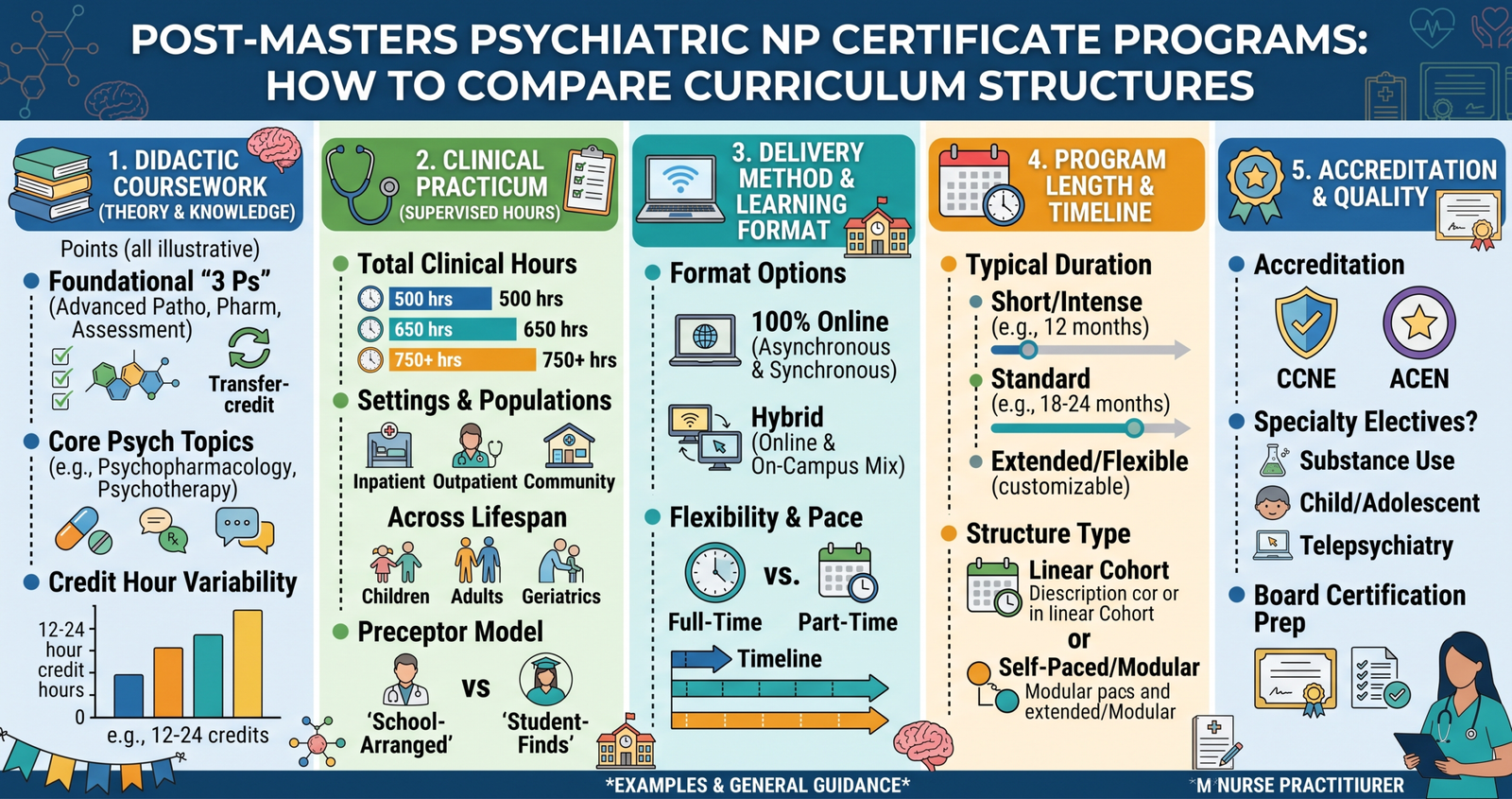
The process usually runs in four steps. The school reviews your transcripts and identifies gaps. You complete the missing didactic courses. You finish supervised psychiatric clinical hours. Then you apply for national certification and state APRN licensure. The biggest difference between programs is who arranges clinical placement. Some build it in, while others leave you to find your own preceptor, and in behavioral health that search can take months.
Reviewing Curriculum Structures
If you want to compare programs rigorously, treat it like a small systematic review. Define your question first, for example which accredited programs include psychotherapy coursework and secure placements. Record where and when you searched. Extract the same details from every program: credits, required courses, clinical hours, placement support, format and accreditation. Then look for patterns and outliers. For a formal review, follow PRISMA reporting guidance.
My expectation, flagged as expectation and not a finding, is that core clinical courses look similar across programs while credit totals, placement support and psychotherapy emphasis differ. Test that against your own data. The practical lesson is to compare what each program requires of you specifically, not what it requires of someone starting from scratch.
Curriculum and Clinical Hours
Common coursework covers advanced psychopharmacology, assessment and differential diagnosis, individual, group and family psychotherapy, neurobiology, substance use and co-occurring disorders, and ethics and telehealth. Psychopharmacology is the course people underestimate. It leans on receptor-level biochemistry, and a weak foundation there is the biggest source of avoidable stress I see. If it’s been a while, review neurotransmitter pathways before term starts.
Clinical hours are the center of the program. PMHNP certification expects a defined number of supervised direct patient care hours, and some programs credit hours from your earlier NP education. Ask whether your hours must span age groups and include psychotherapy, and whether telehealth hours count
Accreditation, Cost and Timeline
Choose a CCNE- or ACEN-accredited school aligned with NONPF competencies, and check your state board of nursing for APRN and prescriptive authority rules. If the program is online, confirm it’s authorized to place students in your state.
Costs vary widely by school type, credit total and residency, and I won’t quote figures I can’t source. Look into employer tuition benefits, HRSA workforce funding and loan repayment for underserved areas, and confirm whether certificates are eligible for federal aid. Most programs take roughly one to two years depending on your gap analysis and pace, and placement delays can stretch that.
Advantages and Limitations
The appeal is targeted preparation without a second degree, a faster route to PMHNP practice and strong demand for mental health providers in many regions. Some programs also let certificate credits transfer toward a DNP later.
The drawbacks are real. A certificate won’t give you the doctorate, so leadership or faculty goals may require more study. Clinical placement can be hard to secure, and some programs give little credit for prior work, which makes them costlier than they look. The work itself is emotionally demanding, so ask yourself honestly whether you want it daily and not just the credential.
Careers and Licensure
PMHNPs work in outpatient clinics, hospitals, community mental health centers, substance use programs, telepsychiatry, correctional settings, integrated primary care and, where state authority allows, private practice.
After graduation you sit for the PMHNP certification exam through the certifying body, then apply for state APRN licensure and prescriptive authority. Make sure your program’s documentation satisfies both.
How to Choose
Ask six questions in roughly this order. Will I be certification-eligible with my background? How much prior coursework and clinical time will count? Who secures my placements? What is the full cost, including fees and travel? What are the certification pass rates and graduate outcomes? Can the credits transfer to a DNP later? If a program won’t answer the first question in writing, move on.
Put your shortlisted programs side by side on total credits for you, clinical hours, placement support, format, accreditation, cost and DNP transfer. A cheaper program with no placement help can cost you a year, so don’t choose on price alone.
Expert Tips
Request the gap analysis before you pay an application fee. Talk to two recent graduates about preceptor support. Start looking for clinical sites early, and keep your own log of hours from day one.
FAQs
How long do post-master’s psychiatric NP certificate programs take?
Commonly around one to two years, depending on credits required and enrollment pace. Your gap analysis gives the real number for you.
Can I get a PMHNP certificate if I’m already a family nurse practitioner?
Generally yes. Most programs build a plan around your existing preparation. Confirm certification eligibility with the program and the certifying body.
Are online PMHNP certificate programs legitimate?
Many are, provided they hold CCNE or ACEN accreditation and meet certification requirements. Verify accreditation and state authorization before paying a deposit.
How many clinical hours do I need?
It depends on the certifying body and how many prior hours your program will count. Check current requirements directly. [INSERT: verified hour requirement and source]
Conclusion
Back to my student and her spreadsheet. The 24-credit and 38-credit programs weren’t contradicting each other. They credited her prior work differently, and one placed students in clinical sites while the other didn’t. Once she requested written gap analyses, the choice was obvious.
So judge these programs by what they require of you, whether they secure placements and whether they lead to certification eligibility in your situation. Your next step this week is to shortlist three accredited programs and email each the same three questions about credit for prior work, clinical placement and certification eligibility. Then compare the replies side by side.
Read More:
https://nurseseducator.com/didactic-and-dialectic-teaching-rationale-for-team-based-learning/
https://nurseseducator.com/high-fidelity-simulation-use-in-nursing-education/
First NCLEX Exam Center In Pakistan From Lahore (Mall of Lahore) to the Global Nursing
Categories of Journals: W, X, Y and Z Category Journal In Nursing Education
AI in Healthcare Content Creation: A Double-Edged Sword and Scary
Social Links:
https://www.facebook.com/nurseseducator/
https://www.instagram.com/nurseseducator/
https://www.pinterest.com/NursesEducator/
https://www.linkedin.com/company/nurseseducator/
https://www.linkedin.com/in/afzalaldin/
https://www.researchgate.net/profile/Afza-Lal-Din
https://scholar.google.com/citations?hl=en&user=F0XY9vQAAAAJ