
Explore the fastest Nurse Practitioner Bridge Programs: Fastest Routes from RN to NP. Nurse Practitioner bridge programs available in 2027. Learn how RNs can advance to NP through accredited, flexible pathways. Start your journey today.
Fastest Routes from RN to NP: Nurse Practitioner Bridge Programs
Introduction
Your nursing career has already taken you far — but what if you could go even further? Nurse Practitioner bridge programs are transforming the way registered nurses elevate their practice, offering streamlined, accelerated pathways to the NP credential without starting over from scratch. If you are an RN ready to diagnose, prescribe, and lead patient care independently, these bridge programs were designed specifically for you. The demand for nurse practitioners is surging across the United States, and healthcare systems are counting on experienced RNs like you to step into these expanded roles. Understanding your options is the first and most important step.
What Are Nurse Practitioner Bridge Programs?
Nurse Practitioner bridge programs are specialized graduate-level education pathways that allow registered nurses to advance directly to the nurse practitioner level. Rather than completing a traditional, sequential nursing education route, bridge programs recognize your existing clinical knowledge and academic background, allowing you to build on it efficiently.
These programs are particularly valuable because they save both time and money. Most bridge formats are available online or in hybrid formats, making them accessible to working nurses who cannot step away from their professional responsibilities.
RN to NP vs. Traditional MSN Pathways
The key distinction between a bridge program and a traditional Master of Science in Nursing (MSN) pathway lies in the entry requirements and the curriculum structure. Traditional MSN programs typically require applicants to already hold a BSN degree. Bridge programs, however, are engineered to meet nurses at different educational starting points — whether that is an ADN, a diploma, or a BSN — and move them forward along an accelerated track.
Furthermore, bridge programs often embed the BSN-level content into the graduate curriculum itself, meaning you are not completing redundant coursework. Instead, you are moving forward consistently and purposefully toward your NP licensure.
Who Qualifies for a Bridge Program?
Eligibility requirements vary by institution, but most nurse practitioner bridge programs require candidates to hold an active, unencumbered RN license, a minimum of one to two years of clinical experience, and an associate or bachelor’s degree in nursing. Some programs also require a minimum GPA from prior academic work and letters of professional recommendation.
Additionally, many schools value demonstrated leadership experience and a clear personal statement outlining your clinical goals. Meeting the minimum requirements is your starting point — not your ceiling.
Types of Nurse Practitioner Bridge Programs Available
There is no single bridge program that fits every nurse’s situation. Understanding the different program types ensures you choose the one that aligns with your academic background, specialty interest, and lifestyle.
ADN to NP Bridge Programs
The ADN-to-NP bridge is one of the most powerful pathways available today. Designed for nurses who hold an associate degree in nursing, this format compresses what would traditionally be a three-stage education journey — ADN to BSN, BSN to MSN, MSN to NP — into a single, cohesive program. These programs are especially valuable for experienced nurses who entered the workforce through community colleges and have spent years building their clinical expertise.
Completion timelines typically range from three to five years, depending on full-time or part-time enrollment. Many programs offer completely online didactic coursework, with clinical hours completed in your local community.
BSN to NP Bridge Programs
For nurses who already hold a Bachelor of Science in Nursing, the BSN-to-NP bridge is the most direct and fastest available route. These programs focus exclusively on graduate-level NP coursework, clinical practicums, and specialty training. Most BSN-to-NP bridges can be completed in as few as two to three years.
Moreover, many BSN-to-NP programs offer post-master’s certificate options for nurses who already hold an MSN in a non-NP specialty, allowing them to add an NP credential without completing an entirely new degree.
Online vs. Hybrid Bridge Programs
Flexibility is one of the defining strengths of today’s nurse practitioner bridge programs. Fully online programs allow you to complete all theoretical coursework remotely, while hybrid programs combine online learning with periodic on-campus intensives. Both formats require you to fulfill clinical practicum hours in approved healthcare settings, which most programs help you arrange within your geographic region.
Choosing between online and hybrid often comes down to your personal learning style and schedule. Either way, accreditation remains the non-negotiable standard.
Top Specializations Within Nurse Practitioner Bridge Programs
Once you commit to a bridge program, the next critical decision is your NP specialty. Your choice will define your scope of practice, your patient population, and your career trajectory.
Family Nurse Practitioner (FNP)
The Family Nurse Practitioner track is the most widely pursued NP specialty nationally. FNPs are trained to provide comprehensive, primary care services across the entire lifespan — from pediatric patients to geriatric populations. This versatility makes FNP-certified professionals among the most employable in the country.
FNP bridge programs typically require between 500 and 700 clinical hours, depending on accreditation standards and state-specific requirements.
Adult-Gerontology Nurse Practitioner (AGNP)
The Adult-Gerontology NP specialty is rapidly growing in demand, driven by an aging U.S. population. AGNP programs prepare nurses to deliver advanced care to adult and elderly patients, with a deep focus on managing chronic illness, complex comorbidities, and end-of-life care.
This specialty is ideal for nurses with backgrounds in medical-surgical, critical care, or long-term care settings.
Psychiatric Mental Health Nurse Practitioner (PMHNP)
With mental health care access reaching a national crisis level, the Psychiatric Mental Health Nurse Practitioner specialty offers both profound purpose and exceptional career stability. PMHNP bridge programs train nurses to assess, diagnose, and treat psychiatric conditions — including prescribing psychotropic medications — across all age groups.
Demand for PMHNPs consistently outpaces supply, making this one of the most strategically valuable specializations available within nurse practitioner bridge programs.
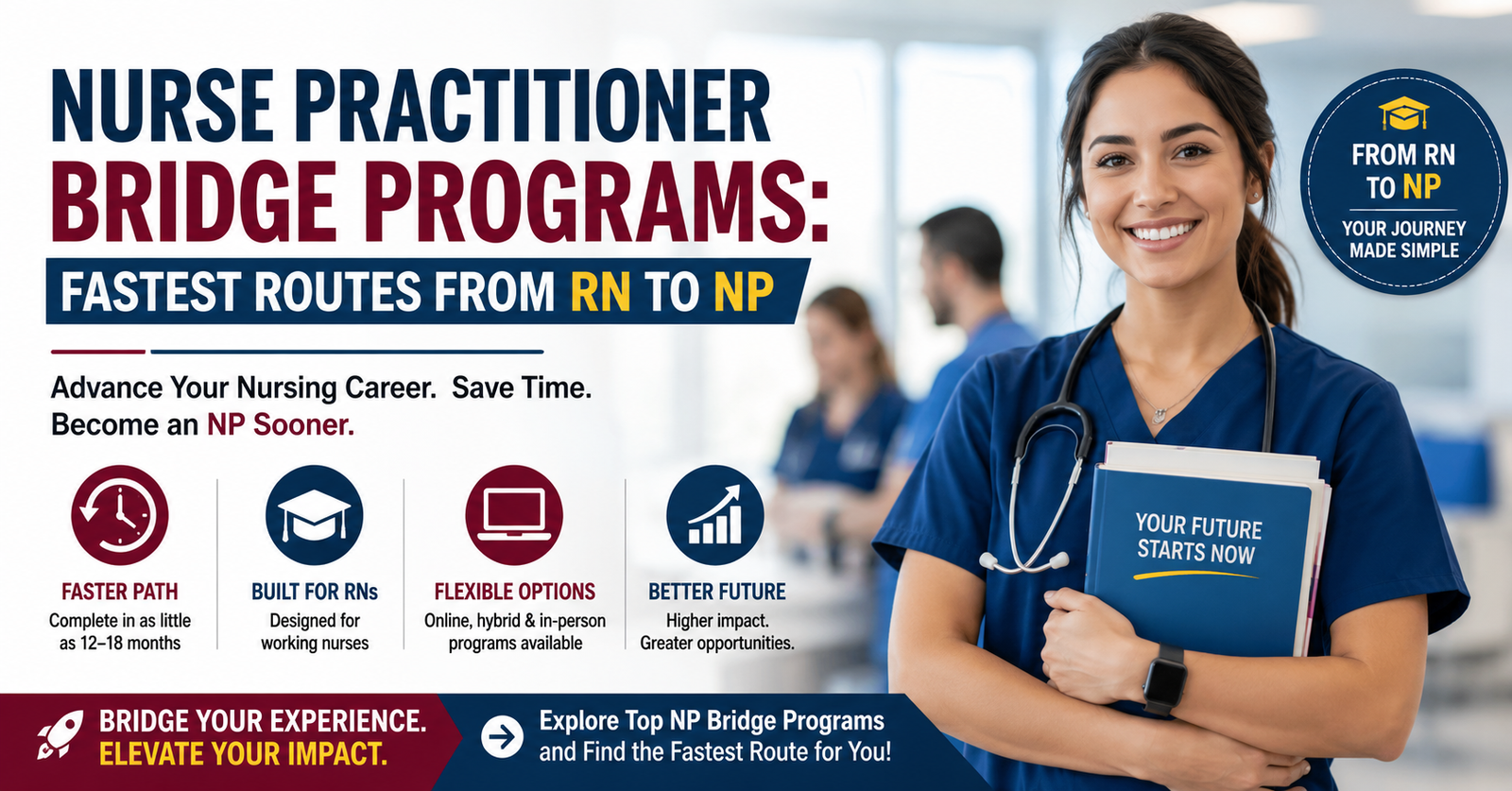
How to Choose the Right Nurse Practitioner Bridge Program
Selecting the right program requires careful evaluation of several factors beyond tuition cost alone. Making an informed decision now protects both your investment and your long-term career outcomes.
Accreditation Standards to Look For
Accreditation is the single most important quality marker for any nurse practitioner bridge program. Look specifically for programs accredited by the Commission on Collegiate Nursing Education (CCNE) or the Accreditation Commission for Education in Nursing (ACEN). Graduating from a non-accredited program can disqualify you from national certification examinations and state licensure.
Always verify accreditation status directly through the official CCNE or ACEN database before submitting any application.
Evaluating Clinical Hour Requirements
Clinical practicum requirements vary significantly between programs and between states. Most bridge programs require between 500 and 1,000 supervised clinical hours. Before enrolling, confirm whether the program assists students in securing clinical placement sites or whether that responsibility falls entirely on the student.
Programs that offer dedicated clinical placement support reduce one of the most common barriers to NP program completion.
Financial Aid and Scholarship Opportunities
Cost should never be the sole reason to avoid advancing your education. Many nurse practitioner bridge programs offer robust financial aid packages, including federal loans, graduate assistantships, and nursing-specific scholarships. Additionally, the NURSE Corps Scholarship Program and various state workforce initiatives provide funding specifically for nurses pursuing advanced practice credentials.
Research financial aid eligibility early — ideally before you finalize your school list — so that cost becomes a manageable factor rather than a barrier.
Timeline and Licensing: What to Expect After Graduation
Completing your bridge program is a major milestone, but your journey to NP practice includes several additional steps that every graduate must understand.
National Certification Examinations
Upon graduating from an accredited nurse practitioner bridge program, you will be required to pass a national certification examination in your chosen specialty. The two primary certifying bodies are the American Nurses Credentialing Center (ANCC) and the American Academy of Nurse Practitioners Certification Board (AANPCB). Both organizations offer specialty-specific examinations that assess your clinical knowledge and readiness to practice at the NP level.
Preparation for these exams should begin well before graduation, using approved review courses and practice question banks.
State Licensure and Practice Authority
After passing your national certification exam, you must apply for NP licensure in your state through the appropriate State Board of Nursing. Scope of practice varies significantly by state. Some states grant full practice authority, meaning NPs can practice independently without a physician collaboration agreement. Other states require varying degrees of physician oversight, particularly early in your career.
Researching your state’s practice environment before choosing a specialty and employer is a strategically important step that many new graduates overlook.
Conclusion
Nurse Practitioner bridge programs represent one of the most empowering decisions an RN can make. They honor the experience you have already built while propelling you toward a level of practice where your impact on patient care deepens significantly. Whether you are starting from an ADN or a BSN, pursuing family medicine or psychiatric care, there is a pathway that fits your goals, your schedule, and your ambition.
The healthcare system needs advanced practice nurses now more than ever. The fastest route to fulfilling that need — and to transforming your own career — begins with choosing the right bridge program and taking that first step forward.
If this guide helped clarify your options, share it with a colleague who is navigating the same decision. Leave a comment below with your questions or your own bridge program experience, and explore more career advancement resources throughout our platform. Your next level starts here.
FAQs
How long do nurse practitioner bridge programs typically take to complete?
Most nurse practitioner bridge programs take between two and five years to complete, depending on your educational starting point, chosen specialty, and whether you enroll full-time or part-time. BSN-to-NP programs generally take two to three years, while ADN-to-NP bridge programs may extend to four or five years due to the additional foundational coursework required.
Can I complete a nurse practitioner bridge program entirely online?
Yes, many accredited nurse practitioner bridge programs offer fully online didactic coursework, allowing you to study from anywhere while continuing to work as an RN. However, all NP programs — regardless of format — require in-person clinical practicum hours completed at approved healthcare facilities in your area. Most programs provide support in locating appropriate clinical sites near you.
What is the difference between an MSN and a DNP for nurse practitioners?
The Master of Science in Nursing (MSN) is currently the minimum required degree for NP licensure in most states, while the Doctor of Nursing Practice (DNP) is the terminal clinical degree and is increasingly being recommended as the entry-level standard for advanced practice. Many bridge programs now offer a direct MSN-to-DNP pathway, allowing you to pursue the highest clinical credential without completing a separate doctoral application process later.
Is work experience required before enrolling in a nurse practitioner bridge program?
Most nurse practitioner bridge programs require applicants to have at least one to two years of active RN clinical experience prior to enrollment. This requirement exists because NP-level coursework assumes a strong foundation of practical nursing knowledge. Some highly competitive programs prefer three or more years of specialty-specific experience, particularly for programs in acute care or psychiatric mental health tracks.
Read More:
https://nurseseducator.com/didactic-and-dialectic-teaching-rationale-for-team-based-learning/
https://nurseseducator.com/high-fidelity-simulation-use-in-nursing-education/
First NCLEX Exam Center In Pakistan From Lahore (Mall of Lahore) to the Global Nursing
Categories of Journals: W, X, Y and Z Category Journal In Nursing Education
AI in Healthcare Content Creation: A Double-Edged Sword and Scary
Social Links:
https://www.facebook.com/nurseseducator/
https://www.instagram.com/nurseseducator/
https://www.pinterest.com/NursesEducator/
https://www.linkedin.com/company/nurseseducator/
https://www.linkedin.com/in/afzalaldin/
https://www.researchgate.net/profile/Afza-Lal-Din
https://scholar.google.com/citations?hl=en&user=F0XY9vQAAAAJ