
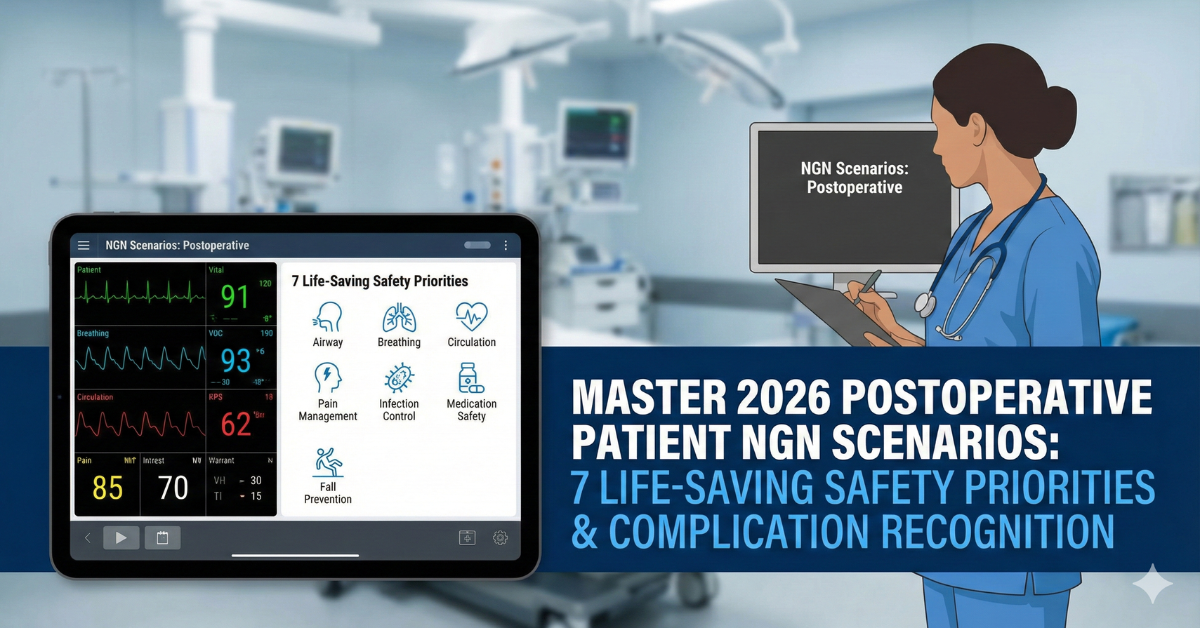
Explore Master 2026 Postoperative Patient NGN Scenarios: 7 Life-Saving Safety Priorities & Complication Recognition. Master postoperative NGN scenarios for 2026 NCLEX. Learn priority assessments, safety protocols, and complication recognition with clinical judgment model strategies.
7 Life-Saving Safety Priorities & Complication Recognition: Master 2026 Postoperative Patient NGN Scenarios
Introduction
Postoperative nursing represents one of the most critical phases in surgical patient care, requiring rapid clinical judgment and precise decision-making skills. According to the National Council of State Boards of Nursing, the Next Generation NCLEX emphasizes clinical judgment measurement through realistic patient care scenarios, with postoperative complications being a frequent testing focus. Recent ATI RN Medical-Surgical NGN assessments highlight that postoperative scenarios constitute approximately thirty percent of physiological adaptation questions, making this content area essential for exam success.
The 2026 NCLEX continues to assess nursing candidates through the Clinical Judgment Measurement Model, which evaluates six core cognitive functions: recognize cues, analyze cues, prioritize hypotheses, generate solutions, take action, and evaluate outcomes. This comprehensive guide provides evidence-based strategies for mastering postoperative NGN scenarios, ensuring you can confidently identify complications, prioritize interventions, and deliver safe patient care in both testing and clinical environments.
Understanding the NGN Clinical Judgment Framework for Postoperative Care
What Makes NGN Postoperative Scenarios Different
The Next Generation NCLEX launched in April 2023 to better measure nursing candidates’ clinical judgment and decision-making abilities through innovative item types. Unlike traditional multiple-choice questions, NGN postoperative scenarios present multi-layered case studies requiring you to synthesize patient data from various sources including vital signs, laboratory values, medication administration records, and nursing progress notes.
These scenarios mirror real-world nursing practice where you must rapidly process information, identify critical changes, and implement priority interventions. The postoperative period presents unique challenges because patients transition through multiple phases of recovery, each with distinct complication risks.
The Six-Step Clinical Judgment Process in Postoperative Nursing
Recognize Cues: Identify relevant and significant assessment findings from the patient presentation. In postoperative scenarios, this means distinguishing normal post-surgical changes from early warning signs of complications. For example, recognizing that a surgical dressing requiring changes twice in two hours indicates excessive bleeding rather than normal drainage.
Analyze Cues: Connect recognized cues to patient pathophysiology and surgical history. When observing purulent drainage at a postoperative wound, nurses should review culture for sensitive organisms before reporting findings to provide complete information to healthcare providers.
Prioritize Hypotheses: Determine which potential complications pose the greatest immediate threat to patient safety. Postoperative scenarios often involve competing priorities such as pain management versus respiratory compromise, requiring systematic evaluation using frameworks like Maslow’s hierarchy or the ABCs (airway, breathing, circulation).
Generate Solutions: Identify evidence-based interventions appropriate for the prioritized patient problems. For postoperative patients, essential interventions include instructing clients to splint the abdomen with a pillow for coughing and planning to ambulate as soon as possible to promote ventilation and decrease thrombosis risk.
Take Action: Implement nursing interventions and physician orders while continuously monitoring patient response. This step tests your knowledge of proper technique, medication administration, and procedural competency.
Evaluate Outcomes: Assess whether interventions achieved desired results and determine if plan modifications are necessary. In NGN scenarios, you may need to identify which assessment findings indicate intervention effectiveness or deterioration requiring escalation.
Priority Postoperative Assessments: The Foundation of Safety
Immediate PACU Assessment Priorities
The Post-Anesthesia Care Unit assessment establishes baseline recovery status and identifies immediate complications. During immediate postoperative assessment, nurses must prioritize maintaining a patent airway, monitoring cardiovascular and central nervous system status, and treating hypotension, shock, hemorrhage, hypertension, or arrhythmias.
Respiratory Assessment Focus: Assess respiratory rate, depth, pattern, and oxygen saturation continuously. Atelectasis represents a significant postoperative concern, particularly in abdominal and thoracic surgeries. Auscultate lung sounds bilaterally and observe for symmetrical chest expansion. Monitor for signs of respiratory depression from residual anesthesia or opioid analgesia.
Cardiovascular Monitoring: Assess heart rate, rhythm, blood pressure, and peripheral perfusion every fifteen minutes initially, then according to protocol. Hypotension may indicate hypovolemia, hemorrhage, or medication effects, while hypertension suggests pain, anxiety, or bladder distention.
Neurological Status: Evaluate level of consciousness, orientation, and ability to follow commands. Assess pupil size, equality, and reactivity. Document Glasgow Coma Scale scores as indicated. Emergence delirium, characterized by restlessness, agitation, and disorientation, requires careful monitoring and may indicate hypoxia, pain, or medication reaction.
Surgical Site Evaluation: Inspect dressings for drainage amount, color, and characteristics. Frequent dressing changes after surgery may indicate poor clotting and increased bleeding, requiring immediate notification of the surgical team. Assess drain function and output if present.
Systematic Head-to-Toe Assessment Protocol
Integumentary System: Beyond the surgical site, assess skin color, temperature, and moisture. Pallor may indicate anemia or shock, while flushed appearance could suggest fever or medication reaction. Check pressure points for early signs of injury, particularly in lengthy procedures.
Gastrointestinal Function: Assess bowel sounds in all four quadrants, noting presence, frequency, and characteristics. Paralytic ileus and intestinal obstruction are potential postoperative complications occurring more frequently in patients undergoing intestinal or abdominal surgery. Document time of first flatus and bowel movement as indicators of returning function.
Genitourinary Status: Monitor urinary output quantity and quality, ensuring minimum output of thirty milliliters per hour. Assess bladder distention through palpation and patient reports of urge to void. Urinary retention is common postoperatively due to anesthesia effects, pain, and positioning.
Pain Assessment: Utilize appropriate pain scales to quantify discomfort intensity, location, quality, and duration. Assess pain with movement and rest. Document effectiveness of interventions thirty minutes after medication administration for intravenous routes, sixty minutes for oral medications.
Life-Threatening Postoperative Complications: Recognition and Response
Hemorrhage and Hypovolemic Shock
Early Recognition Signs: Tachycardia represents the initial compensatory mechanism for decreased circulating volume. Restlessness, anxiety, and thirst indicate cellular hypoxia. As hemorrhage progresses, hypotension develops along with cool, clammy skin, decreased urine output, and altered mental status.
Assessment Parameters: Monitor vital signs frequently, noting trends rather than isolated values. A heart rate increase of twenty beats per minute or systolic blood pressure decrease of twenty millimeters of mercury warrants immediate attention. Assess surgical dressings and drain output for increasing blood loss. Monitor hemoglobin and hematocrit values for decreasing trends.
Priority Interventions: Position patient flat with legs elevated unless contraindicated by surgical procedure. Administer supplemental oxygen to maximize oxygen delivery to tissues. Establish or maintain large-bore intravenous access for fluid resuscitation. Notify surgeon immediately while continuing to monitor vital signs every five to fifteen minutes.
Respiratory Complications: Atelectasis and Pulmonary Embolism
Atelectasis Development: This lung collapse occurs when alveoli deflate due to hypoventilation, mucus plugging, or inadequate coughing. Risk factors include general anesthesia, abdominal or thoracic surgery, obesity, smoking history, and prolonged immobility.
Clinical Manifestations: Decreased or absent breath sounds over affected areas, tachypnea, tachycardia, fever, and decreased oxygen saturation. Patients may report dyspnea and chest discomfort. Prevention through early mobilization, incentive spirometry use, and deep breathing exercises proves more effective than treatment of established atelectasis.
Pulmonary Embolism Warning Signs: This life-threatening complication presents with sudden dyspnea, chest pain (particularly pleuritic), tachycardia, tachypnea, anxiety, and hemoptysis in some cases. Risk factors include orthopedic surgery, pelvic procedures, prolonged immobility, obesity, cancer, and hypercoagulable states.
Immediate Actions: Place patient in high Fowler’s position to maximize lung expansion. Administer high-flow oxygen as ordered. Establish intravenous access if not present. Notify physician immediately and prepare for diagnostic testing including arterial blood gases, D-dimer, and computed tomography pulmonary angiography. Do not leave patient unattended.
Surgical Site Infection and Wound Dehiscence
Infection Indicators: Typically manifesting between postoperative days three to five, surgical site infections present with increasing incisional pain, erythema extending beyond incision margins, warmth, edema, and purulent drainage. Fever, elevated white blood cell count, and malaise accompany localized signs.
Risk Factor Assessment: Patients with diabetes, obesity, malnutrition, immunosuppression, prolonged surgical time, and contaminated wounds face elevated infection risk. Smoking and corticosteroid use further compromise wound healing.
Wound Dehiscence Recognition: This partial or complete separation of wound layers typically occurs between postoperative days five to twelve. Patients may report a “popping” sensation or sudden discharge of serosanguineous fluid. Evisceration represents protrusion of organs through surgical incisions, constituting a surgical emergency requiring immediate intervention.
Emergency Intervention Protocol: If dehiscence or evisceration occurs, position patient supine with knees flexed to reduce abdominal tension. Cover protruding organs with sterile saline-moistened dressings. Do not attempt to replace organs. Keep patient calm and NPO. Notify surgeon immediately and prepare patient for emergency surgery.
Deep Vein Thrombosis and Prevention
Clinical Presentation: Unilateral leg swelling, warmth, erythema, and calf tenderness characterize deep vein thrombosis. Homans’ sign (calf pain with dorsiflexion) lacks sensitivity and specificity and may dislodge clots, so avoid this assessment technique. Many cases remain asymptomatic until pulmonary embolism occurs.
Prevention Strategies: Sequential compression devices provide mechanical prophylaxis by promoting venous return. Early ambulation remains the most effective prevention strategy. Ensure adequate hydration to prevent hemoconcentration. Administer pharmacologic prophylaxis including low-molecular-weight heparin or direct oral anticoagulants as prescribed.
NGN Question Format Strategies for Postoperative Scenarios
Matrix Multiple Choice Mastery
These questions present multiple patient findings or interventions organized in rows and columns, requiring selection of all applicable options. For postoperative scenarios, you might receive vital signs across different time points and must identify which findings require immediate follow-up.
Strategic Approach: Read the complete scenario before examining the matrix. Identify the specific question stem asking what you need to select. Systematically evaluate each option against normal postoperative parameters and complication indicators. Remember that NGN scoring provides partial credit, so you’re rewarded for correct selections even if you miss some options.
Extended Multiple Response Questions
Unlike traditional select-all-that-apply with five or six options, extended multiple response presents more possibilities, typically requiring selection of specific numbers of correct answers.
Application Example: “The nurse is caring for a postoperative patient six hours after abdominal surgery. Which assessment findings would the nurse report to the surgeon? Select the four findings that require notification.”
Analysis Framework: Prioritize findings indicating life-threatening complications first (hemorrhage, respiratory compromise), followed by those suggesting developing complications (fever, excessive pain), then abnormal findings requiring monitoring (decreased bowel sounds, nausea).
Drop-Down Cloze Items
These scenarios present patient situations with blank spaces that you complete by selecting from drop-down menus. They test your ability to apply clinical judgment within context.
Sample Scenario: “The nurse is preparing to discharge a patient postoperative day three following laparoscopic cholecystectomy. The patient’s temperature is [DROP-DOWN: normal/elevated/decreased], incision is [DROP-DOWN: clean and dry/erythematous/dehisced], and bowel sounds are [DROP-DOWN: active/hypoactive/absent]. Based on these findings, the nurse should [DROP-DOWN: proceed with discharge/notify surgeon/implement aspiration precautions].”
Trend Analysis Questions
These items present data across multiple time points, requiring identification of patterns indicating improvement or deterioration. Postoperative scenarios frequently test recognition of worsening vital signs, increasing pain, or developing complications.
Evaluation Strategy: Create mental or written notes comparing each time point to baseline and normal parameters. Identify directional trends (improving versus deteriorating) rather than focusing on single abnormal values. Consider the timeline of typical postoperative recovery when evaluating whether findings are expected or concerning.
Evidence-Based Postoperative Nursing Interventions
Pain Management Optimization
Multimodal Analgesia Approach: Combining different classes of analgesics targets pain through various mechanisms while reducing individual medication doses and side effects. This approach typically includes opioids for moderate to severe pain, nonsteroidal anti-inflammatory drugs for inflammation, and acetaminophen for baseline analgesia.
Assessment Before Administration: Always assess pain location, intensity, quality, and onset before administering analgesics. Verify last dose timing to prevent overdosage. Assess respiratory status before opioid administration, withholding medication if respiratory rate falls below twelve breaths per minute or as specified by facility protocol.
Non-Pharmacologic Interventions: Position changes, ice packs, splinting during movement, distraction, relaxation techniques, and music therapy complement medication management. These interventions prove particularly valuable during medication onset periods and for patients wishing to minimize opioid use.
Early Mobilization Protocols
Planning to ambulate the client as soon as possible promotes ventilation and decreases the risk of thrombosis, making early mobilization a cornerstone of postoperative recovery.
Progressive Activity Timeline: Begin with bed exercises including ankle pumps, leg slides, and arm circles on the operative day. Progress to sitting at bedside with legs dependent, then standing at bedside, followed by ambulation in room and hallway. Individualize progression based on surgical procedure, patient condition, and physician orders.
Orthostatic Hypotension Prevention: Assess patient’s blood pressure in supine position, after sitting up, again after standing, and two to three minutes later to identify orthostatic changes. A twenty millimeter of mercury drop in systolic pressure or ten millimeter drop in diastolic pressure with symptoms indicates orthostatic hypotension requiring slower progression.
Respiratory Hygiene Maintenance
Incentive Spirometry Education: Teach patients to seal lips around mouthpiece, inhale slowly and deeply to raise indicator to target level, hold breath for three to five seconds, then exhale slowly. Repeat ten times every hour while awake. Document volumes achieved and patient compliance.
Coughing and Deep Breathing Technique: Instruct patients to take slow, deep breaths through nose, hold for three seconds, then exhale completely through mouth. After three deep breaths, take another deep breath and cough forcefully two to three times. Repeat every two hours while awake. Splinting the abdomen with a pillow while coughing reduces discomfort and protects the incision.
Fluid and Electrolyte Management
Intake and Output Monitoring: Maintain accurate records of all fluid intake including intravenous fluids, oral liquids, and tube feedings. Document all output including urine, wound drainage, nasogastric drainage, and emesis. Calculate fluid balance every shift and twenty-four hours.
Laboratory Value Surveillance: Monitor serum electrolytes, particularly sodium, potassium, and chloride. Postoperative patients risk imbalances due to fluid shifts, NPO status, gastrointestinal losses, and medication effects. Elderly patients are less able to correct and compensate for fluid and electrolyte imbalances, requiring particularly vigilant monitoring.
Special Populations: Elderly Postoperative Patients
Elderly patients continue to be at increased risk for postoperative complications due to age-related physiologic changes in respiratory, cardiovascular, and renal function and increased incidence of comorbid conditions.
Age-Related Considerations
Pharmacokinetic Changes: Decreased hepatic metabolism and renal clearance result in prolonged medication effects. Anesthetics and opioids can cause confusion in older adults, and altered pharmacokinetics results in delayed excretion and prolonged respiratory depressive effects. Start with lower doses and titrate carefully while monitoring for adverse effects.
Cognitive Assessment: Distinguish between expected anesthesia effects, postoperative delirium, and baseline cognitive status. Use standardized tools like the Confusion Assessment Method to identify delirium systematically. Reorient frequently, maintain normal sleep-wake cycles when possible, and ensure sensory aids (glasses, hearing aids) are available.
Mobility Challenges: Arthritis, muscle weakness, and balance impairment increase fall risk. Ensure call lights are within reach, is in lowest position, and walking aids are available. Maintain physical activity while patient is confused, as physical deterioration can worsen delirium and place patients at increased risk for other complications.
Discharge Planning and Patient Education
Readiness for Discharge Criteria
Key discharge criteria include stable vital signs, effective pain control with understanding of pain management plan, return of typical bowel function, and knowledge of postoperative wound care.
Physiologic Stability: Vital signs should remain within expected parameters for at least two hours. Pain should be managed with oral analgesics. Patients should tolerate oral intake without nausea or vomiting. Urinary function should be adequate, with patient voiding at least once before discharge for outpatient procedures.
Knowledge Assessment: Patients or caregivers must demonstrate knowledge of wound care, dietary recommendations including fluid requirements, therapeutic activity, pain management, and signs of complications. Use teach-back method to verify understanding by asking patients to explain information in their own words.
Support System Verification: Patients need a responsible support person available who has been educated on patient care needs. For complex care requirements, collaborate with case management to arrange home health services or temporary skilled nursing facility placement.
Critical Teaching Points
Warning Signs Requiring Medical Attention: Teach patients to immediately contact healthcare providers for fever above 100.4°F (38°C), increasing incisional pain unrelieved by prescribed analgesics, incision separation or drainage, difficulty breathing, chest pain, unilateral leg swelling or pain, or inability to eat or drink.
Activity Restrictions: Provide specific guidelines regarding weight lifting limitations, driving restrictions, return to work timeline, and sexual activity resumption. Emphasize gradual activity progression while avoiding overexertion.
Medication Management: Review all prescribed medications including purpose, dose, timing, and potential side effects. Provide written instructions. Discuss pain medication expectations, emphasizing that some discomfort is normal while severe pain requires evaluation.
Conclusion
Mastering postoperative patient NGN scenarios requires integration of comprehensive assessment skills, complication recognition abilities, and systematic clinical judgment application through the six-step NCSBN model. Success on 2026 NCLEX postoperative questions demands understanding that these scenarios test not merely knowledge recall but your capacity to synthesize multiple data sources, identify priority concerns, and implement evidence-based interventions under time constraints.
The Next Generation NCLEX reflects modern nursing practice realities where rapid decision-making amid complex patient presentations determines outcomes. Recent scoping reviews examining postoperative nursing activities to prevent wound complications emphasize that nursing interventions significantly impact patient recovery trajectories and complication rates. By practicing systematic assessment approaches, learning to recognize early complication warning signs, and applying the clinical judgment framework to each scenario, you develop the critical thinking patterns essential for both examination success and safe clinical practice.
Remember that postoperative care extends beyond technical skill competency to encompass holistic patient consideration including pain management, mobility restoration, psychological support, and discharge preparation. Approach each NGN scenario as an opportunity to demonstrate comprehensive nursing judgment spanning immediate safety concerns through long-term recovery planning. Your ability to prioritize among competing demands, recognize subtle clinical changes, and implement appropriate interventions reflects the essence of professional nursing practice that the Next Generation NCLEX seeks to measure and verify before licensure.
Frequently Asked Questions
FAQ 1: What percentage of NCLEX questions focus on postoperative nursing care?
Postoperative care falls primarily within the Physiological Adaptation category, which comprises approximately eleven to seventeen percent of NCLEX questions. However, postoperative concepts also appear in Reduction of Risk Potential and Pharmacological Therapies categories, making this content area significant across multiple testing domains.
FAQ 2: How do I prioritize between pain management and respiratory concerns in postoperative NGN scenarios?
Always prioritize using the ABCs framework: airway, breathing, circulation. Respiratory compromise poses immediate life threat, taking precedence over pain management. However, adequate pain control enables effective deep breathing and coughing, preventing respiratory complications. Address respiratory concerns first, then implement pain management to facilitate respiratory hygiene.
FAQ 3: What are the most commonly tested postoperative complications in NGN case studies?
Frequently tested complications include hemorrhage and hypovolemic shock, atelectasis and respiratory depression, surgical site infection, wound dehiscence, deep vein thrombosis, paralytic ileus, and urinary retention. NGN scenarios often present subtle early warning signs requiring recognition before obvious symptoms develop.
FAQ 4: How can I improve my clinical judgment skills for postoperative NGN questions?
Practice with NGN-format questions emphasizing the six clinical judgment steps. Study case scenarios requiring integration of multiple data sources. Focus on recognizing patterns and trends rather than memorizing isolated facts. Analyze both correct and incorrect answer rationales to understand the clinical reasoning behind decisions. Utilize practice resources aligned with the NCSBN Clinical Judgment Measurement Model framework.
Read More:
https://nurseseducator.com/didactic-and-dialectic-teaching-rationale-for-team-based-learning/
https://nurseseducator.com/high-fidelity-simulation-use-in-nursing-education/
First NCLEX Exam Center In Pakistan From Lahore (Mall of Lahore) to the Global Nursing
Categories of Journals: W, X, Y and Z Category Journal In Nursing Education
AI in Healthcare Content Creation: A Double-Edged Sword and Scary
Social Links:
https://www.facebook.com/nurseseducator/
https://www.instagram.com/nurseseducator/
https://www.pinterest.com/NursesEducator/
https://www.linkedin.com/company/nurseseducator/
https://www.linkedin.com/in/nurseseducator/
https://x.com/nurseseducator?t=-CkOdqgd2Ub_VO0JSGJ31Q&s=08
https://www.researchgate.net/profile/Afza-Lal-Din
https://scholar.google.com/citations?hl=en&user=F0XY9vQAAAAJ