
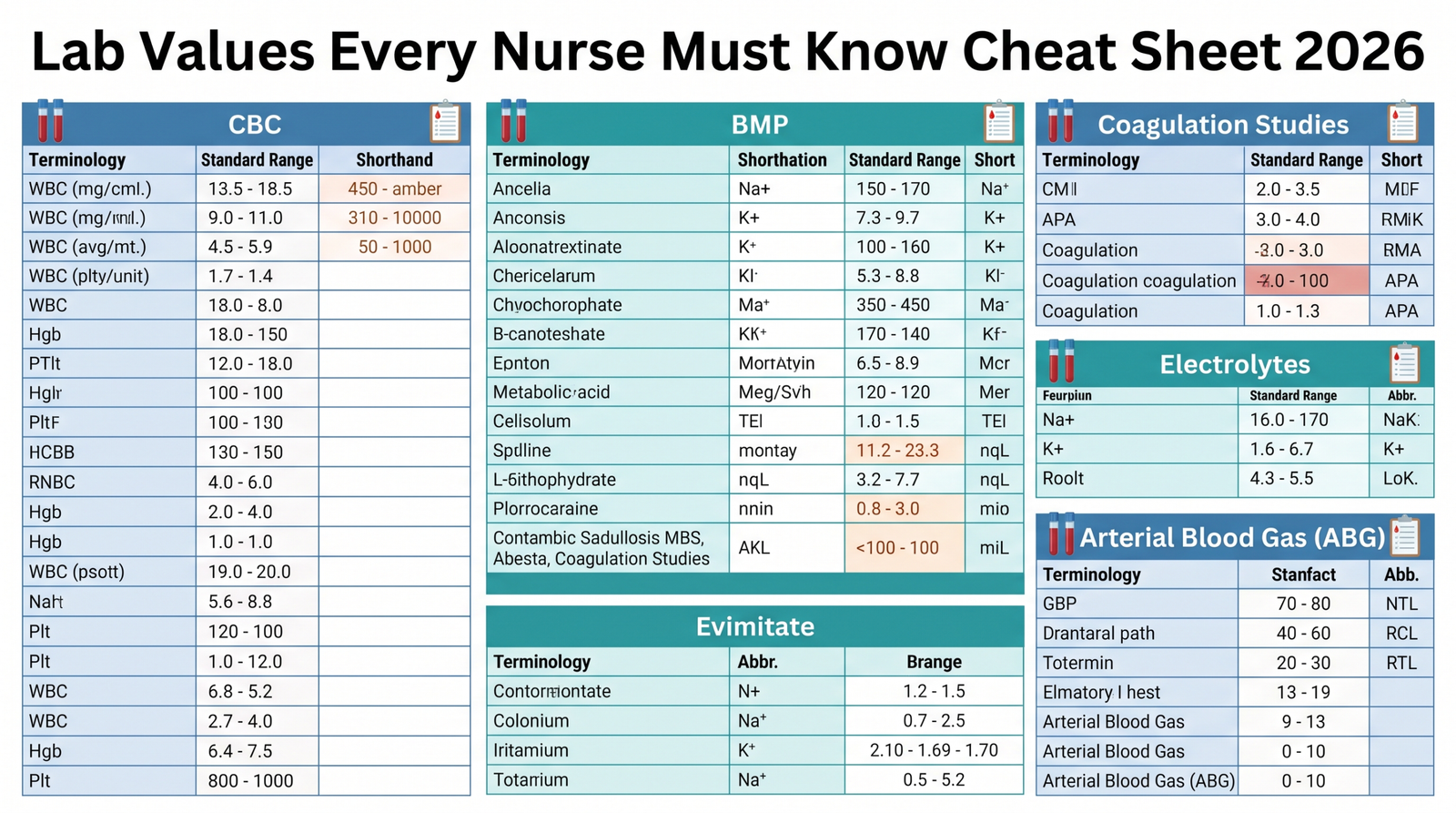
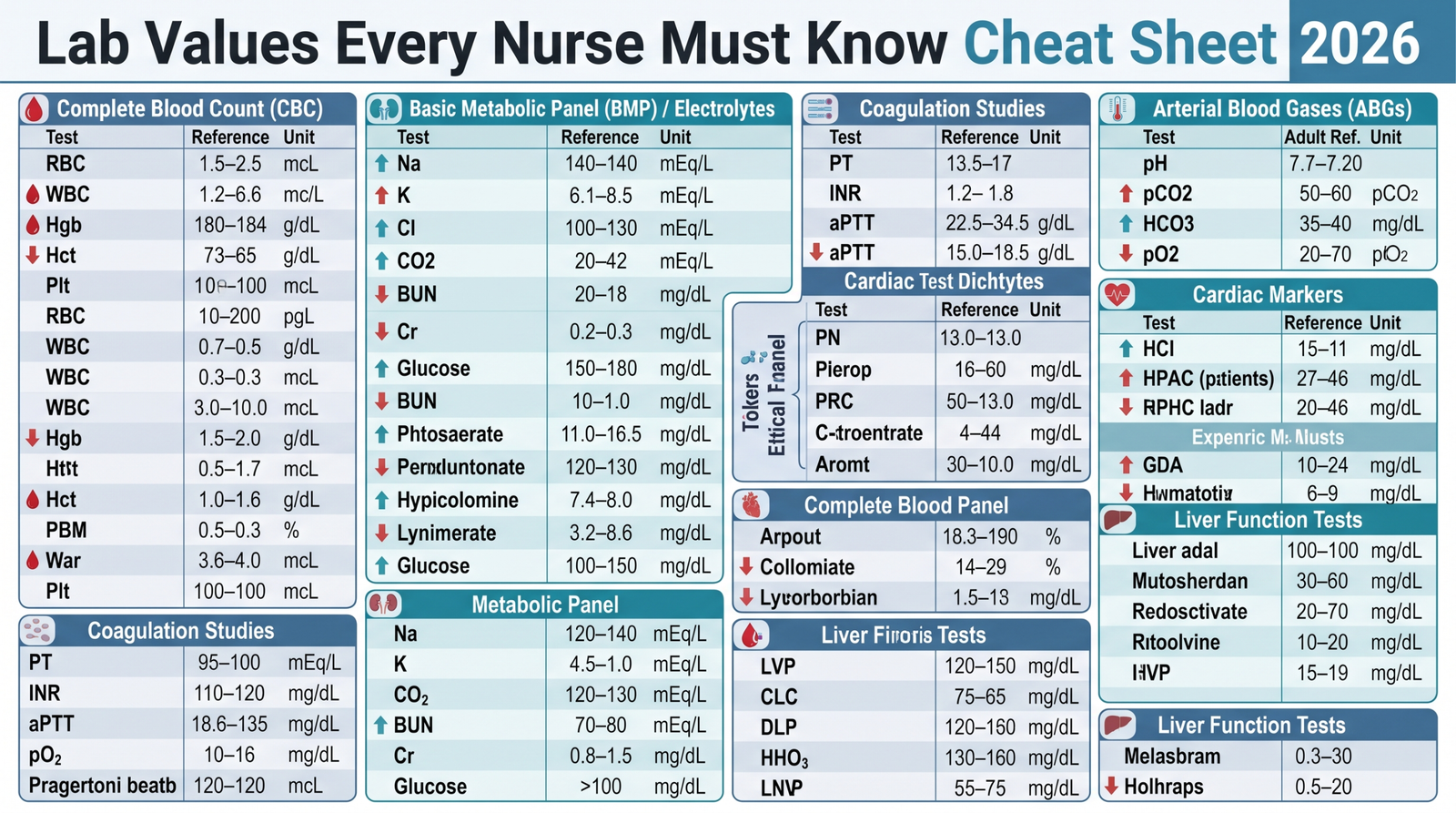
Keep this cheat sheet of Lab Values Every Nurse Must Know Cheat Sheet. Lab values each nurse should understand electrolytes, CBC, ABGs, coagulation, and drug stages with short scientific recommendations.
Explore Lab Values Every Nurse Must Know Cheat Sheet
Introduction
An unmarried quantity on a lab file can alternate your subsequent circulate on the bedside. That is why the lab values each nurse should understand deserve an everlasting vicinity on your memory, now no longer simply your notes. Whether you’re making ready for the NCLEX or running a hectic shift, short recollect protects your patients.
This cheat sheet organizes the critical levels via way of means of category. Moreover, every phase provides brief scientific recommendations so that you recognize what the numbers mean.
Why Lab Values Matter in Nursing
Labs Support Your Clinical Judgment
Lab consequences verify what your evaluation suggests. For example, crackles and edema make greater feel whilst a BNP is elevated. Therefore, continually pair the numbers with the affected person in the front of you.
Know the Trend, Not Just the Number
A potassium of 3.6 can be normal, but a drop from 4.8 in in the future merit’s attention. Consequently, examine every result with preceding values. Trends regularly provide you with a warning earlier than a disaster appears.
Electrolytes and Kidney Function
Core Electrolyte Ranges
Electrolyte imbalances reason risky dysrhythmias and neurologic changes. Memorize those first.
| Test | Normal Range |
| Sodium (Na) | 135 to 145 mEq/L |
| Potassium (K) | 3.5 to 5.0 mEq/L |
| Chloride (Cl) | 98 to 106 mEq/L |
| Calcium (total) | 8.5 to 10.5 mg/dL |
| Magnesium (Mg) | 1.5 to 2.5 mg/dL |
| Phosphorus | 2.5 to 4.5 mg/dL |
| Bicarbonate (HCO3) | 22 to 26 mEq/L |
Potassium merits unique respect. Low tiers reason weak spot and dysrhythmias, at the same time as excessive tiers reason peaked T waves and may prevent the heart.
Kidney Function Tests
Kidney labs display how nicely the frame clears waste. In addition, they manual medicine dosing.
| Test | Normal Range |
| BUN | 10 to 20 mg/dL |
| Creatinine | 0.6 to 1.2 mg/dL |
Creatinine is the greater, dependable marker, because BUN additionally rises with dehydration and excessive protein intake.
Blood Counts and Clotting Studies
Complete Blood Count (CBC)
The CBC exhibits anaemia, infection, and bleeding risk. Furthermore, values fluctuate barely with the aid of using sex.
| Test | Normal Range |
| WBC | 5,000 to 10,000/mm³ |
| Hemoglobin | Male 14 to 18 g/dL; Female 12 to 16 g/dL |
| Hematocrit | Male 42% to 52%; Female 37% to 47% |
| Platelets | 150,000 to 400,000/mm³ |
A growing WBC shows infection, whilst a platelet matter beneath 50,000 increases severe bleeding concerns. Always document vital drops promptly.
Coagulation Tests
These assessments manual anticoagulant therapy, so accuracy is vital.
| Test | Normal Range | Therapeutic Goal |
| PT | 11 to 13.5 seconds | Used for warfarin monitoring |
| INR | 0.8 to 1.1 | 2 to 3 on warfarin |
| aPTT | 30 to 40 seconds | 1.5 to 2.5 times control on heparin |
Remember the antidotes. Vitamin K reverses warfarin, and protamine sulphate reverses heparin.
Acid-Base Balance and Oxygenation
Arterial Blood Gas Ranges
ABGs display how properly the lungs and kidneys hold balance. As a result, they seem continuously in assessments and essential care.
| Test | Normal Range |
| pH | 7.35 to 7.45 |
| PaCO2 | 35 to 45 mm Hg |
| HCO3 | 22 to 26 mEq/L |
| PaO2 | 80 to 100 mm Hg |
| SaO2 | 95% to 100% |
Quick ABG Interpretation
First, examine the pH to determine acidosis or alkalosis. Next, test the PaCO2 for a breathing purpose and the HCO3 for a metabolic purpose. A beneficial reminiscence useful resource is ROME, which means breathing opposite, metabolic equal.
For instance, a low pH with an excessive PaCO2 manner breathing acidosis. Meanwhile, a low pH with a low HCO3 manner metabolic acidosis.
Glucose, Cardiac Markers, and Drug Levels
Glucose and Cardiac Labs
Blood sugar and coronary heart markers call for speedy recognition. Keep those stages handy.
| Test | Normal Range |
| Fasting glucose | 70 to 100 mg/dL |
| HbA1c | Below 5.7% |
| Troponin I | Below 0.04 ng/mL |
| BNP | Below 100 pg/mL |
Elevated troponin indicators myocardial injury, and an excessive BNP factors in the direction of coronary heart failure. Likewise, an HbA1c of 6.5% or better helps a diabetes diagnosis.
Therapeutic Drug Levels
Narrow healing home windows make those ranges crucial for safety.
| Drug | Therapeutic Range |
| Digoxin | 0.5 to 2.0 ng/mL |
| Lithium | 0.6 to 1.2 mEq/L |
| Phenytoin | 10 to 20 mcg/mL |
Signs of toxicity encompass nausea, imaginative and prescient changes, and dysrhythmias with digoxin, and tremors and confusion with lithium. Therefore, investigate the affected person every time a degree is high.
Liver and Protein Markers
Liver enzymes replicate hepatic injury. In addition, albumin suggests dietary status.
| Test | Normal Range |
| ALT | 7 to 56 units/L |
| AST | 10 to 40 units/L |
| Total bilirubin | 0.1 to 1.2 mg/dL |
| Albumin | 3.5 to 5.0 g/dL |
Conclusion
The lab values each nurse ought to understand are simpler to grasp while you institution them with the aid of using machine and hyperlink everyone to an affected person story. Start with electrolytes, then upload the CBC, coagulation, ABGs, and drug degrees. With ordinary review, those numbers turn into automatic.
If this cheat sheet helped, percentage it together along with your look at institution, depart a remark with the lab cost you locate hardest, and discover greater nursing assets on our platform.
FAQs
What is the maximum critical lab valuing each nurse ought to understand?
Start with sodium, potassium, calcium, BUN, creatinine, the CBC, and the coagulation test. Add ABGs, glucose, troponin, and key drug degrees along with digoxin. These seem most customarily in medical exercise and at the NCLEX.
Are ordinary lab degrees the equal everywhere?
No, degrees range barely among laboratories, age groups, and trying out methods. Always evaluate consequences with the reference variety imprinted on the affected person`s document. The values on this manual are not unusual place grownup degrees.
How can I memorize lab values quickly?
Group them with the aid of using class and use flashcards for every day quick reviews. Link every cost to a medical consequence, along with excessive potassium inflicting peaked T waves. Teaching the values to a classmate additionally strengthens recall.
Which lab values are taken into consideration essential?
Critical values are consequences that want instantaneously issuer notification, along with a totally low potassium or a markedly excessive INR. Each facility units its very own essential thresholds. Follow your sanatorium coverage and document those consequences with out delay.
Read More:
https://nurseseducator.com/didactic-and-dialectic-teaching-rationale-for-team-based-learning/
https://nurseseducator.com/high-fidelity-simulation-use-in-nursing-education/
First NCLEX Exam Center In Pakistan From Lahore (Mall of Lahore) to the Global Nursing
Categories of Journals: W, X, Y and Z Category Journal In Nursing Education
AI in Healthcare Content Creation: A Double-Edged Sword and Scary
Social Links:
https://www.facebook.com/nurseseducator/
https://www.instagram.com/nurseseducator/
https://www.pinterest.com/NursesEducator/
https://www.linkedin.com/company/nurseseducator/
https://www.linkedin.com/in/afzalaldin/
https://www.researchgate.net/profile/Afza-Lal-Din
https://scholar.google.com/citations?hl=en&user=F0XY9vQAAAAJ
https://orcid.org/0000-0001-6976-9158