

Learn How to Extend a Travel Nursing Contract in 2026: 6 Smart Steps Every Travel Nurse Must Know. How to extend a travel nursing contract in 2026 — from timing and pay negotiation to tax home rules and recruiter strategy. A complete step-by-step guide.
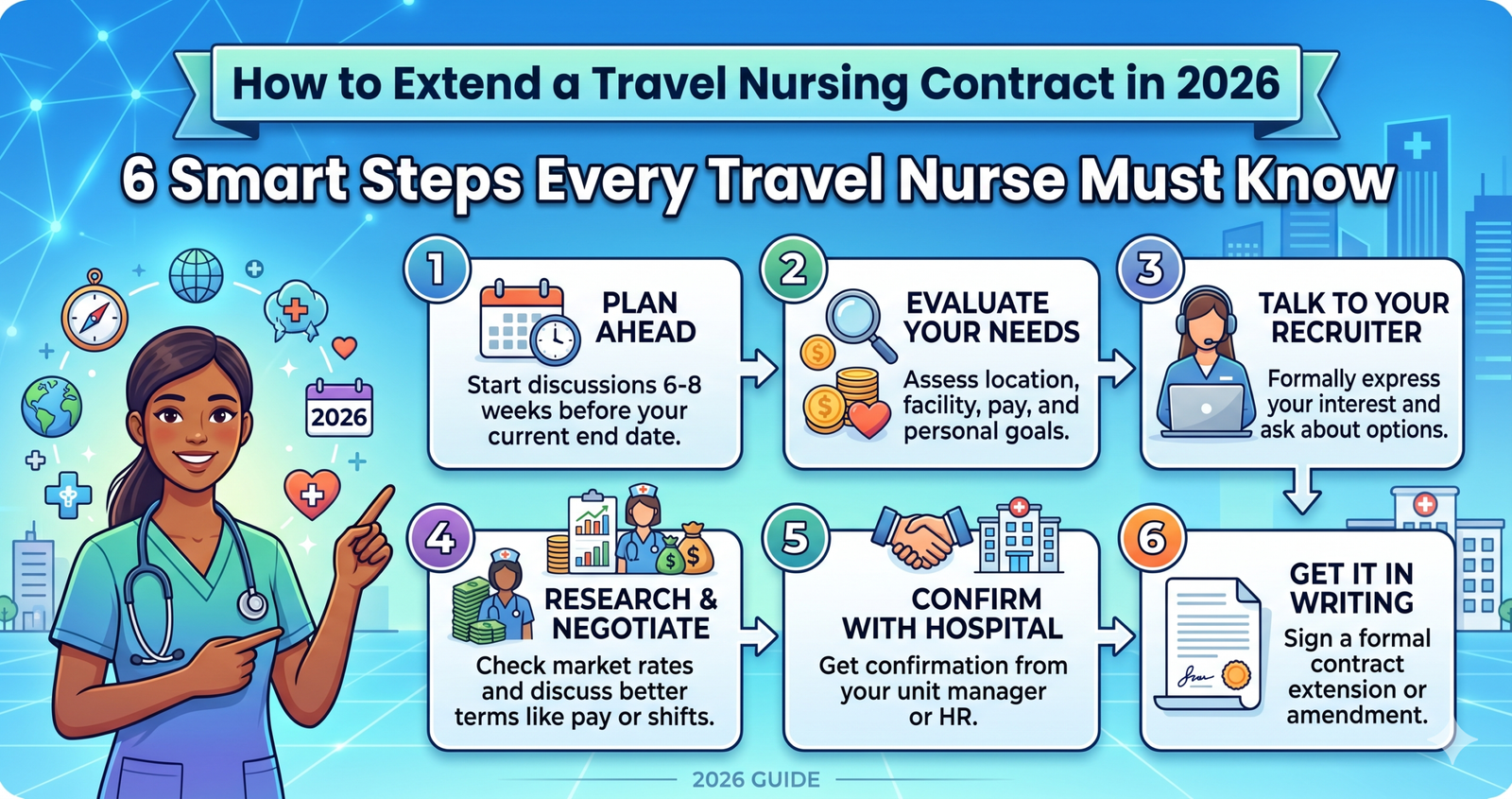
6 Smart Steps Every Travel Nurse Must Know: How to Extend a Travel Nursing Contract in 2026
Introduction
A travel nursing contract extension is one of the most practical and rewarding decisions a travel nurse can make. Rather than packing up and relocating to a new assignment, extending allows you to deepen relationships at your current facility, eliminate the stress of onboarding, and often negotiate improved compensation — all while maintaining the flexibility that makes travel nursing so compelling. In 2026, understanding the extension process — including timing, pay negotiation, housing stipend implications, and critical IRS tax rules — is essential knowledge for every traveling nurse.
What Is a Travel Nursing Contract Extension and Why Does It Benefit Everyone?
A travel nursing contract extension is a formal agreement between the nurse, the staffing agency, and the healthcare facility to continue the working relationship beyond the original contract end date. Standard travel nursing contracts typically run 13 weeks, though crisis and short-term assignments can range from four weeks upward. Extensions may be offered in similar increments — commonly eight to thirteen weeks — though the duration is often flexible and negotiable based on both parties’ needs.
Extensions are widely described by industry professionals as a genuine win-win arrangement. For the healthcare facility, retaining an already-oriented, clinically competent nurse ensures continuity of care and eliminates the considerable time and expense of recruiting, credentialing, and onboarding a replacement. For the travel nurse, an extension removes the logistical burden of relocation, job searching, and adapting to a new electronic health record system. Because agencies incur significantly lower costs on extension contracts — including avoided recruitment fees, non-billable orientation hours, and travel arrangement expenses — there is also meaningful financial leverage available to the nurse during negotiation.
Step 1: Decide Early — Timing Is Everything
The most important strategic decision in securing a contract extension is initiating the conversation at the right time. Industry guidance from experienced travel nurse recruiters consistently recommends beginning the extension conversation four to five weeks before your original contract end date. Approaching the facility or your recruiter too early — say, at the start of your assignment — may result in no clear answer, as staffing decisions about future needs are typically not finalized that far in advance. Waiting too long, however, risks losing the opportunity entirely if the facility has already begun recruiting for your replacement.
According to AMN Healthcare’s placement specialists, both the facility and the travel nurse can initiate the extension discussion. Site managers will often broach the subject themselves approximately halfway through an initial assignment when they recognize a nurse’s value, reliability, and cultural fit. However, nurses who know they want to extend should not wait to be asked — proactive communication with both the facility manager and your recruiter demonstrates professionalism and gives everyone involved the maximum time to plan accordingly.
Step 2: Be the Nurse Who Gets Asked to Stay
The most powerful position from which to negotiate a contract extension is being the nurse the facility genuinely does not want to lose. This sounds straightforward, but it requires intentional professional conduct from day one of your assignment. Being reliable, punctual, and clinically excellent — using sound clinical judgment, following facility protocols, and maintaining strong relationships with colleagues and managers — are the professional behaviors that generate the goodwill on which extension opportunities are built.
Nurses who integrate well into the team culture, learn the facility’s electronic health record system quickly, and demonstrate a willingness to support their unit beyond the minimum requirements of their contract are overwhelmingly more likely to receive extension offers. AMN Healthcare’s recruitment specialists note that extensions are “very common” for nurses who invest genuinely in their temporary workplace community. Professional reputation, in travel nursing, travels with you — and it often determines whether you are asked to return.
Step 3: Communicate With Your Recruiter and Negotiate Smartly
Once you have decided to pursue an extension, your recruiter becomes your most important professional ally. Inform your recruiter of your interest in extending as early as possible — this allows them to begin working with the facility on terms before the end-of-contract window creates time pressure. Your recruiter is also positioned to negotiate on your behalf and to advise you on what terms are realistically achievable given current market conditions and the facility’s budget.
Contract extensions are generally easier for staffing agencies to execute than new placements — the agency avoids significant operational costs including travel stipends, non-billable orientation hours, and recruitment overhead. This means that while the bill rate (what the facility pays the agency per hour) may remain the same as the original contract, the agency’s lower expenses on the extension create real room for improved compensation to the nurse. According to Jackson Nurse Professionals, terms that are frequently open to negotiation during extension include the hourly pay rate, overtime rate, housing stipend, schedule flexibility, and contract duration. Nurses in high-demand specialties — including ICU, emergency, labor and delivery, and pediatrics — who are difficult to replace, have the most leverage.
Being open to alternative forms of compensation can also be productive. Health Carousel Travel Nursing advises nurses to consider negotiating for additional paid time off, increased housing stipends, or reimbursement for continuing education if direct pay increases are constrained by facility budgets. Knowing your market value, understanding the GSA per diem rates for your location, and approaching the conversation with specific and evidence-based requests strengthens your negotiating position considerably.
Step 4: Understand the Financial Terms of Your Extension Contract
Not all extension contract terms mirror those of the original contract. One of the most important financial details to clarify before signing an extension is whether your housing stipend — a significant portion of total travel nurse compensation — will remain the same, increase, or decrease. According to Jackson Nurse Professionals, housing stipends can be subject to adjustment upon extension based on current market conditions or internal budget changes. Clarifying this before signing prevents unwelcome financial surprises mid-extension.
Additionally, travel nurses should be aware that extension contracts may come with bonuses not typically available at the start of an assignment. Extension bonuses are a recognized category of travel nursing incentives, offered by facilities seeking to retain productive nurses when demand is high or replacement candidates are scarce. Along with completion bonuses, these represent tangible financial rewards for nurses who have demonstrated value and commitment. Always review the complete pay package — including hourly rate, overtime, stipends, and any bonus structures — with your recruiter before signing the extension agreement.
Step 5: Know the IRS One-Year Rule Before You Commit
One of the most consequential and frequently misunderstood aspects of travel nursing contract extensions is the IRS one-year rule, which carries significant tax implications for nurses who extend at the same facility or geographic area. According to IRS guidelines, a temporary work assignment is defined as one that the worker reasonably expects to last — and that does last — one year or less. When a travel nurse works in the same city or general area for more than 12 months, the IRS may classify that location as their new tax home.
This classification matters enormously because travel nurses’ non-taxable stipends — for housing, meals, and incidentals — are only tax-free when the nurse is working away from their established tax home and incurring duplicate living expenses. Once the IRS considers the assignment location a new tax home, those stipends become taxable income. Critically, as tax specialists note, the expectation of exceeding one-year matters as much as the calendar — if you accept an extension that you reasonably expect will push your total time in that location past twelve months, stipends may become taxable from the moment that expectation exists, not only after the twelfth month passes.
The practical guidance from travel nursing tax professionals is clear: never extend a contract at the same location beyond twelve months without first consulting a tax professional who specializes in travel healthcare. If you do exceed the twelve-month threshold, you must typically take a full-year break from that location before returning and reclaiming tax-free stipend eligibility there. Planning extension timelines carefully around this rule protects both your tax compliance and your total take-home income.
Step 6: Review All Contract Terms and Protect Your License
Before signing any extension agreement, review the complete contract with the same diligence you applied to your original assignment. Key terms to verify include the new start and end dates, shift requirements, unit assignment, pay package details, and any updated cancellation or contract breach clauses. Confirm whether your professional license remains valid in the assignment state for the extended period and whether any certifications — such as BLS, ACLS, or specialty-specific credentials — need renewal before the extension begins.
Travel nurses who work as independent contractors rather than agency employees should also confirm their malpractice insurance coverage extends through the new contract period. As discussed extensively in professional liability literature, agency-provided malpractice policies typically cover only the period of active contract — and coverage gaps between the original contract end and the extension start date can represent a period of legal exposure if the documentation is not carefully coordinated. Reviewing your policy terms before each extension ensures you remain continuously protected throughout your travel nursing career.
Conclusion
Extending a travel nursing contract is one of the most strategically sound decisions an experienced travel nurse can make — offering professional stability, financial opportunity, and the personal satisfaction of deepening clinical relationships within a familiar community. The key steps are consistent across every extension opportunity: start the conversation four to five weeks before your contract end date, perform at a level that makes you indispensable, work with your recruiter to negotiate all available terms, clarify your complete pay package including stipend details, and consult a travel nursing tax professional before committing to any extension that risks approaching the IRS one-year threshold.
For nursing students, new graduates, experienced RNs, and seasoned travelers alike, understanding the extension process is foundational knowledge for building a sustainable, rewarding career in travel nursing.
FAQs
How far in advance should I request a travel nursing contract extension?
Industry experts recommend initiating the extension conversation four to five weeks before your original contract end date. This gives the facility enough time to confirm their staffing needs while leaving room for negotiation, and it prevents the agency from beginning recruitment for your replacement.
Can I negotiate higher pay on a travel nursing contract extension?
Yes. Because agencies incur lower costs on extensions — avoiding recruitment, travel, and onboarding expenses — there is typically financial room for improved compensation. Nurses in high-demand specialties or those who are difficult to replace have the most leverage, and negotiations may also include housing stipends, overtime rates, bonuses, paid time off, and continuing education reimbursement.
What is the IRS one-year rule and how does it affect contract extensions?
The IRS defines temporary work assignments as those lasting one year or less. If you work in the same city or general area for more than 12 months, the IRS may reclassify that location as your tax home — making your housing and meal stipends taxable income rather than tax-free reimbursements. This can significantly reduce your take-home pay, so consulting a travel healthcare tax professional before extending past twelve months is strongly advised.
Does extending a travel nursing contract affect my malpractice insurance coverage?
It can. Agency-provided malpractice policies are typically claims-made and cover only the active contract period. Travel nurses should verify that their personal professional liability coverage — if they carry individual insurance — extends through the new contract dates and should confirm there are no coverage gaps between the end of the original contract and the start of the extension.
Read More:
https://nurseseducator.com/didactic-and-dialectic-teaching-rationale-for-team-based-learning/
https://nurseseducator.com/high-fidelity-simulation-use-in-nursing-education/
First NCLEX Exam Center In Pakistan From Lahore (Mall of Lahore) to the Global Nursing
Categories of Journals: W, X, Y and Z Category Journal In Nursing Education
AI in Healthcare Content Creation: A Double-Edged Sword and Scary
Social Links:
https://www.facebook.com/nurseseducator/
https://www.instagram.com/nurseseducator/
https://www.pinterest.com/NursesEducator/
https://www.linkedin.com/company/nurseseducator/
https://www.linkedin.com/in/afzalaldin/
https://www.researchgate.net/profile/Afza-Lal-Din
https://scholar.google.com/citations?hl=en&user=F0XY9vQAAAAJ