
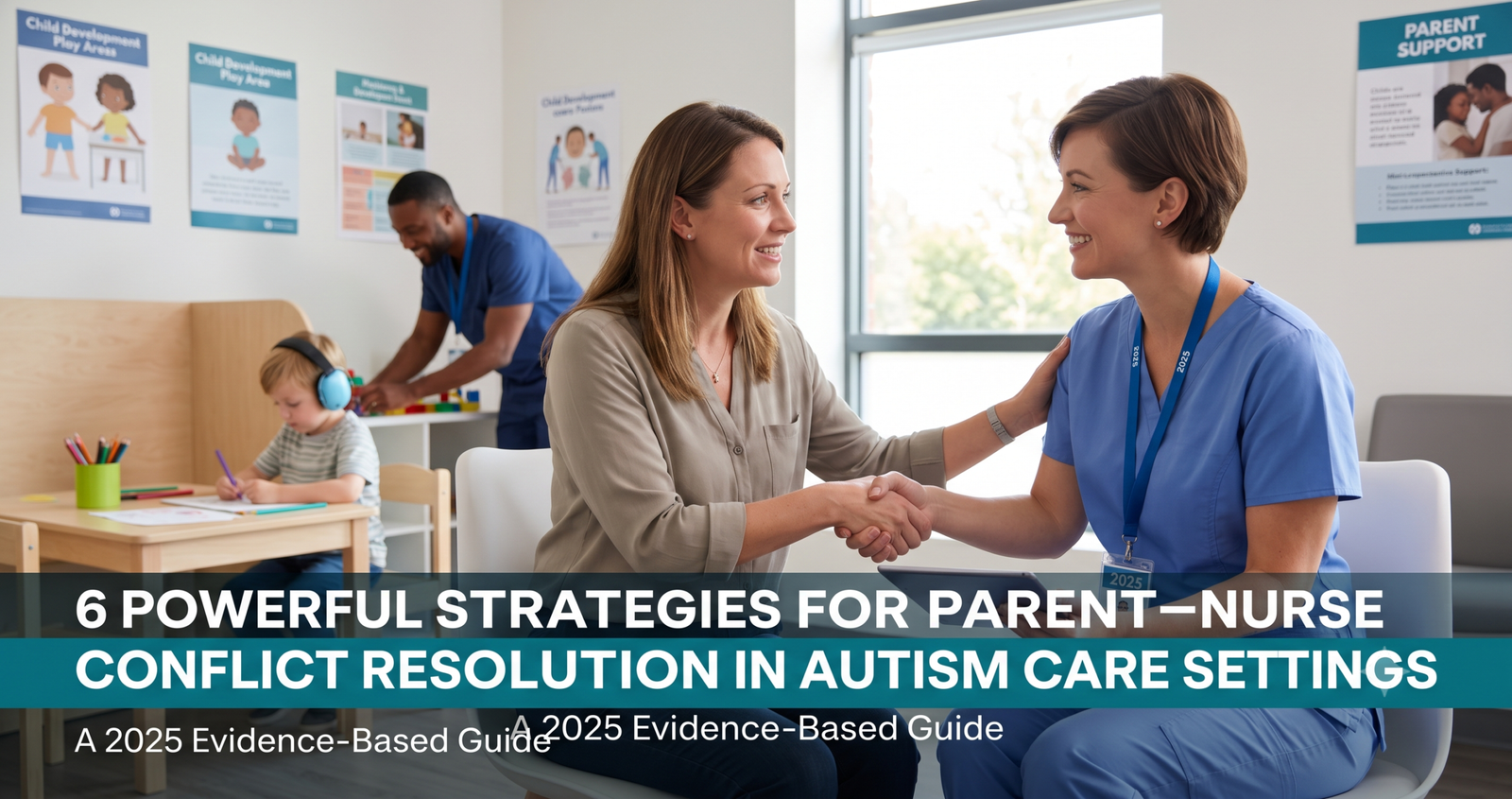
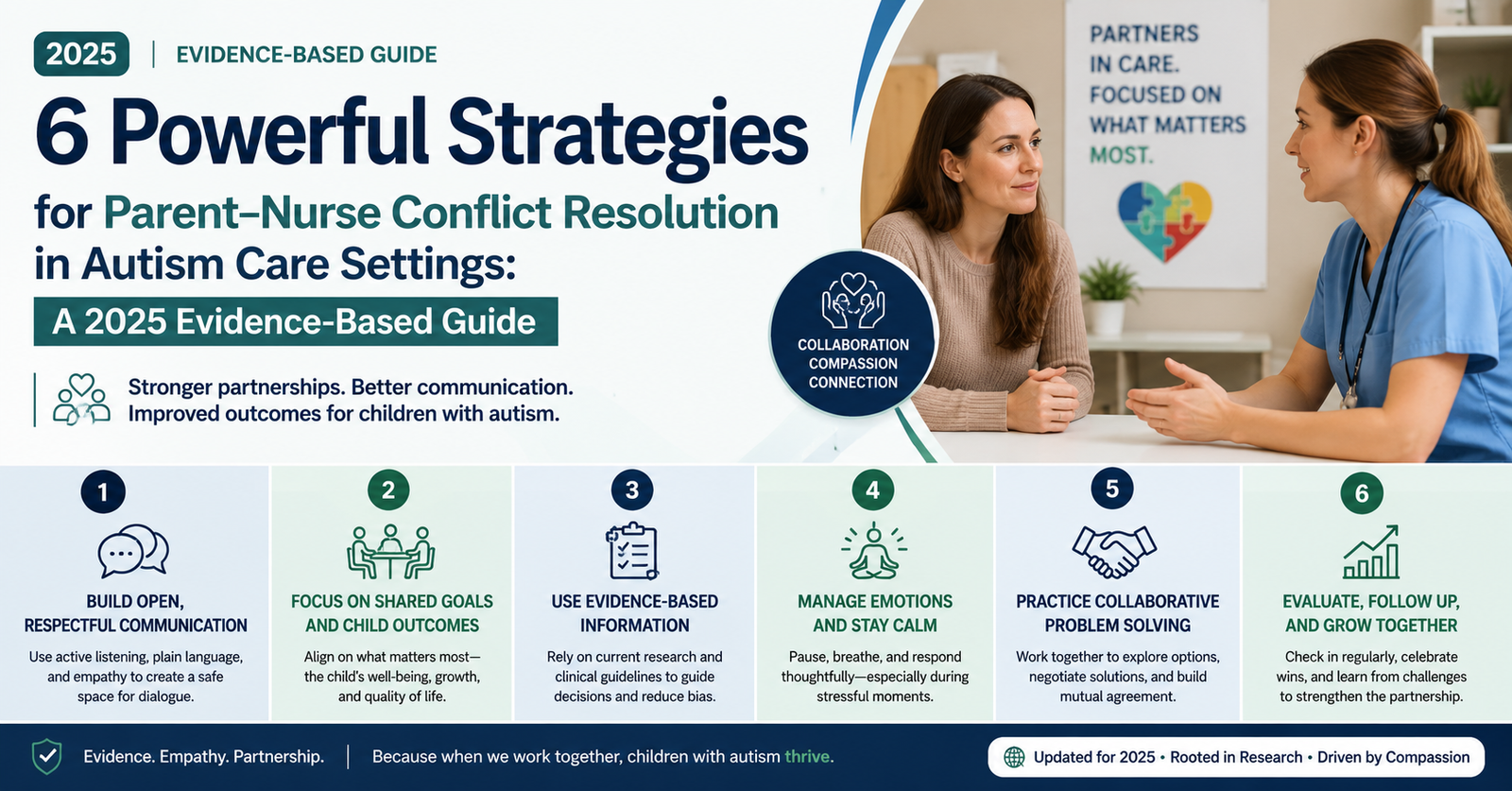
Discover 6 Powerful Strategies for Parent–Nurse Conflict Resolution in Autism Care Settings: A 2025 Evidence-Based Guide. 6 powerful strategies for parent–nurse conflict resolution in autism care settings in 2025. Evidence-based tools for nurses, educators, and families of autistic children.
A 2025 Evidence-Based Guide: 6 Powerful Strategies for Parent–Nurse Conflict Resolution in Autism Care Settings
Introduction
Conflict between parents and nurses in autism care settings is far more common than many healthcare institutions acknowledge. Parents who live with and care for their autistic children around the clock carry deep expertise about their child’s needs, triggers, and routines — knowledge that is not always recognized or respected in clinical environments. Nurses, in turn, operate within institutional frameworks, staffing constraints, and evidence-based protocols that may not always align with parental expectations.
When these two worlds collide, the result is often tension, mistrust, and fragmented care. According to a 2025 study published in Health SA Gesondheid (Williams, Sokhela & Ngxongo), key challenges to family involvement in hospital nursing care of children with ASD include nurses not listening to families, an uncaring attitude of nurses, lack of ASD knowledge, and critical staffing shortages. Understanding and resolving these conflicts is not a soft skill — it is a clinical and ethical priority.
Why Parent–Nurse Conflict Occurs in Autism Care Settings
Conflict in any healthcare setting does not emerge without cause. In the specific context of autism care, conflict is shaped by a unique combination of clinical complexity, emotional vulnerability, and systemic gaps. Autistic children present with highly individualized sensory, behavioral, and communication profiles that vary significantly from one child to another. A nurse who lacks adequate training in ASD may inadvertently use approaches — such as direct eye contact, a loud voice, or abrupt physical contact — that distress an autistic child, triggering behavioral responses that parents have spent years learning to prevent. This divergence in approach can quickly generate friction.
Parents of autistic children often arrive at healthcare encounters carrying years of accumulated expertise about their child’s specific needs. They know which sensory inputs cause meltdowns, which communication strategies work, and which routines must be preserved to maintain stability. When nurses fail to elicit or integrate this parental knowledge into the care plan, parents feel dismissed and unheard. A scoping review published in the Journal of Advanced Nursing (Greenwood et al., 2024) found that recognizing parental expertise as crucial knowledge of the individualized needs of autistic patients is vital to advocating and informing care and is likely to increase both patient and family satisfaction during hospital experiences.
On the institutional side, nurses face real constraints — high patient loads, limited ASD-specific training, time pressure, and staffing shortages — that reduce their capacity to deliver the kind of individualized, relationship-centered care that autism demands. A 2024 systematic review on conflict management in nursing published in PMC (Magadze, 2024) confirmed that high workloads, role ambiguity, and interpersonal tensions are pervasive drivers of conflict in nursing environments. When systemic pressures prevent nurses from engaging meaningfully with families, conflict is a predictable outcome — not a personal failing.
The Thomas–Kilmann Model Applied to Autism Care Conflicts
Understanding the theoretical framework behind conflict resolution equips nurses with more than good intentions — it provides a structured, evidence-based approach to navigating difficult interactions. The Thomas–Kilmann Conflict Mode Instrument (TKI), widely applied in nursing practice, identifies five conflict-handling styles: competing, collaborating, compromising, avoiding, and accommodating. Each style has its place, but not every style is equally effective when managing parent–nurse conflict in autism care settings.
A 2026 study exploring nursing managers’ competence in applying the TKI model found that in healthcare environments, the collaborative style — characterized by high concern for both one’s own needs and the needs of others — produces the most constructive and durable conflict resolutions. In the context of autism care, collaboration means nurses and parents jointly developing a care approach that draws on both clinical expertise and lived parental knowledge. It requires active listening, mutual respect, and a willingness to adapt institutional practices to the individual needs of the autistic child.
Research consistently shows that avoiding — the predominant conflict style among nurses in several international studies — is the least effective approach when parent concerns are substantive and recurring. Avoiding conflict in autism often manifests as deflecting parental input, failing to document family concerns, or assigning difficult conversations to more senior staff. While avoidance may temporarily reduce tension, it erodes trust over time, deepens parental frustration, and ultimately compromises the quality and safety of care delivered to the autistic child.
Building Trust as a Foundation for Conflict Prevention
Trust is the single most powerful preventative tool in the parent–nurse relationship — and it is built through consistent, empathetic communication long before conflict arises. A 2024 ScienceDirect scoping review on trust between pediatric nurses and caregivers found that communication was the most frequently noted facilitator of trust between caregivers and nurses, and that when caregivers trusted their nurses, this trusts itself facilitated higher quality communication — creating a virtuous cycle that strengthens the entire care experience.
In autism care settings, trust-building begins at the very first interaction. When a nurse introduces themselves to the family, acknowledges the parent’s role as a primary expert on their child’s needs, and takes time to ask open-ended questions about the child’s routines, sensory sensitivities, and behavioral history, they immediately signal a collaborative stance. This stance communicates that the nurse views the parent not as an obstacle to care but as an indispensable partner in it. Such seemingly small gestures carry enormous relational weight for families who have often experienced dismissal or condescension in healthcare settings.
Nurses can further reinforce trust by following through on commitments made to families, communicating transparently about care and any changes, and proactively sharing information rather than waiting for parents to ask. In settings where autistic children have limited verbal communication skills, parents are often the most reliable interpreters of their child’s distress, pain, and preferences. Failing to leverage this expertise not only alienates families but exposes patients to preventable harm — making trust-building an issue of clinical safety as much as relational care.
Evidence-Based Communication Strategies for Conflict Resolution
When conflict does arise, the nurse’s communication approach can either escalate or defuse the situation. Evidence-based communication strategies in nursing conflict resolution share a common thread: they prioritize the relationship before the problem. This principle, aligned with Hildegard Peplau’s Interpersonal Relations Theory in Nursing, holds that the therapeutic nurse–patient/family relationship is not incidental to care — it is the medium through which care is effectively delivered. In conflict scenarios, restoring relational safety is the prerequisite for reaching practical resolution.
Concrete communication strategies that nurses should employ in parent conflict scenarios include active listening without interruption, reflecting the parent’s concerns back to demonstrate understanding, using “I” statements to express perspectives without assigning blame, and explicitly inviting parents to contribute to problem-solving. Phrases such as “I want to make sure we’re both working toward the same goal for your child” or “Help me understand what has worked for your child at home” signal openness and shared purpose. These approaches lower defensive responses and create space for genuine dialogue.
Nurses should also be aware of and manage their own non-verbal communication. Crossed arms, hurried movement, minimal eye contact, or a distracted demeanor during difficult conversations with parents will undermine even the most carefully chosen words. Psychiatric and pediatric nursing training must reinforce that non-verbal attunement — the alignment of tone, body language, and presence — is as clinically significant as verbal communication, particularly in emotionally charged encounters with families of autistic children.
Family-Centered Care as a Structural Solution to Recurring Conflict
Individual communication strategies are necessary but insufficient if the institutional environment does not structurally support parent–nurse partnership. Family-centered care (FCC) is an internationally endorsed model of pediatric healthcare delivery that formally positions families as partners in care planning, decision-making, and care delivery. When implemented rigorously, FCC reduces the conditions that generate parent–nurse conflict by building family involvement into every dimension of the care system — from admission protocols to discharge planning.
A 2025 integrative review in the Journal of Pediatric Nursing on nursing strategies in the care of autistic children and adolescents (ScienceDirect, 2025) emphasized that individualized, early interventions must engage families as active participants in care delivery, and that the shift toward a neurodiversity-centered perspective demands care environments that respect and support individual differences. FCC operationalizes this philosophy by ensuring that a child’s care plan incorporates the family’s knowledge of their child’s unique neurodevelopmental profile from the outset, reducing the friction caused by generic, protocol-driven approaches that ignore individual needs.
Structurally, hospitals and care settings can support FCC by designating family liaison roles within ASD care teams, creating standardized intake tools that capture detailed parental knowledge about the child’s sensory needs, behavioral cues, and communication style, and developing clear escalation pathways for resolving disputes respectfully and promptly. These structures normalize conflict resolution as a professional process — not a personal confrontation — and create accountability for how disagreements between families and nurses are handled at the institutional level.
The Role of Nursing Education in Preparing Nurses for Conflict in Autism Care
No conflict resolution strategy can succeed if nurses lack both the knowledge and the professional confidence to implement it. Nursing education programs must equip students — and practice nurses through continuing education — with a dual competency: deep understanding of autism spectrum disorder and robust training in interpersonal conflict management. These two competency areas are often addressed in separate curricular silos, yet in autism care, they are inseparable in practice.
A 2025 cross-sectional study on nurses’ understanding of autism across global clinical settings found considerable gaps in nurses’ competencies related to identification, behavioral interventions, and communication strategies, particularly in culturally diverse or resource-limited environments. These knowledge gaps are directly implicated in parent–nurse conflict: when nurses misinterpret autistic behavior as defiance or noncompliance, parents who understand their child’s neurological reality will inevitably push back — and rightly so. ASD education that incorporates the neurodiversity perspective, sensory processing awareness, and individualized behavioral frameworks is essential preparation for the reality of autism care encounters.
Simulation-based learning, reflective practice, and interprofessional education are particularly effective formats for building conflict resolution competence in nursing students. Role-playing difficult conversations with ASD families — including scenarios involving diagnostic disagreements, treatment refusal, or parental complaints — gives students a safe environment in which to develop their communication and emotional regulation skills. Organizations such as the International Council of Nurses (ICN) have increasingly called for conflict management to be treated as a core clinical competency, on par with clinical assessment and medication management, across all nursing specializations.
Conclusion
Parent–nurse conflict in autism care settings is neither inevitable nor acceptable as a permanent feature of care delivery. It is a signal — one that points directly to knowledge gaps, communication breakdowns, structural failures, and systemic pressures that nursing education, leadership, and institutional policy have the power to address. By applying evidence-based conflict management frameworks such as the Thomas–Kilmann Model, grounding practice in Peplau’s interpersonal theory, building trust through consistent and transparent communication, and embedding family-centered care into institutional structures, nurses can transform conflict into collaboration.
For nursing students, educators, researchers, and practicing clinicians, developing these competencies is not peripheral to excellence in autism care — it is the very heart of it. Autistic children deserve care that honors both clinical expertise and the irreplaceable knowledge of the families who love and know them best.
FAQs
What are the most common causes of conflict between parents and nurses in autism care settings?
The most common causes include nurses lacking ASD-specific knowledge, failing to involve or listen to parents in care planning, institutional pressures reducing individualized care, and communication breakdowns stemming from differing expectations between families and clinical teams.
How does the Thomas–Kilmann Conflict Model apply to parent–nurse conflicts in autism care?
TKI identifies five conflict styles — competing, collaborating, compromising, avoiding, and accommodating. Research consistently supports the collaborative style as most effective in autism care, as it integrates both parental expertise and clinical knowledge to produce mutually satisfactory care solutions for the autistic child.
Why is trust-building so important in preventing parent–nurse conflict?
Trust is the relational foundation that enables open communication, shared decision-making, and flexible problem-solving. When parents trust their nurses, they communicate more effectively, comply more readily with care plans, and are more likely to raise concerns constructively rather than confrontationally — all of which significantly reduce conflict incidence.
What role does nursing education play in reducing conflict with parents of autistic children?
Nursing education that integrates ASD-specific clinical knowledge with interpersonal conflict management training prepares nurses to engage families as partners rather than obstacles. Simulation-based learning and reflective practice are especially effective in building the communication and emotional regulation skills needed to navigate these complex care relationships.
Read More:
https://nurseseducator.com/didactic-and-dialectic-teaching-rationale-for-team-based-learning/
https://nurseseducator.com/high-fidelity-simulation-use-in-nursing-education/
First NCLEX Exam Center In Pakistan From Lahore (Mall of Lahore) to the Global Nursing
Categories of Journals: W, X, Y and Z Category Journal In Nursing Education
AI in Healthcare Content Creation: A Double-Edged Sword and Scary
Social Links:
https://www.facebook.com/nurseseducator/
https://www.instagram.com/nurseseducator/
https://www.pinterest.com/NursesEducator/
https://www.linkedin.com/company/nurseseducator/
https://www.linkedin.com/in/afzalaldin/
https://www.researchgate.net/profile/Afza-Lal-Din
https://scholar.google.com/citations?hl=en&user=F0XY9vQAAAAJ