
The Research Quarry Problem and Problem Statement or Hypothesis. is the core concern of nursing researchers and students in health care settings.
How to Develop Quarry ,Problem and Problem Statement
What is a Research Problem?
Research Quarry ,Problem and Problem Statement or Hypothesis: The situation difficult to interpret or mysterious encountering situation that a researcher finds to address through series investigation design known as research problem. Researchers traditionally find a west study subject, narrow the scope of the problem, and then identify questions persistently linked with a selected paradigm.
Source and Characters of Research Problem
The natural origin of ideas for nursing research problems are experiences during practices, relevant literature when someone makes a view of existing knowledge, social issues when conflicts or opinions emerge among people, theory and external sources when previous research reviewed. Several criteria must be considered when assessing the value of a research problem. The research problem must be clinically significant or beneficial; research able or can be go through research process (questions of a moral or ethical nature are inappropriate); make able /can be addressed; and interesting.
Barriers to Research Problem
The availability or feasibility includes issues of time, collaboration between study participants. Moreover, availability of facilities and equipment, investigator experience, and ethical considerations. Investigators share their goals in research reports such as problems, declarations of intent, research questions or hypotheses.
Problem Statement and Statement of Purpose
The problem statement articulates the nature, context, and meaning of the problem being studied. A purpose statement summarizes the overall objective of the study; In both qualitative and quantitative studies, the purpose statement identifies the key concepts (variables) and the study group or population.
Statements of purpose often communicate through the use of verbs and other key words the underlying research tradition of qualitative studies or whether the study is experimental or non-experimental in quantitative studies.
What is Research QuestionResearch question or quarry is the unique or very directed question that researchers that a study designer planned to work on. Generally, the existence, nature, strength, and direction of relationships are the keys to research questions.
Problem Statement and Relationship with Variable
Some research questions relate to moderating variables that affect the strength or direction of a relationship between independent and dependent variables; others deal with mediating variables that intervene between the independent and dependent variables/attribute and facilitate to express why the relationship exists among them.
What is Hypothesis?In quantitative investigations, a hypothesis is a tentative statement of expected relationships between two or more variables. Moreover a testable hypothesis establishes the expected association/Link between one or more independent variables/ or unknown and one or more dependent variables.
Types of hypothesis
Simple hypotheses express a predicted relationship between an independent variable and a dependent variable, while complex hypotheses establish an expected relationship between two or more independent variables and two or more dependent variables (or make predictions about mediating or moderating variables).
Short Notes
Directional hypotheses predict the direction of a relationship; Undirected or non-directional hypotheses predict the existence of relationships, not show their direction or path. Research hypotheses predict the existence of relationships; Statistical or null hypotheses express the lack of a relationship existence.
Worth of both Type of Hypothesis
Hypotheses are never definitively proved/ Justified or disproved/ Non justified .
Hypothesis can be accepted or rejected, supported or not supported by data.
If Null hypothesis rejected then Research Hypothesis accepted and vice versa
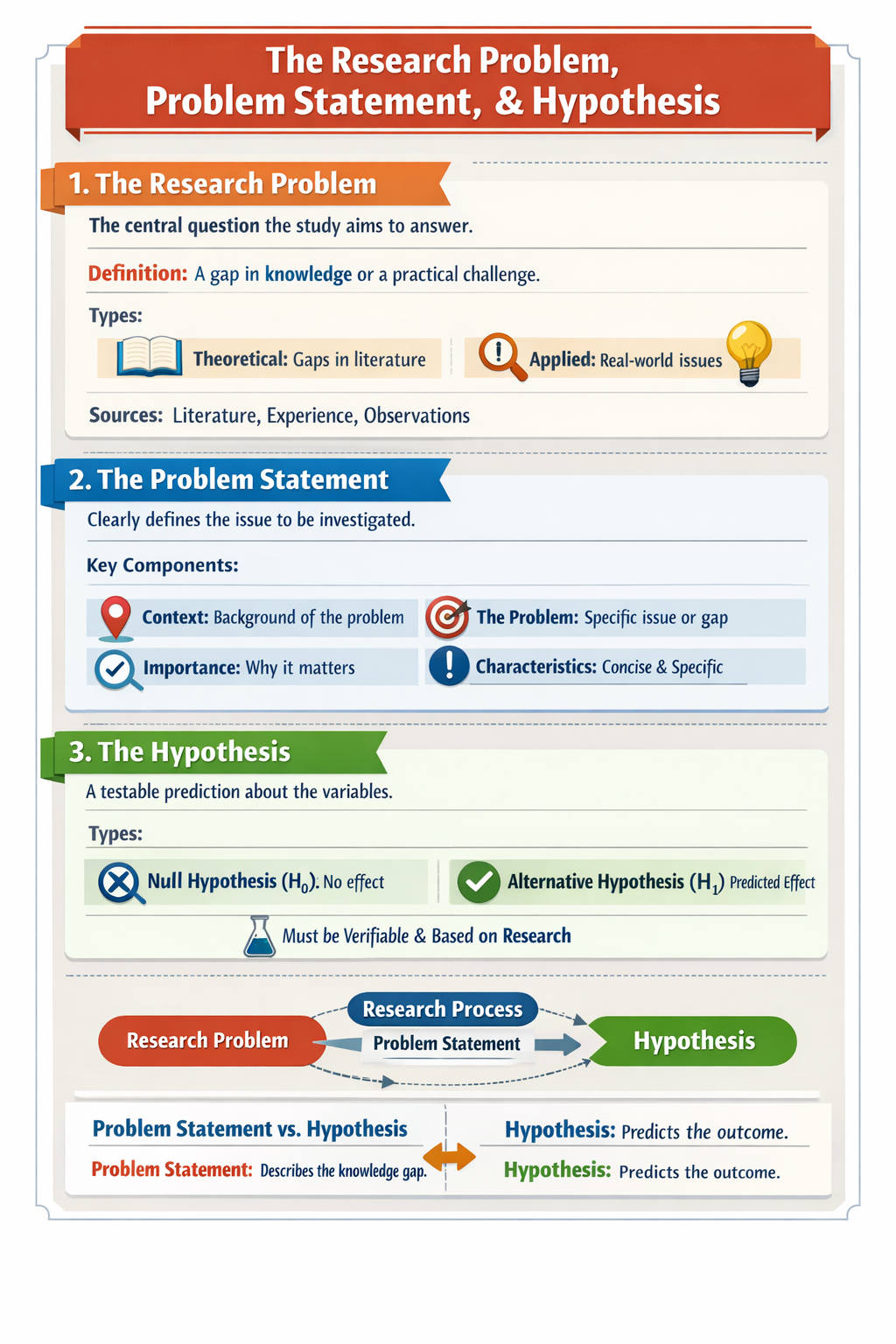
The research problem, the problem statement, and the hypothesis form the basis of all research. They define what is being investigated, why it is relevant, and what the expected outcome is. A research problem is a specific question, a contradiction, or a gap in knowledge that needs to be investigated. The problem statement describes this problem clearly and concisely, while a hypothesis is a testable prediction about the relationship between variables.
1. The Research Problem
A research problem is the central question that a study aims to answer and serves as the “why” of the research.
Definition: It is a gap in knowledge, a practical challenge that requires a solution, or a contradiction between two or more perspectives.
Types:
Theoretical: Focuses on gaps in the literature and seeks to expand knowledge.
Applied: Focuses on finding solutions to practical, real-world problems.
Sources: Literature reviews, personal experience, observations, and theoretical discussions.
2. The Problem Statement
The problem statement is the explicit and formal formulation of the research problem and is usually the first step in a study. Purpose: The hypothesis justifies the study, establishes the methodology, and defines the scope of the research.
Key Components:
Context: Background of the problem.
The Problem: The specific gap or problem (current state vs. desired state).
Importance: Why the problem needs to be solved and what its implications are.
Characteristics: The hypothesis should be concise, specific, and testable.
3. The Hypothesis
A hypothesis is a preliminary and testable answer to the research question. It is frequently used in quantitative research to predict the study’s results.
Definition: A precise statement that predicts the relationship between two or more variables (independent and dependent).
Types:
Null Hypothesis ( ): Assumes that there is no relationship or effect.
Alternative Hypothesis ( ): Predicts a specific relationship or effect. Directed/Undirected: Predicts a specific direction of the outcome (e.g., “higher,” “lower”) or simply that a relationship exists.
Criteria: Must be verifiable (acceptable or refutable) and based on existing knowledge or theories.
Relationship between components: These elements follow a logical sequence:
Identify the main topic (e.g., academic performance).
Identify the research problem (e.g., lack of sleep affects grades).
Formulate the problem statement (e.g., “Despite the recognized importance of sleep, there is little data on how specific sleep hygiene measures and practices improve the grades of first-year students”).
Develop the hypothesis (e.g., “Frequent students who participate in a four-week sleep hygiene program will have a higher GPA than those who do not”).
Difference: Problem statement vs. hypothesis
Problem statement: Describes the knowledge gap.
Hypothesis: Predicts the solution or outcome of this gap. A study may contain one or more research questions (derived from the problem) and one or more hypotheses.
Read More:
https://nurseseducator.com/dialectic-teaching-with-team-based-learning/
https://nurseseducator.com/high-fidelity-simulation-use-in-nursing-education/
First NCLEX Exam Center In Pakistan From Lahore (Mall of Lahore) to the Global Nursing
Categories of Journals: W, X, Y and Z Category Journal In Nursing Education
AI in Healthcare Content Creation: A Double-Edged Sword and Scary
Social Links:
https://www.facebook.com/nurseseducator/
https://www.instagram.com/nurseseducator/
I am really inspired along with your writing talents and also with the structure in your blog. Is that this a paid theme or did you customize it your self? Anyway keep up the excellent high quality writing, it’s uncommon to peer a great weblog like this one these days!