
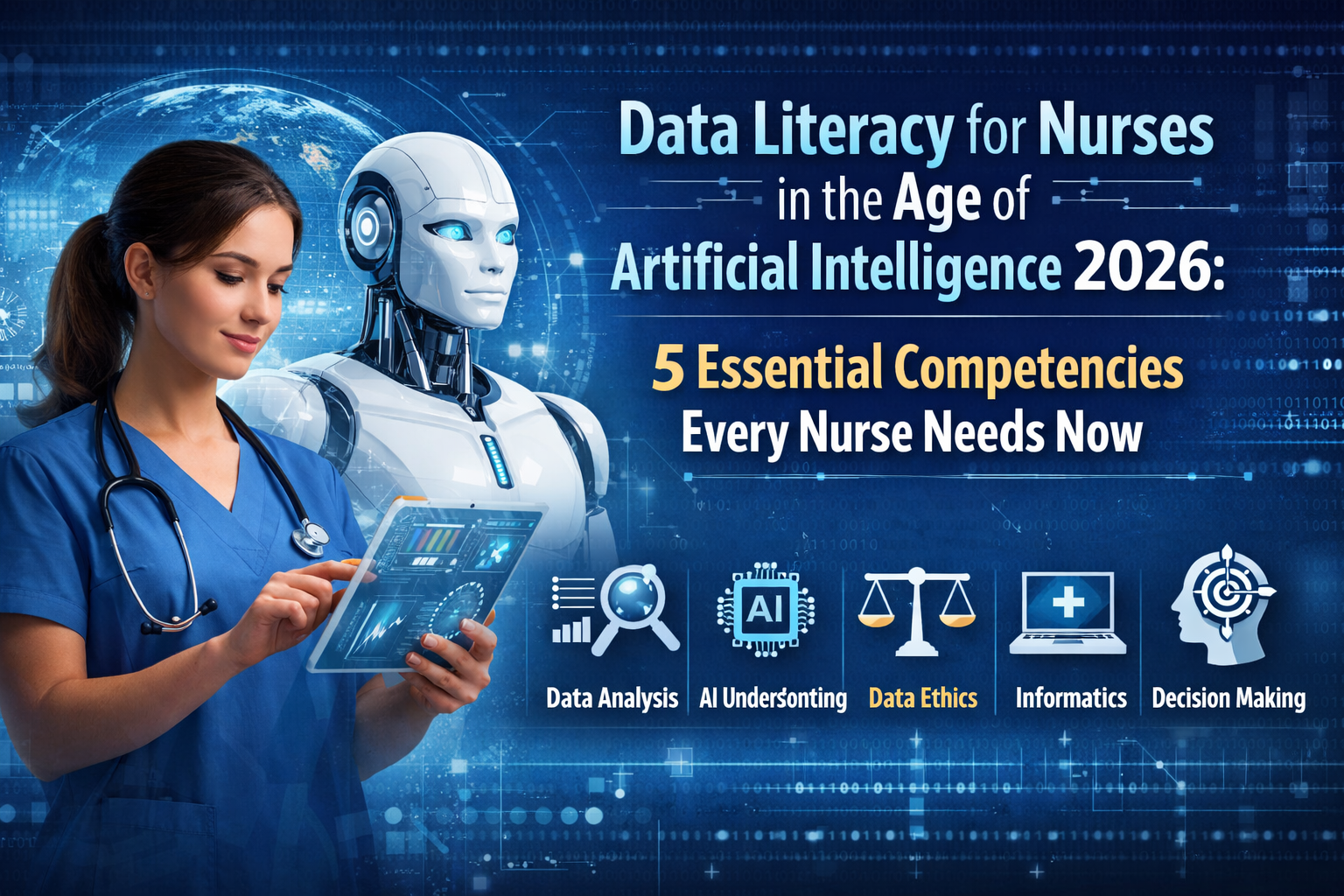
Discover Data Literacy for Nurses in the Age of Artificial Intelligence 2026: 5 Essential Competencies Every Nurse Needs Now. Why data literacy for nurses in the age of AI is critical in 2026. Explore 5 essential competencies, current evidence, and strategies for nursing practice.
5 Essential Competencies Every Nurse Needs Now: Data Literacy for Nurses in the Age of Artificial Intelligence 2026
Introduction
Artificial intelligence is no longer a distant concept in healthcare — it is an active presence at the bedside, in the clinic, and inside all electronic health record system nurses use daily. A 2024 survey cited in PMC’s Digital Health journal found that 66% of American physicians already use some form of AI in their practice, a figure rising sharply year over year. As the largest segment of the global healthcare workforce, nurses are generating, interpreting, and acting upon vast quantities of clinical data every single shift.
Yet research consistently reveals a critical gap: most nurses possess only moderate AI literacy, and many remain excluded from the very processes that design the AI tools shaping their practice. Addressing data literacy for nurses is no longer an optional professional development goal — in 2026, it is a foundational clinical and ethical imperative.
What Is Data Literacy in Nursing — and Why Does It Matter in 2026?
Data literacy, in the context of nursing, refers to a nurse’s ability to read, interpret, evaluate, and apply data meaningfully within clinical decision-making and patient care. It goes far beyond knowing how to navigate an electronic health record. A data-literate nurse understands how algorithms work, what kind of data trains AI models, where those models can fail, and what ethical implications arise when automated systems influence care.
The Royal College of Nursing in the United Kingdom declared in 2018 that “every nurse” must become an e-nurse — embracing digital health technologies as a professional expectation. By 2025, scholars publishing in Digital Health (PMC) have taken this further, asserting that the profession must now aspire to make “every nurse an AI nurse” — equipped not just to use these technologies but to actively shape, evaluate, and govern them. Without foundational data literacy, nurses risk becoming passive recipients of AI-generated decisions rather than critical, informed clinical advocates for their patients.
The Current State of AI Literacy Among Nurses — What Evidence Shows
The evidence paints a picture of promise mixed with significant concern. A 2024 cross-sectional study of 505 perioperative nurses published in Nursing & Health Sciences (Wiley Online Library) found a mean AI literacy score of 44.35 out of a possible range, reflecting only moderate proficiency. Crucially, while awareness of AI was present, actual use of AI tools among these nurses remained minimal. A comprehensive systematic review published in Frontiers in Digital Health (2025), synthesizing 37 studies involving approximately 10,290 nursing students and practicing nurses across six databases, found that nursing students generally hold moderately positive attitudes toward AI — with senior students and male nurses demonstrating greater enthusiasm than their counterparts.
However, through practicing nurses, consistent concerns about data privacy, cybersecurity, algorithmic bias, and insufficient training emerged as primary barriers to confident AI adoption. A 2024 qualitative study from Saudi Arabia revealed that 55% of nurses expressed ethical concerns specifically related to patient privacy in AI-driven care environments. These findings reveal a workforce that is curious about AI but not yet equipped — a gap that data literacy education must urgently close.
5 Essential Data Literacy Competencies Every Nurse Must Develop
Building data literacy in nursing requires moving through a structured set of competencies. The following five domains reflect both current nursing research and emerging frameworks for AI integration in clinical practice.
1. Understanding AI Fundamentals and Clinical Applications.
Nurses must develop a working understanding of how AI and machine learning systems function — not at an engineering level, but at a level sufficient to understand what these tools can and cannot do in clinical settings. This includes knowing how predictive algorithms flag patient deterioration, how AI supports triage decisions, and how natural language processing tools assist documentation. The Nursing Outlook journal published a landmark 2025 framework — the N.U.R.S.E.S. model — which stands for Navigate AI basics, Utilize AI strategically, Recognize AI pitfalls, Skills support, Ethics in action, and Shape the future. This framework provides nurses with a practical, structured pathway from foundational understanding to active leadership in AI governance.
2. Critical Evaluation of AI-Generated Outputs.
Data literacy demands that nurses never passively accept AI outputs as clinical truth. Algorithmic systems can produce errors, perpetuate biases embedded in their training data, or generate what researchers call “hallucinations” — confident-sounding but factually incorrect outputs. The Nursing Outlook publication explicitly identifies algorithmic bias and hallucinations as documented risks that have already led to harmful outcomes in healthcare settings, including wrongful prior authorization denials for patient care. A data-literate nurse understands that AI advises; the nurse decides. Critical evaluation of AI-generated clinical recommendations is therefore a patient safety skill, not merely a technical one.
3. Ethical Reasoning Around Data Privacy and Patient Autonomy.
As AI systems in healthcare increasingly rely on patient data — including electronic health records, biometric data, and observational nursing notes — ethical engagement with data privacy becomes central to nursing practice. A PMC-published qualitative study (2025) highlighted that nurses across multiple countries raised serious concerns about hacking, unauthorized access, and the misuse of patient information through AI-integrated systems.
Nurses must understand that transparency in AI — informing patients when AI is being used in their care — is a direct extension of the principle of informed consent and patient autonomy. The EU AI Act, the world’s first comprehensive legal framework for AI, is now in full effect as of 2026, establishing regulatory obligations that nurses, as frontline implementers of AI tools, must understand in principle.
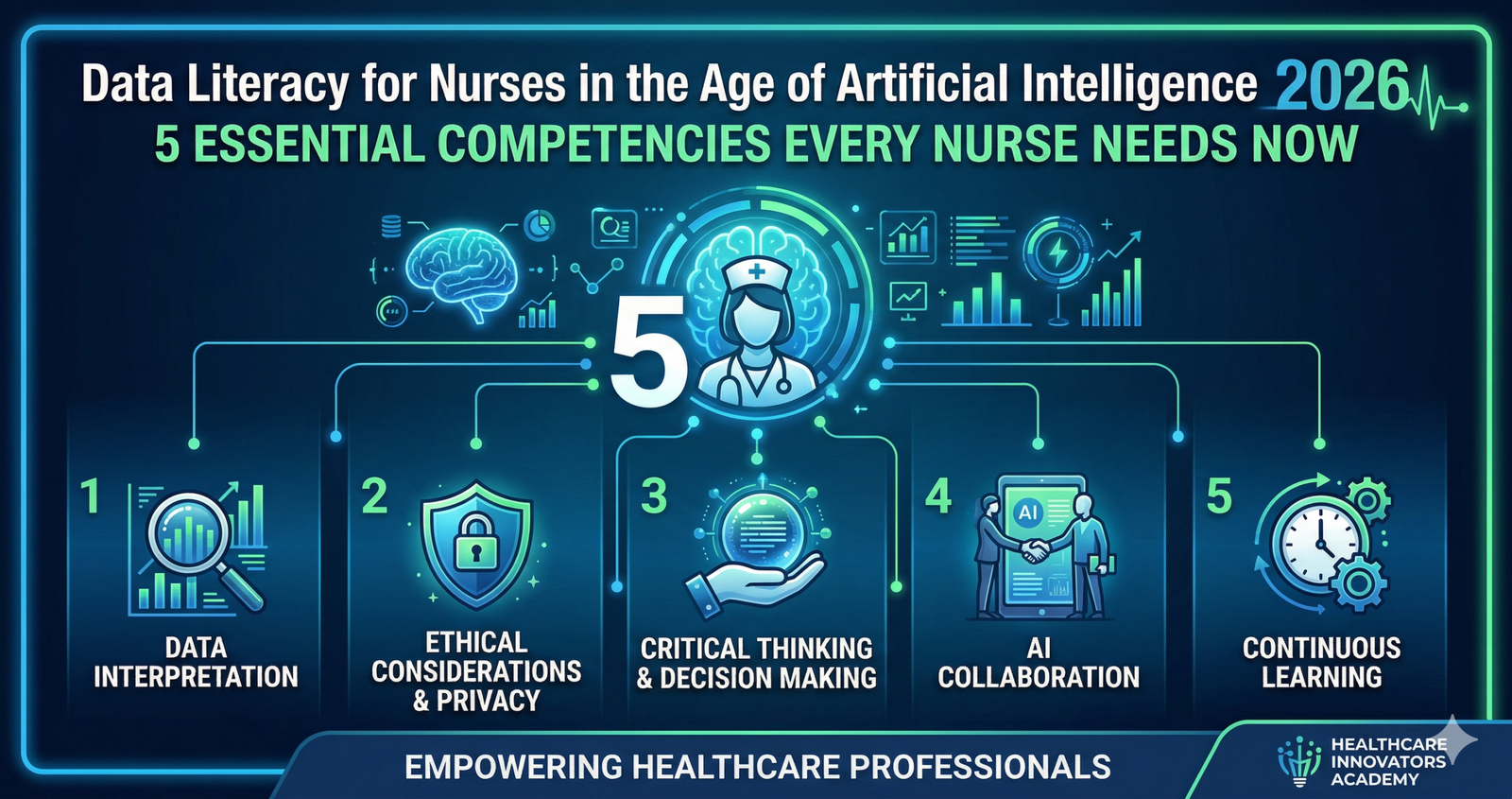
4. Data Generation Awareness — Understanding the Nurse’s Role as a Data Contributor.
A frequently overlooked dimension of nursing data literacy is recognizing that nurses themselves are among the most prolific generators of healthcare data. Every clinical note, observation, medication administration record, and care plan entry feeds into the datasets that train and validate AI systems. As a 2025 commentary in Digital Health (PMC) pointedly noted, despite being key data contributors, nurses are frequently excluded from the development, validation, implementation, and evaluation of these technologies. Data-literate nurses understand their power in this equation and can advocate for nursing-specific perspectives to be embedded in the design of AI tools that affect their practice.
5. Continuous Learning and Digital Professional Development.
AI technologies evolve at a rate that no single educational intervention can permanently address. Data literacy in nursing is therefore not a destination but a sustained professional practice. The American Organization for Nursing Leadership (AONL) identified digital nursing as one of the top three workforce competencies projected to reshape nurse staffing models through 2030. The National League for Nursing (NLN) has similarly issued an AI vision statement calling for the systematic integration of AI literacy into undergraduate and graduate nursing curricula — framing it not as a technology elective but as a core professional competency on equal footing with clinical assessment skills. Nurses who commit to ongoing digital learning position themselves not as technology users but as technology leaders.
Barriers to Data Literacy in Nursing — What Is Holding the Profession Back?
Despite the urgent need, multiple structural barriers impede nurses’ progress toward meaningful data literacy. Time remains the most commonly cited obstacle — nurses navigating high patient loads and mandatory overtime have limited capacity for additional learning. Institutional culture presents another barrier: many healthcare organizations continue to design and deploy AI systems without meaningful nursing input, reinforcing a passive relationship between nurses and technology rather than a collaborative one. Research also points to AI anxiety as a significant psychological barrier.
A 2025 study published in BMC Nursing, examining 478 nurses in China, found that AI anxiety directly mediates the relationship between AI literacy and nurses’ attitudes toward AI adoption — meaning that nurses with lower literacy tend to experience greater anxiety, which in turn further reduces their willingness to engage with AI tools. This creates a self-reinforcing cycle that only structured, accessible education can interrupt. Additionally, nursing education curricula in many institutions still treat digital literacy and AI competency as peripheral concerns rather than foundational requirements, leaving graduates unprepared for AI-integrated clinical environments from the moment they enter the workforce.
Strategies for Advancing Data Literacy — From the Classroom to the Bedside
Addressing the data literacy gap in nursing requires a coordinated response across education, institutional leadership, and professional policy. In nursing education, the call to action is clear: AI literacy must be embedded into undergraduate and graduate curricula as a core competency, not an optional module. A 2025 publication in Nurse Education Today described generative AI literacy in nursing education as a “crucial call to action,” noting that nursing students increasingly use AI for academic tasks but often lack the ethical and critical frameworks to do so responsibly.
Leadership residency programs and simulation-based learning environments offer powerful contexts for nurses to practice data interpretation and AI evaluation in safe, supported settings. At the institutional level, shared governance models that formally include nurses in AI procurement, implementation, and evaluation committees are not merely good practice — they are an ethical obligation. At the policy level, the establishment of nursing-specific AI governance frameworks, robust data security standards, and accountability mechanisms for AI malfunctions represents the structural foundation upon which a data-literate nursing workforce can be built and sustained.
Conclusion
Data literacy for nurses in the age of artificial intelligence is one of the most consequential professional competencies of the twenty-first century. The evidence gathered through 2024 and 2025 paints an unambiguous picture: AI is already embedded in nursing practice, yet the majority of nurses remain only moderately prepared to engage with it critically, ethically, and confidently. For nursing students, developing data literacy from the earliest stages of training is an investment in both career resilience and patient safety.
For practicing nurses, building these competencies through continuous education and professional development is both a personal and a collective ethical responsibility. For educators and researchers, the mandate is equally clear — nursing curricula must evolve to reflect the digital realities of contemporary healthcare. And for institutions and policymakers, creating the structural conditions in which nurses can develop, apply, and lead in data literacy is the most direct path to a healthcare system where AI serves humanity rather than diminishes it.
FAQs
What is the difference between data literacy and AI literacy for nurses?
Data literacy broadly refers to a nurse’s ability to interpret, evaluate, and use data in clinical decision-making, including understanding statistics, electronic health records, and research evidence. AI literacy is a more specific competency focused on understanding how artificial intelligence systems work, their limitations, biases, and ethical implications. Both are interconnected and essential for safe, informed nursing practice in today’s digital healthcare environment.
Why are nurses frequently excluded from AI development in healthcare, and how can this change?
Nurses are often excluded from AI design and validation processes due to organizational structures that prioritize technical and administrative stakeholders over frontline clinicians. This exclusion is problematic because nurses generate the largest volume of clinical data that trains these systems. Advocacy for nursing representation in AI governance committees, shared decision-making structures, and inclusion in multidisciplinary digital health teams are key steps toward meaningful nursing involvement in AI development.
How does low data literacy affect patient safety in AI-integrated nursing settings?
When nurses lack the competency to critically evaluate AI-generated outputs, they may act on incorrect algorithmic recommendations, miss system biases that disproportionately harm certain patient populations, or fail to recognize AI-related errors in time-sensitive clinical scenarios. Research published in peer-reviewed journals confirms that low data and AI literacy among nurses is directly associated with reduced patient safety climates and an increased risk of adverse clinical events.
What practical steps can nursing students take right now to build data literacy?
Nursing students can begin building data literacy by familiarizing themselves with how electronic health record systems organize and display patient data, taking online courses in healthcare informatics and introductory AI concepts, engaging with current literature on AI in nursing practice through databases like CINAHL and PubMed, and actively questioning how clinical decision-support tools in their placement sites generate recommendations. Developing the habit of critical evaluation — asking “how was this generated, and what are its limitations?” — is the foundational mindset of data-literate nursing practice.
Read More:
https://nurseseducator.com/didactic-and-dialectic-teaching-rationale-for-team-based-learning/
https://nurseseducator.com/high-fidelity-simulation-use-in-nursing-education/
First NCLEX Exam Center In Pakistan From Lahore (Mall of Lahore) to the Global Nursing
Categories of Journals: W, X, Y and Z Category Journal In Nursing Education
AI in Healthcare Content Creation: A Double-Edged Sword and Scary
Social Links:
https://www.facebook.com/nurseseducator/
https://www.instagram.com/nurseseducator/
https://www.pinterest.com/NursesEducator/
https://www.linkedin.com/company/nurseseducator/
https://www.linkedin.com/in/afzalaldin/
https://www.researchgate.net/profile/Afza-Lal-Din
https://scholar.google.com/citations?hl=en&user=F0XY9vQAAAAJ