
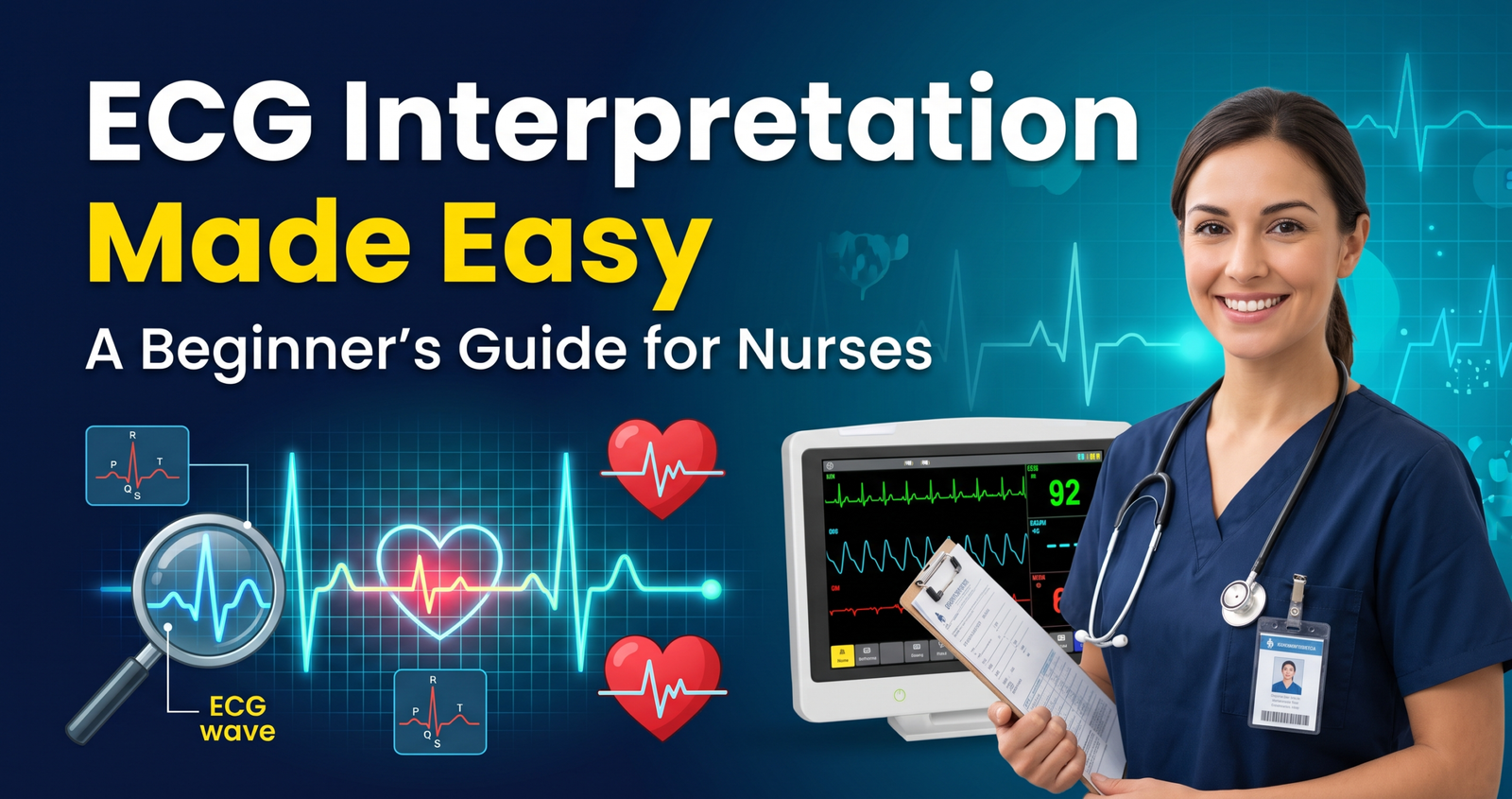
Explore ECG Interpretation Made Easy: A Beginner’s Guide for Nurses. ECG interpretation made smooth for nurses: examine the waves, an easy 5-step approach, and key rhythms to understand with self belief on the bedside.
How ECG Interpretation Made Easy: A Beginner’s Guide for Nurses
Introduction
Few talents make new nurses’ sense as anxious as studying a rhythm strip. Yet ECG interpretation made smooth is a practical goal, due to the fact an easy, repeatable approach turns squiggly strains into clean scientific information. In this guide, you’ll examine the fundamental waves, a five-step approach, and the rhythms you should understand quickly.
Many college students attempt to memorize dozens of strips with out know-how what they show. However, after you hold close how the coronary heart conducts electricity, styles start to make sense. Let`s begin.
Understanding the Basics of the ECG
How the Heart Conducts Electricity
Each regular heartbeat begins off evolved withinside the sinoatrial (SA) node, travels to the atrioventricular (AV) node, after which actions down the package deal branches and Purkinje fibbers. This pathway makes the atria agreement earlier than the ventricles. Therefore, any disruption alongside the path adjustments the form or timing of the tracing.
The Waves and Intervals
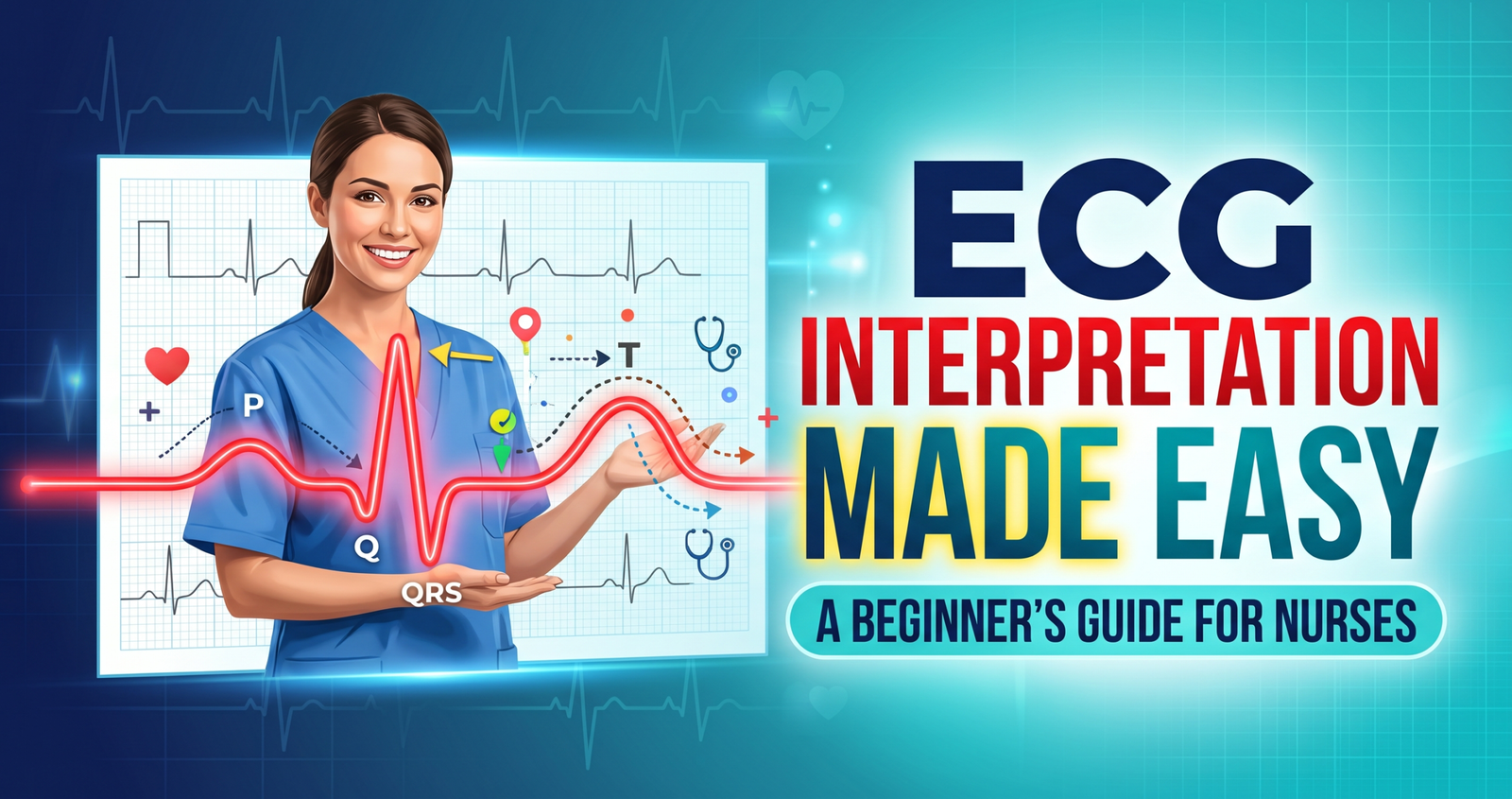
The P wave represents atrial depolarization, the QRS complicated represents ventricular depolarization, and the T wave represents ventricular repolarization. The PR c program language period typically measures 0.12 to 0.20 seconds, and the QRS is typically much less than 0.12 seconds. Consequently, measuring those systems facilitates you see conduction problems.
Reading the Graph Paper
On trendy ECG paper, one small field equals 0.04 seconds, and one huge field equals 0.20 seconds. Five huge packing containers constitute one 2d. As a result, you may estimate coronary heart fee and degree periods with easy counting.
A Five-Step Method for Reading Any Rhythm
Step One: Determine the Rate
For ordinary rhythms, be counted number the huge packing containers among R waves and divide three hundred with the aid of using that number. For abnormal rhythms, be counted number the R waves in a 6-2d strip and multiply with the aid of using 10. Notably, a regular grownup fee falls among 60 and one hundred beats in line with minute.
Step Two: Check the Rhythm
Next, study the spacing among R waves to determine whether the rhythm is ordinary or abnormal. Use callipers or a bit of paper to examine the periods. Irregular styles frequently advocate atrial traumatic inflammation or ectopic beats.
Steps Three to Five: P Waves, PR Interval, and QRS
Then ask whether each QRS has a P wave in the front of it, and whether every P wave is accompanied with the aid of using a QRS. Measure the PR c programming language and the QRS width to test for blocks. Finally, positioned the findings collectively to call the rhythm.
Rhythms Every Nurse Must Recognize
Normal Sinus Rhythm and Its Variations
Normal sinus rhythm has an ordinary sample, a fee of 60 to one hundred, and one P wave earlier than each QRS. Sinus bradycardia falls under 60, even as sinus tachycardia exceeds one hundred. Both are handled primarily based totally at the purpose and on whether the consumer is symptomatic.
Atrial Rhythms
Atrial traumatic inflammation seems like an irregularly abnormal rhythm and not using an awesome P wave. It increases the threat of stroke, so anticoagulation is a key consideration. In contrast, atrial flutter produces a “sawtooth” sample with ordinary flutter waves.
Ventricular Rhythms and Heart Blocks
Ventricular tachycardia indicates a wide, speedy QRS and might purpose hypotension or lack of pulse. Ventricular traumatic inflammation seems chaotic and calls for instantaneously defibrillation. Meanwhile, third-diploma coronary heart block indicates P waves and QRS complexes that march independently of every other.
Nursing Actions That Follow the Strip
Treat the Client, Not the Monitor
Before you react to any rhythm, check the client. Check consciousness, pulse, blood pressure, and oxygen saturation. For instance, a lead that has fallen off can mimic a risky rhythm, so affirm the relationship first.
Know Your Emergency Responses
For a pulseless client, start CPR and contact for assist proper away. Pulseless ventricular tachycardia and ventricular traumatic inflammation want activate defibrillation, whilst asystole and pulseless electric hobby name for notable compressions and medications. Therefore, exercise those algorithms till they experience automatic.
Document and Communicate
Record the rhythm, rate, intervals, and the client`s symptoms. Report vast modifications to the company the use of a dependent layout which includes SBAR. Likewise, connect a strip to the chart whilst your facility calls for it.
Tips for Learning ECG Interpretation Faster
Practice With Real Strips Daily
Look at 5 to 10 rhythm strips every day and comply with the equal 5-step manner each time. Consistency builds sample reputation quicker than occasional lengthy sessions. Over time, not unusual place rhythms will experience acquainted immediately.
Use Visual and Memory Aids
Draw the conduction pathway from reminiscence and label every wave. Create flashcards that pair a rhythm with its key function and its precedence action. Additionally, institution rhythms into families, which includes sinus, atrial, junctional, and ventricular.
Learn From Your Mistakes
Keep a quick log of strips you misinterpret and the clue you missed. Review it weekly, then retest comparable strips. As a result, your accuracy improves steadily.
Conclusion
Reading an ECG will become possible when you observe a system. Learn the waves and intervals, follow the five-step technique, and join every rhythm to a nursing motion. With everyday exercise, ECG interpretation made clean will flow from an intention to a talent you operate with confidence.
Did this manual help? Share it with a classmate, depart a remark with the rhythm you locate hardest, and discover our different nursing observe assets to maintain constructing your skills.
FAQs
How can nurses make ECG interpretation clean to learn?
Use the equal five-step technique on each strip: price, rhythm, P waves, PR c programming language, and QRS width. Daily exercise with actual strips builds reputation quickly. Learning the coronary heart`s conduction pathway first makes each rhythm less complicated to understand.
What are the ordinary values on an ECG?
An ordinary PR c programming language is 0.12 to 0.20 seconds, and an ordinary QRS is much less than 0.12 seconds. An ordinary person coronary heart price is 60 to 100 beats consistent with minute. Always test those measurements in opposition to your facility’s standards.
Which rhythms are maximum crucial for nursing college students to know?
Normal sinus rhythm, atrial fibrillation, ventricular tachycardia, ventricular fibrillation, and third-diploma coronary heart block seem maximum often. Asystole and pulseless electric interest also are essential. Learn the instantaneously nursing motion for every.
How do I rely coronary heart price on an ECG strip?
For an everyday rhythm, divide three hundred through the quantity of massive bins among R waves. For an abnormal rhythm, rely on the R waves in a six-2d strip and multiply through 10. Both techniques deliver a quick, dependable estimate.
Read More:
https://nurseseducator.com/didactic-and-dialectic-teaching-rationale-for-team-based-learning/
https://nurseseducator.com/high-fidelity-simulation-use-in-nursing-education/
First NCLEX Exam Center In Pakistan From Lahore (Mall of Lahore) to the Global Nursing
Categories of Journals: W, X, Y and Z Category Journal In Nursing Education
AI in Healthcare Content Creation: A Double-Edged Sword and Scary
Social Links:
https://www.facebook.com/nurseseducator/
https://www.instagram.com/nurseseducator/
https://www.pinterest.com/NursesEducator/
https://www.linkedin.com/company/nurseseducator/
https://www.linkedin.com/in/afzalaldin/
https://www.researchgate.net/profile/Afza-Lal-Din
https://scholar.google.com/citations?hl=en&user=F0XY9vQAAAAJ
https://orcid.org/0000-0001-6976-9158