
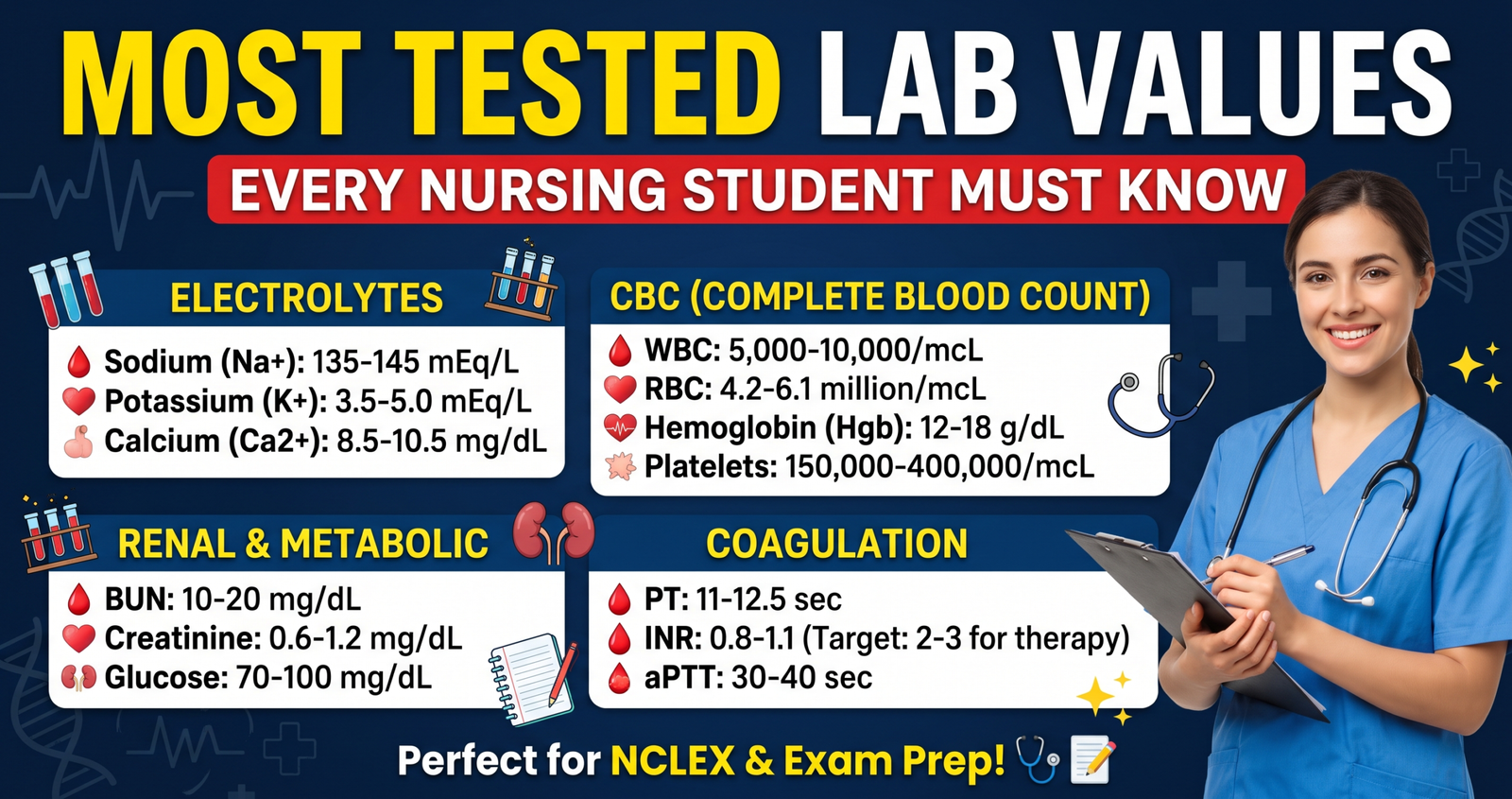
Master the Most Tested Lab Values Every Nursing Student Must Know. Maximum examined lab values each nursing scholar must know, with ordinary levels, scientific meaning, and reminiscence guidelines to ace the NCLEX.
Explore Most Tested Lab Values Every Nursing Student Must Know
Introduction
Lab values seem on nursing exams, in scientific rotations, and on the bedside each unmarried day. Learning the maximum examined lab values is one of the highest-go back investments you may make on your education. In this guide, you’ll research the important thing levels, what bizarre effects mean, and a way to do not forget them with out feeling overwhelmed.
Many college students attempt to memorize lengthy charts and neglect about them inside days. However, linking every wide variety to a scientific tale makes remember a way easier. Let`s get started.
Why Lab Values Matter for Nurses
Labs Drive Clinical Decisions
Nurses use lab effects to identify early adjustments, query orders, and guard customers from harm. For example, a low potassium stage earlier than a digoxin dose adjustment what you do next. Therefore, knowledge labs is a protection skill, now no longer simply an examination skill.
How the NCLEX Tests Labs
The examination hardly ever asks for more than a few in isolation. Instead, it offers a client, a lab result, and a choice approximately what the nurse must do first. As a result, you want each the ordinary variety and the scientific meaning.
A Note on Reference Ranges
Ranges range barely among laboratories, so continually test your facility’s reference values. The levels underneath replicate the ones usually used for grownup customers in nursing education. Consequently, deal with them as examine anchors in preference to generic rules.
Electrolytes: The Highest-Yield Group
Potassium and Sodium
Potassium usually runs from 3.5 to 5.0 mEq/L, and each extremes threaten the heart. Low tier’s purpose weak spot and dysrhythmias, while excessive tiers produce peaked T waves and life-threatening rhythms. Sodium levels from a hundred thirty-five to one hundred forty-five mEq/L, and bizarre values regularly purpose neurological adjustments which include confusion or seizures.
Calcium and Magnesium
Calcium usually measures 8.5 to 10.5 mg/dL. Low calcium reasons tetany, superb Chvostek and Trousseau signs, and muscle cramps, whilst excessive calcium reasons weak spot and kidney stones. Magnesium falls among 1.5 and 2.5 mEq/L, and coffee tiers regularly accompany low potassium and calcium.
Phosphorus and Chloride
Phosphorus generally levels from 3.0 to 4.5 mg/dL and actions withinside the contrary route of calcium. Chloride runs from ninety-eight to 106 mEq/L and commonly follows sodium. Notably, those seem much less frequently than potassium and sodium, so prioritize accordingly.
Blood Counts and Clotting Studies
Red Cells, Haemoglobin, and Haematocrit
Normal haemoglobin is 12 to 16 g/dL in girls and 14 to 18 g/dL in men. Haematocrit is set 3 instances the haemoglobin fee. Low effects advocate anaemia or blood loss, so verify for fatigue, pallor, and tachycardia.
White Blood Cells and Platelets
A white blood mobiliary rely of 5,000 to 10,000/mm³ is typical, and extended counts frequently sign infection. Meanwhile, platelets variety from 150,000 to 400,000/mm³, and counts underneath 50,000 boost bleeding risk. Therefore, institute bleeding precautions whilst platelets are dangerously low.
PT, INR, and aPTT
Warfarin is monitored with the INR, commonly focused at 2 to 3, and its antidote is diet K. Heparin is monitored with the aPTT, with a healing intention of 1.5 to 2.5 instances the control, and its antidote is protamine sulphate. Pairing every drug with its lab and antidote earns dependable points.
Kidney, Liver, and Metabolic Markers
BUN and Creatinine
BUN commonly measures 10 to 20 mg/dL, and creatinine runs approximately 0.6 to 1.2 mg/dL. Creatinine is the extra unique marker of kidney function; due to the fact BUN rises with dehydration and excessive protein intake. Consequently, a growing creatinine needs to set off you to check nephrotoxic medications.
Glucose and HbA1c
Fasting glucose commonly levels from 70 to a hundred mg/dL. The HbA1c displays common glucose over 3 months, and a fee of 6.5% or better helps a diabetes diagnosis. Likewise, don’t forget that hypoglycaemia under 70 mg/dL desires instant treatment.
Liver Enzymes and Ammonia
AST and ALT upward thrust with liver injury, with ALT being extra liver unique. Ammonia ranges growth in liver failure and might purpose hepatic encephalopathy. Therefore, anticipate confusion and a flapping tremor whilst ammonia climbs.

Cardiac Markers, Drug Levels, and Blood Gases
Troponin and BNP
Troponin is the maximum touchy and unique marker for myocardial injury, and any elevation is significant. BNP rises in coronary heart failure, so an excessive fee helps that diagnosis. In contrast, an everyday BNP makes coronary heart failure unlikely.
Therapeutic Drug Levels
Digoxin has a healing variety of 0.5 to 2.0 ng/mL. Lithium stages from 0.6 to 1.2 mEq/L, and toxicity can increase fast above this variety. Additionally, continually test those stages earlier than giving a dose whilst toxicity is suspected.
Arterial Blood Gases
Normal pH is 7.35 to 7.45, PaCO₂ is 35 to 45 mmHg, and HCO₃ is 22 to 26 mEq/L. Use the ROME technique: respiration opposite, metabolic equal. Thus, a low pH with an excessive PaCO₂ suggests respiration acidosis.
Study Tips to Remember Lab Values
Group Labs with the aid of using System
Organize values with the aid of using frame device in place of alphabetically. This technique connects numbers to associated sicknesses and nursing actions. As a result, you consider the tale and the range together.
Use Flashcards and Spaced Repetition
Quiz your self with flashcards that display the lab call on one aspect and the variety plus a key join up the different. Review them each day in quick sessions. Over time, repetition actions the records into long-time period memory.
Practice With Clinical Scenarios
Finally, exercise questions that pair a lab fee with a customer situation. Ask what the result means, what you verify next, and whilst to name the provider. This dependency builds the judgment the examination rewards.
Most Tested Lab Values Every Nursing Student Must Know
Why Lab Values Matter
Lab values are among the most heavily tested topics in nursing exams and on the NCLEX. Questions rarely ask you to recite a number. Instead, they ask you to spot an abnormal value, link it to a condition or drug, and choose the right nursing action.
This guide covers the values that come up most often: normal adult ranges, what high and low results mean, and the key nursing actions for each.
Note: Reference ranges vary slightly between laboratories and textbooks. In clinical practice, always follow your institution’s ranges and policies. The values here are the commonly used adult ranges for exam preparation.
1. Electrolytes
Electrolytes are the single most tested lab group. Potassium alone appears in countless exam questions because both high and low levels can cause fatal heart rhythms.
| Electrolyte | Normal range | Low (hypo-) signs | High (hyper-) signs | Key nursing points |
|---|---|---|---|---|
| Potassium (K⁺) | 3.5–5.0 mEq/L | Muscle weakness, leg cramps, flat T waves, U waves, constipation | Tall peaked T waves, wide QRS, muscle weakness, bradycardia, cardiac arrest | Hold digoxin if K⁺ is low (toxicity risk). Never give IV K⁺ as a push or bolus. Loop and thiazide diuretics lower K⁺; ACE inhibitors and spironolactone raise it. |
| Sodium (Na⁺) | 135–145 mEq/L | Confusion, headache, seizures, nausea | Thirst, dry mucous membranes, restlessness, agitation | Na⁺ problems show up as neurological changes. Correct slowly, as rapid correction of low Na⁺ can cause osmotic demyelination. Seizure precautions. |
| Calcium (Ca²⁺) | 8.5–10.5 mg/dL | Positive Chvostek’s and Trousseau’s signs, tetany, numbness, prolonged QT | Muscle weakness, kidney stones, constipation, confusion, shortened QT | Low Ca²⁺ is a risk after thyroid or parathyroid surgery. Keep IV calcium gluconate available. |
| Magnesium (Mg²⁺) | 1.5–2.5 mEq/L | Tremors, hyperreflexia, seizures, torsades de pointes | Hyporeflexia, respiratory depression, hypotension, bradycardia | During magnesium sulfate therapy (preeclampsia), monitor reflexes and respirations. Antidote: calcium gluconate. Low Mg²⁺ often travels with low K⁺. |
| Chloride (Cl⁻) | 96–106 mEq/L | Usually seen with metabolic alkalosis (vomiting, NG suction) | Usually seen with metabolic acidosis | Tends to move in the same direction as sodium. |
| Phosphorus (PO₄³⁻) | 2.5–4.5 mg/dL | Muscle weakness, respiratory failure (refeeding syndrome) | Seen in kidney failure; causes low calcium | Phosphorus and calcium have an inverse relationship. Phosphate binders are given with meals in CKD. |
Exam tip: Calcium and magnesium both affect nerve and muscle excitability. Low levels make muscles twitchy (tetany, hyperreflexia); high levels make them sluggish (weakness, hyporeflexia).
2. Complete Blood Count (CBC)
The CBC is tested mainly through infection risk, bleeding risk, and anemia. Expect questions on neutropenic and bleeding precautions.
| Test | Normal range | Low means | High means | Key nursing points |
|---|---|---|---|---|
| Hemoglobin (Hgb) | Male 14–18 g/dL; Female 12–16 g/dL | Anemia, blood loss | Dehydration, polycythemia | Watch for fatigue, pallor, tachycardia. A transfusion is often considered when Hgb falls below 7 g/dL. |
| Hematocrit (Hct) | Male 42–52%; Female 37–47% | Anemia, blood loss, fluid overload | Dehydration | Roughly 3 × the Hgb value. A high Hct with high BUN points to dehydration. |
| WBC | 5,000–10,000/mm³ | Leukopenia: infection risk (chemotherapy, immunosuppression) | Infection, inflammation, leukemia | ANC below 1,000 = neutropenic precautions: private room, hand hygiene, no fresh flowers or raw fruit. |
| Platelets | 150,000–400,000/mm³ | Thrombocytopenia: bleeding risk | Clotting risk | Below 50,000 = bleeding precautions: soft toothbrush, electric razor, no IM injections, no aspirin. Watch for heparin-induced thrombocytopenia (HIT). |
| RBC | Male 4.7–6.1 million/mm³; Female 4.2–5.4 million/mm³ | Anemia | Polycythemia | Read together with Hgb and Hct. |
3. Kidney Function
Kidney values tell you whether the body is clearing waste. Exams link them to dehydration, kidney injury, and drugs that are cleared by the kidneys or harm them.
| Test | Normal range | What abnormal results mean | Key nursing points |
|---|---|---|---|
| BUN | 10–20 mg/dL | High: dehydration, kidney disease, GI bleeding, high-protein intake | BUN can rise from dehydration alone, so it is less specific than creatinine. |
| Creatinine | Male 0.6–1.2 mg/dL; Female 0.5–1.1 mg/dL | High: reduced kidney function | The best single blood marker of kidney function. Check before giving contrast dye, metformin, aminoglycosides (gentamicin), or vancomycin. |
| BUN:creatinine ratio | About 10:1 to 20:1 | Above 20:1 suggests dehydration or a pre-renal cause | Helps tell dehydration apart from intrinsic kidney damage. |
| eGFR | Above 90 mL/min/1.73 m² | Below 60 for 3 months or more indicates chronic kidney disease | Used to stage CKD and adjust drug doses. |
4. Blood Glucose and HbA1c
Glucose questions focus on telling hypoglycemia from hyperglycemia and acting fast.
| Test | Normal range | Key points |
|---|---|---|
| Fasting blood glucose | 70–100 mg/dL | 100–125 = prediabetes; 126 or higher on two tests = diabetes. |
| Hypoglycemia | Below 70 mg/dL | Shaky, sweaty, confused, tachycardic. Rule of 15: give 15 g fast-acting carbohydrate, recheck in 15 minutes. Unconscious patient: IV dextrose or IM glucagon, nothing by mouth. |
| HbA1c | Below 5.7% | 5.7–6.4% = prediabetes; 6.5% or higher = diabetes. Reflects the average glucose over about 3 months. The usual target for diabetic patients is below 7%. |
Exam tip: “Cold and clammy, need some candy; hot and dry, sugar high.” When unsure whether a diabetic patient is high or low, treat as hypoglycemia, because low glucose harms the brain faster.
5. Coagulation Studies
These are almost always tested alongside anticoagulants. The key is knowing which test monitors which drug.
| Test | Normal range | Therapeutic range | Monitors | Antidote |
|---|---|---|---|---|
| PT | 11–13.5 seconds | 1.5–2 × control | Warfarin | Vitamin K |
| INR | 0.8–1.1 | 2–3 for most conditions (often 2.5–3.5 for mechanical heart valves) | Warfarin | Vitamin K |
| aPTT | 30–40 seconds | 1.5–2.5 × control (about 46–70 seconds, varies by lab) | Unfractionated IV heparin | Protamine sulfate |
Memory tip: “WarP and HepT” — Warfarin goes with PT/INR; Heparin goes with aPTT. Low-molecular-weight heparin (enoxaparin) does not usually need aPTT monitoring.
Nursing points: An INR above the therapeutic range means bleeding risk. Hold the dose and notify the provider. Teach patients on warfarin to keep vitamin K intake (green leafy vegetables) consistent rather than avoiding it.
6. Arterial Blood Gases (ABGs)
ABG interpretation is a favourite exam skill. Learn the ranges, then use a step-by-step method.
| Value | Normal range | Meaning |
|---|---|---|
| pH | 7.35–7.45 | Below 7.35 = acidosis; above 7.45 = alkalosis |
| PaCO₂ | 35–45 mmHg | The respiratory (lung) component. Acts as an acid. |
| HCO₃⁻ | 22–26 mEq/L | The metabolic (kidney) component. Acts as a base. |
| PaO₂ | 80–100 mmHg | Oxygen level in arterial blood |
| SaO₂ | 95–100% | Oxygen saturation |
Quick interpretation method (ROME)
Respiratory Opposite: pH and PaCO₂ move in opposite directions. Metabolic Equal: pH and HCO₃⁻ move in the same direction.
- Check the pH: acidosis or alkalosis?
- Check PaCO₂: if it moves opposite to pH, the cause is respiratory.
- Check HCO₃⁻: if it moves with pH, the cause is metabolic.
- Check for compensation: if pH is back within 7.35–7.45 but the other values are abnormal, it is fully compensated.
| Condition | pH | PaCO₂ | HCO₃⁻ | Common causes |
|---|---|---|---|---|
| Respiratory acidosis | ↓ | ↑ | Normal or ↑ | COPD, opioid overdose, hypoventilation |
| Respiratory alkalosis | ↑ | ↓ | Normal or ↓ | Anxiety, hyperventilation, pain |
| Metabolic acidosis | ↓ | Normal or ↓ | ↓ | DKA, diarrhea, kidney failure |
| Metabolic alkalosis | ↑ | Normal or ↑ | ↑ | Vomiting, NG suction, excess antacids |
7. Cardiac Markers, Drug Levels and Other High-Yield Values
Cardiac markers
| Test | Normal range | Key points |
|---|---|---|
| Troponin I / T | Below the lab’s 99th percentile (often below 0.04 ng/mL for conventional assays) | The most specific marker of heart muscle damage. Rises 3–6 hours after an MI and stays raised for up to about 2 weeks. Drawn serially. |
| BNP | Below 100 pg/mL | Raised in heart failure. Used to tell heart failure apart from other causes of shortness of breath. |
| CK-MB | Below about 5 ng/mL (varies by lab) | Returns to normal within 2–3 days, so it helps detect a second MI. |
Therapeutic drug levels
| Drug | Therapeutic range | Signs of toxicity | Key points |
|---|---|---|---|
| Digoxin | 0.5–2.0 ng/mL (often 0.5–0.9 in heart failure) | Nausea, vomiting, visual changes (yellow-green halos), bradycardia | Check apical pulse for a full minute; hold if below 60 bpm in adults. Low K⁺ increases toxicity. Antidote: digoxin immune fab. |
| Lithium | 0.6–1.2 mEq/L | Above 1.5: tremor, vomiting, diarrhea, confusion | Narrow range. Keep sodium and fluid intake steady, as dehydration or low sodium raises lithium levels. |
| Phenytoin | 10–20 mcg/mL | Nystagmus, ataxia, slurred speech | Teach good oral hygiene (gum overgrowth). |
| Theophylline | 10–20 mcg/mL | Tachycardia, restlessness, seizures | Narrow therapeutic window. |
| Vancomycin trough | Commonly 10–20 mcg/mL (many hospitals now use AUC-based dosing) | Nephrotoxicity, ototoxicity | Draw the trough just before the next dose. Watch creatinine. |
Other values worth knowing
| Test | Normal range | Key points |
|---|---|---|
| Albumin | 3.5–5.0 g/dL | Low: malnutrition, liver disease, poor wound healing, edema. |
| Total cholesterol | Below 200 mg/dL | LDL (“bad”) below 100 mg/dL; HDL (“good”) 40 mg/dL or higher in men, 50 or higher in women; triglycerides below 150 mg/dL. |
| Ammonia | 15–45 mcg/dL (varies by lab) | High in liver failure; causes confusion and asterixis. Treated with lactulose. |
| Urine specific gravity | 1.005–1.030 | High: dehydration. Low: overhydration or diabetes insipidus. |
Quick Reference and Study Tips
Keep this one-page summary for last-minute revision.
| Lab | Normal range |
|---|---|
| Potassium | 3.5–5.0 mEq/L |
| Sodium | 135–145 mEq/L |
| Calcium | 8.5–10.5 mg/dL |
| Magnesium | 1.5–2.5 mEq/L |
| Hemoglobin | M 14–18 / F 12–16 g/dL |
| WBC | 5,000–10,000/mm³ |
| Platelets | 150,000–400,000/mm³ |
| BUN | 10–20 mg/dL |
| Creatinine | 0.6–1.2 mg/dL |
| Fasting glucose | 70–100 mg/dL |
| HbA1c | Below 5.7% |
| INR (on warfarin) | 2–3 |
| pH | 7.35–7.45 |
| PaCO₂ | 35–45 mmHg |
| HCO₃⁻ | 22–26 mEq/L |
| Digoxin | 0.5–2.0 ng/mL |
| Lithium | 0.6–1.2 mEq/L |
How to study lab values
- Learn the patterns, not just the numbers. Know what each abnormal value looks like in a patient.
- Link labs to drugs. Digoxin and potassium, warfarin and INR, heparin and aPTT, lithium and sodium.
- Prioritise life-threatening values. Potassium, glucose, pH and platelets are the ones most likely to need immediate action.
- Think “what would the nurse do?” Hold the drug, notify the provider, start monitoring, or apply precautions.
- Practise with questions. Applying lab values to case-based questions builds recall far better than memorising lists.
Mastering these values will help you answer exam questions with confidence and, more importantly, keep your patients safe in clinical practice.
Conclusion
You do now no longer want to memorize each lab withinside the hospital. Instead, consciousness on electrolytes, blood counts, clotting studies, kidney and liver markers, cardiac markers, and blood gases. Mastering the maximum generally examined lab values will enhance your examination ratings and make you a more secure nurse.
Did this manual help? Share it with a examine partner, depart a remark with the lab fee you war with maximum, and discover our different nursing examine sources to preserve growing.
FAQs
What is the maximum generally examined lab values at the NCLEX?
Potassium, sodium, calcium, haemoglobin, platelets, INR, aPTT, BUN, creatinine, glucose, and arterial blood gases seem maximum often. Drug stages including digoxin and lithium also are frequent. Focus on those first, then extend your review.
How can nursing students memorize lab values quickly?
Group values via way of means of frame machine and hyperlink everyone to a medical signal or nursing action. Flashcards and spaced repetition make evaluation efficient. Practice scenario-primarily based totally inquiries to make the numbers meaningful.
Do I want to recognize precise ordinary tiers for the NCLEX?
Yes, for the maximum normally examined lab values, you ought to recognize the tiers well. However, the examination specializes in what a strange result way and what the nurse ought to do. Understanding each element is the most secure strategy.
Which lab fee is maximum critical for nurses to monitor?
Potassium is frequently taken into consideration one of the maximum important, due to the fact strange ranges can reason deadly dysrhythmias. Troponin and INR also are excessive priority. Always comply with your facility`s protocols for reporting important values.
Read More:
https://nurseseducator.com/didactic-and-dialectic-teaching-rationale-for-team-based-learning/
https://nurseseducator.com/high-fidelity-simulation-use-in-nursing-education/
First NCLEX Exam Center In Pakistan From Lahore (Mall of Lahore) to the Global Nursing
Categories of Journals: W, X, Y and Z Category Journal In Nursing Education
AI in Healthcare Content Creation: A Double-Edged Sword and Scary
Social Links:
https://www.facebook.com/nurseseducator/
https://www.instagram.com/nurseseducator/
https://www.pinterest.com/NursesEducator/
https://www.linkedin.com/company/nurseseducator/
https://www.linkedin.com/in/afzalaldin/
https://www.researchgate.net/profile/Afza-Lal-Din
https://scholar.google.com/citations?hl=en&user=F0XY9vQAAAAJ
https://orcid.org/0000-0001-6976-9158