
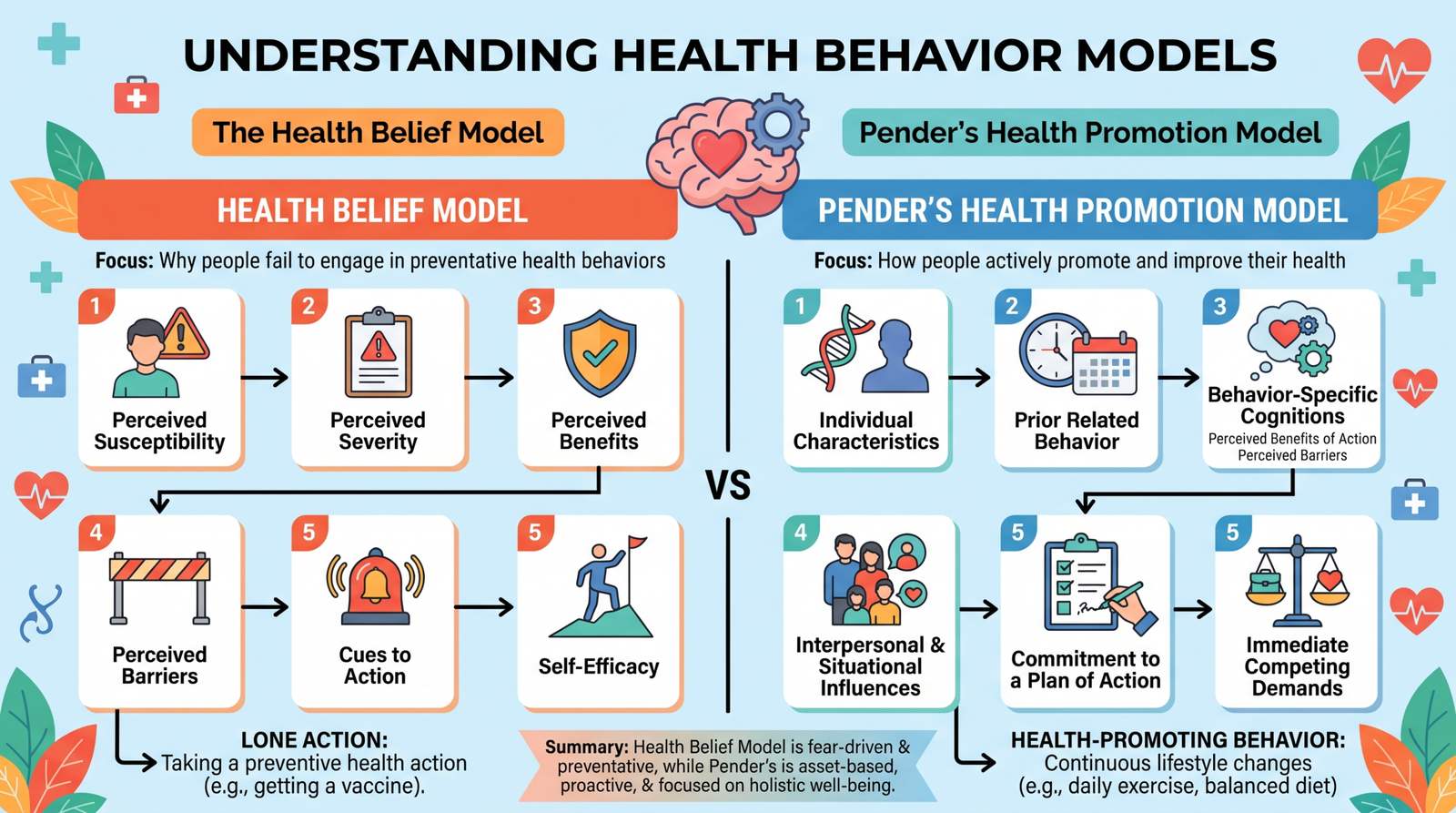
Understand the Health Belief Model and Pender’s Health Promotion Model. Health Belief Model and Pender`s Health Promotion Model: key constructs, differences, and the way nurses observe them in affected person teaching.
What is Health Belief Model and Pender’s Health Promotion Model 2026
Introduction
Why does one affected person observe each guidance whilst any other ignores the equal advice? The Health Belief Model and Pender’s Health Promotion Model assist nurses’ solution that question. Both frameworks explain why humans pick out wholesome behaviours, and each manual affected person teaching, network programs, and examination answers.
In this manual, you’ll research the middle thoughts of every version and the way they differ. Moreover, you’ll see sensible examples that display the way to use them in actual care.
Why Health Behaviour Models Matter in Nursing
From Information to Action
Giving sufferers data isn’t always enough, due to the fact information on my own not often adjustments behaviour. People act primarily based totally on their ideals, feelings, and circumstances. Therefore, fashions assist you recognize what’s certainly riding an affected person’s choices.
Where These Models Fit
Both fashions help fitness promoting and ailment prevention, which might be primary to network and public fitness nursing. They additionally seem frequently on exams. As a result, studying them nicely can pay off in each exercise and testing.
The Health Belief Model
Origins and Core Idea
Social psychologists withinside the US Public Health Service evolved the Health Belief Model (HBM) withinside the 1950s. They desired to explain why humans did now no longer be part of screening and vaccination programs. The primary concept is that humans act after they accept as true with, they’re at danger, the danger is serious, and the movement will assist at an affordable cost.
The Main Constructs
The version consists of numerous ideals that form behaviour. Learn everyone with an easy example.
| Construct | Meaning | Example |
| Perceived susceptibility | Belief about the chance of getting a condition | “I could develop diabetes because my parents have it.” |
| Perceived severity | Belief about how serious the condition is | “Diabetes could damage my kidneys and eyes.” |
| Perceived benefits | Belief that the action works | “Walking daily can lower my blood sugar.” |
| Perceived barriers | Obstacles to acting | “I have no safe place to walk.” |
| Cues to action | Triggers that prompt behaviour | A reminder call or a relative’s diagnosis |
| Self-efficacy | Confidence in one’s ability to act | “I believe I can stick to this plan.” |
Researchers delivered self-efficacy later, considering that self assurance strongly predicts behaviour. In addition, enhancing elements which includes age, culture, education, and beyond enjoy impact those ideals.
Applying the HBM in Practice
Imagine an affected person who refuses a flu vaccine. You discover their ideals and locate they sense healthy, so perceived susceptibility is low. They additionally worry facet effects, so perceived obstacles are high.
You can then deal with every perception directly. Explain actual risks, describe benefits, accurate myths, and provide a handy vaccination time. Consequently, your coaching turns into centred as opposed to generic.
Pender`s Health Promotion Model
Origins and Core Idea
Nola Pender added the Health Promotion Model (HPM) in 1982 and later revised it. Unlike the HBM, it specializes in transferring towards wellness in place of keeping off illness. Pender careworn that the version does now no longer depend upon worry or risk as a motivator.
The version explains how private elements, thoughts, and emotions integrate to supply health-selling behaviour. Moreover, it acknowledges that competing needs can disrupt even robust intentions.
The Main Components
The HPM has 3 essential corporations of ideas. Each one provides a layer to the explanation.
| Component | What It Includes |
| Individual characteristics and experiences | Prior related behaviour and personal factors (biological, psychological, sociocultural) |
| Behaviour-specific cognitions and affect | Perceived benefits, perceived barriers, perceived self-efficacy, activity-related affect, interpersonal influences, and situational influences |
| Behavioural outcome | Commitment to a plan of action, immediate competing demands and preferences, and the health-promoting behaviour itself |
Key Concepts Explained
Activity-associated influence manner the emotions someone has before, during, and after a behaviour. Someone who enjoys dancing is much more likely to hold exercise than a person who unearths it unpleasant. Interpersonal impacts encompass family, peers, and fitness professionals, whilst situational impacts encompass the environment, together with get entry to secure parks.
Commitment to a course of action manner the man or woman decides when, where, and a way to act. However, competing needs together with paintings or childcare can also additionally interrupt the plan. Therefore, nurses assist sufferers put together for limitations in advance.
Applying the HPM in Practice
Consider an affected person who desires to begin exercise however continues quitting. You overview previous experience, which indicates beyond accidents and occasional confidence. You additionally examine that the affected person enjoys organization activities.
Together, you construct a plan round strolling with a neighbour 3 mornings a week. As a result, you improve self-efficacy, social support, and entertainment all at once.
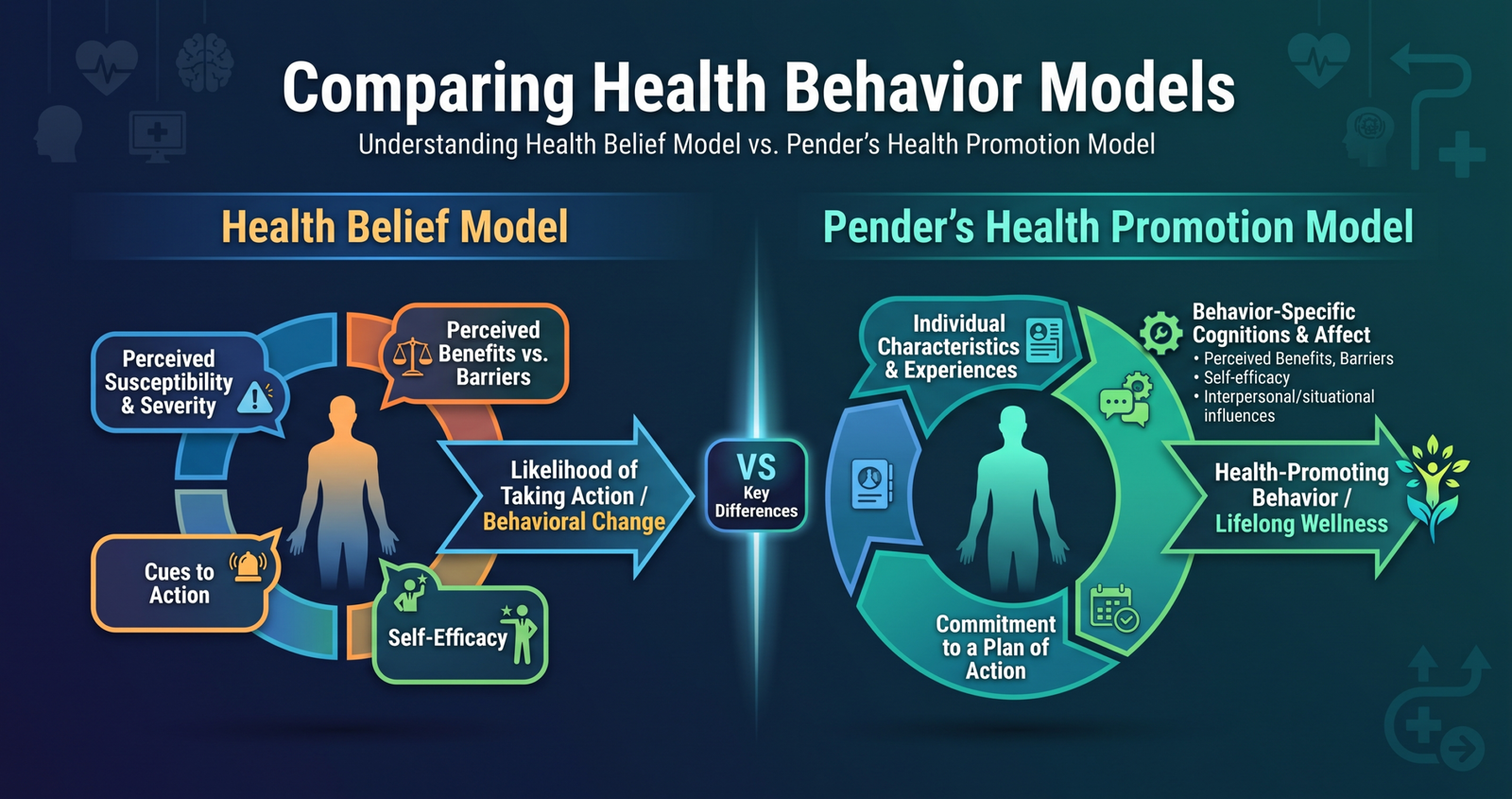
Health Belief Model and Pender`s Health Promotion Model: Key Differences
Side-by-Side Comparison
Both fashions percentage thoughts together with perceived benefits, barriers, and self-efficacy. Even so, they fluctuate in cognizance and scope.
| Feature | Health Belief Model | Pender’s Health Promotion Model |
| Main focus | Avoiding illness | Pursuing well-being |
| Motivator | Perceived threat | Positive goals and competence |
| Key unique ideas | Susceptibility, severity, cues to action | Activity-related affect, interpersonal and situational influences |
| Best use | Screening, vaccination, adherence | Lifestyle change and wellness programs |
Choosing the Right Model
Use the HBM whilst you want to recognize why an affected person avoids a preventive action, consisting of a mammogram. Use the HPM whilst you need to assist ongoing healthful living, consisting of nutrients and activity. In many cases, you could integrate each for a fuller picture.
Tips for Using These Models in Patient Teaching
Ask Before You Teach
Begin with open questions on the affected person`s beliefs, worries, and dreams. Their solutions display which assemble wishes attention. Furthermore, respectful listening builds trust.
Match Your Teaching to the Barrier
Address the precise impediment in preference to repeating fashionable advice. For value obstacles, percentage low-value options. For self belief obstacles, set small, potential dreams and have fun every success.
Use Teach-Back and Follow-Up
Ask sufferers to explain the plan of their very own words. Then timetable follow-up to check development and regulate the plan. Consequently, you switch a one-time communication into ongoing assist.
Conclusion
The Health Belief Model and Pender’s Health Promotion Model deliver nurses realistic lenses for knowledge behaviour. The HBM explains how perceived danger and obstacles form action, at the same time as the HPM highlights self belief, feelings, and social assist in pursuing well-being. Learn the constructs, exercise with actual affected person scenarios, and fit your coaching to what all people believes and wishes.
If this manual helped, percentage it together along with your look at group, go away a remark with the version you locate trickiest, and discover greater nursing look at sources on our platform.
FAQs
What is the Health Belief Model in nursing?
The Health Belief Model explains why humans take or keep away from fitness moves primarily based totally on their beliefs. Its important thoughts consist of perceived susceptibility, severity, benefits, barriers, cues to action, and self-efficacy. Nurses use it to plot centred coaching and prevention programs.
What is Pender`s Health Promotion Model?
Pender’s Health Promotion Model explains how private factors, thoughts, and emotions result in fitness-selling behaviour. It specializes in well being in preference to worry of contamination. Key ideas consist of self-efficacy, interest-associated affect, and dedication to a plan of action.
What is the primary distinction among the Health Belief Model and Pender’s Health Promotion Model?
The HBM facilities on fending off contamination thru perceived threat. Pender’s version facilities on pursuing health thru wonderful motivation and competence. Pender’s version additionally provides impacts together with emotions approximately an interest and the encompassing environment.
How do nurses use the Health Belief Model and Pender’s Health Promotion Model?
Nurses use them to evaluate why sufferers act or do now no longer act, then tailor coaching to the precise barrier or motivator. They observe them in vaccination, screening, way of life counselling, and network programs. Using each fashion frequently offers a greater entire picture.
Read More:
https://nurseseducator.com/didactic-and-dialectic-teaching-rationale-for-team-based-learning/
https://nurseseducator.com/high-fidelity-simulation-use-in-nursing-education/
First NCLEX Exam Center In Pakistan From Lahore (Mall of Lahore) to the Global Nursing
Categories of Journals: W, X, Y and Z Category Journal In Nursing Education
AI in Healthcare Content Creation: A Double-Edged Sword and Scary
Social Links:
https://www.facebook.com/nurseseducator/
https://www.instagram.com/nurseseducator/
https://www.pinterest.com/NursesEducator/
https://www.linkedin.com/company/nurseseducator/
https://www.linkedin.com/in/afzalaldin/
https://www.researchgate.net/profile/Afza-Lal-Din
https://scholar.google.com/citations?hl=en&user=F0XY9vQAAAAJ
https://orcid.org/0000-0001-6976-9158