

Learn How to Write a Nursing Care Plan Template and Example. A way to write a nursing care plan step with the aid of using step, with an easy template, NANDA-fashion diagnoses, SMART goals, and a Laborde example.
Explore How to Write a Nursing Care Plan Template and Example
Introduction
A clean care plan shape can sense overwhelming, specially for the duration of your first scientific rotation. Knowing a way to write a nursing care plan turns that clean web page right into a clean roadmap for safe, affected person-focused care. Once you recognize the structure, the procedure turns into logical or even satisfying.
In this manual, you may examine every step of the procedure, see a reusable template, and stroll thru a whole example. Moreover, you may choose up hints that assist you keep away from the maximum not unusual place pupil mistakes.
What Is a Nursing Care Plan?
Definition and Purpose
A nursing care plan is a written manual that outlines an affected person`s problems, goals, and the nursing moves had to attain the ones goals. It maintains all and sundry at the care group running closer to the equal outcomes. Therefore, it improves communication, continuity, and affected person safety.
Care plans additionally display your scientific reasoning. Instructors and employers use them to look the way you think, now no longer simplest what you do.
The Link to the Nursing Process
Every care plan follows the nursing procedure, referred to as ADPIE: evaluation, diagnosis, planning, implementation, and evaluation. Each step feeds the next, so skipping one weakens the entire plan. As a result, studying ADPIE is the important thing to writing robust plans.
Step-with the aid of using-Step: How to Write a Nursing Care Plan
Step 1: Assessment
Start with the aid of using amassing subjective data, that’s what the affected person tells you, and goal data, that’s what you look at or measure. This consists of essential signs, bodily findings, lab results, history, and medications. In addition, observe the affected person’s goals, culture, and help system.
Thorough evaluation protects you from constructing a plan on guesses. Always cluster associated cues together, which includes shortness of breath, crackles, and occasional oxygen saturation.
Step 2: Nursing Diagnosis
Next, interpret your statistics and call the affected person`s issues. A nursing prognosis isn’t the same as a clinical prognosis, as it describes the affected person’s reaction to a condition. Many applications use the NANDA-I format, which regularly consists of the problem, the associated factor, and the evidence.
A not unusual place shape is problem, associated with cause, as evidenced via way of means of symptoms and symptoms and symptoms. For example, “Impaired fueloline change associated with fluid withinside the alveoli as evidenced via way of means of crackles and oxygen saturation of 88%.”
Prioritize your diagnoses the use of the ABCs and Maslow’s hierarchy. Life-threatening issues come first.
Step 3: Planning With SMART Goals
Now set desires, additionally known as predicted outcomes. Strong desires are SMART, which means specific, measurable, achievable, relevant, and time bound. Instead of writing “affected person will breathe better,” write “affected person will hold an oxygen saturation of 92% or better on room air inside 24 hours.”
Include each short-time period and long-time period desires while appropriate. Furthermore, contain the affected person in purpose setting, because human beings observe plans, they helped create.
Step 4: Implementation of Interventions
Then listing the moves, you may take to attain every purpose. Interventions must be specific, evidence-based, and inside your scope of practice. In addition, write an intent for everyone, and is the reason why the movement works.
Include unbiased moves, together with positioning and teaching, and collaborative moves, together with giving ordered medications. Be clean approximately how regularly you may carry out every movement.
Step 5: Evaluation
Finally, determine whether the desires have been met, in part met, or now no longer met. Compare the affected person’s cutting-edge repute together along with your measurable outcomes. If a purpose isn’t always met, revise the plan, because care plans are dwelling documents.
Evaluation closes the loop and begins off evolved a brand-new cycle of reassessment.
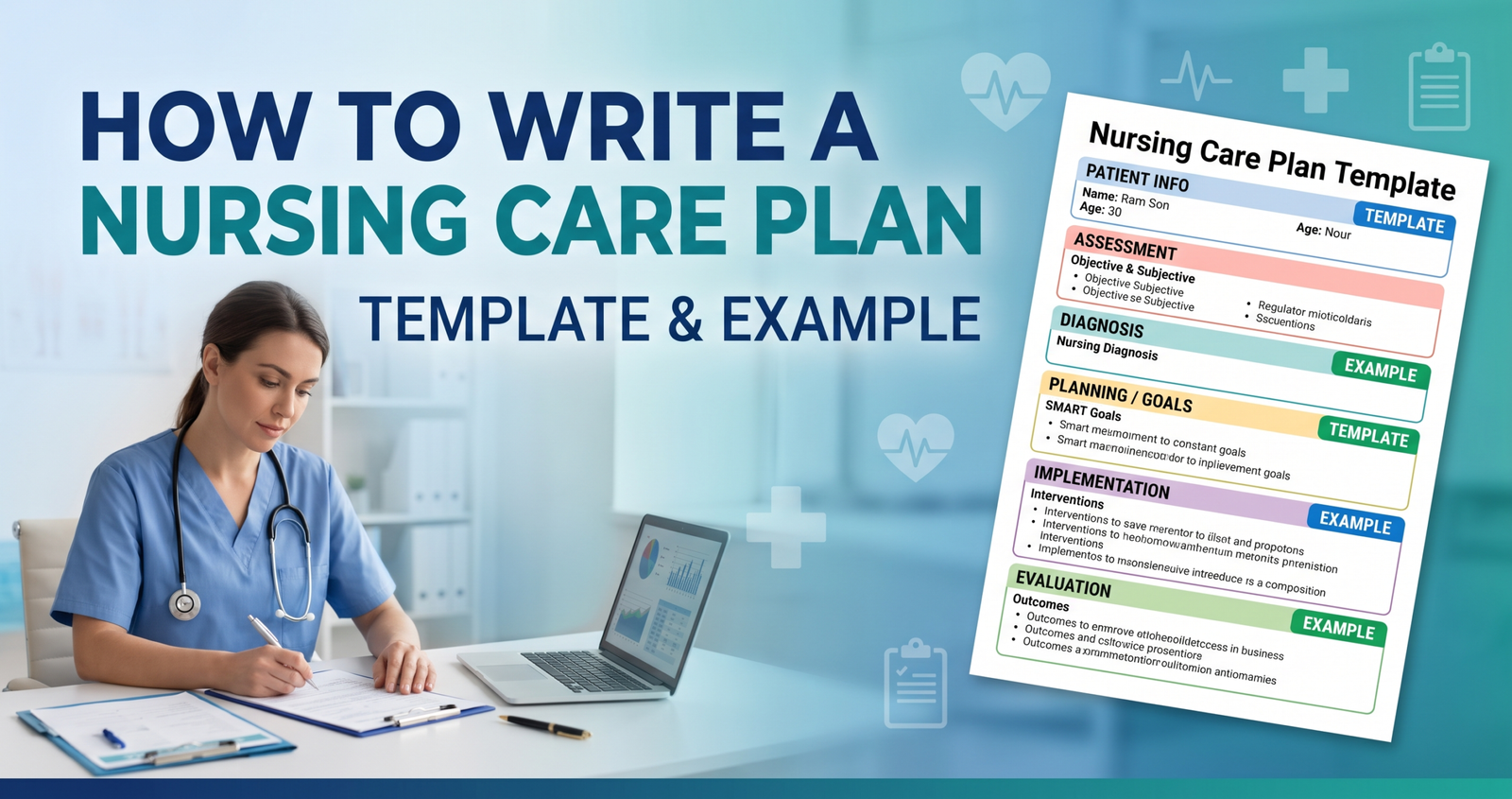
A Simple Nursing Care Plan Template
The Core Format
Most care plans fit the same basic layout. You can copy this structure into your notes or clinical forms.
| Section | What to Write |
| Assessment data | Subjective and objective findings that support the problem |
| Nursing diagnosis | Problem, related factor, and evidence |
| Goal / expected outcome | A SMART statement with a time frame |
| Interventions | Specific nursing actions with frequency |
| Rationale | The reason each intervention helps |
| Evaluation | Whether the goal was met, with supporting data |
Tips for Using the Template
Keep every container brief and precise and use affected person-particular information as opposed to time-honoured phrases. Also, quantity your interventions so they’re smooth to follow. Because teachers regularly look at for logical flow, make certain every aim absolutely suits a diagnosis.
Worked Example: Nursing Care Plan for Fluid Volume Excess
The Patient Scenario
A 70-year-antique affected person with coronary heart failure reviews shortness of breath and swollen ankles. The evaluation suggests a weight benefit of four kilos in 3 days, bilateral crackles, 2+ pitting edema, and an oxygen saturation of 91% on room air. Vital symptoms and symptoms display a coronary heart price of 102 and a respiration price of 24.
The Completed Care Plan
| Section | Example |
| Assessment data | Dyspnea, crackles, edema, weight gain of 4 lb, SpO2 91% |
| Nursing diagnosis | Excess fluid volume related to compromised regulatory mechanisms as evidenced by edema, crackles, and weight gain |
| Goal | Patient will show clear lung sounds, reduced edema, and a weight loss of 2 lb within 48 hours |
| Interventions | Weigh daily at the same time; record intake and output; raise head of bed; give diuretic as ordered; assess lung sounds every 4 hours; teach sodium restriction |
| Rationale | Daily weights and I&O track fluid status; upright position eases breathing; diuretics remove excess fluid; sodium restriction reduces fluid retention |
| Evaluation | After 48 hours, lungs clear, edema 1+, weight down 2.5 lb: goal met |
Why This Example Works
Notice how the prognosis makes use of proof from the assessment, and the aim is measurable and time bound. Each intervention connects to a clean rationale. Consequently, any nurse may want to choose up this plan and recognize precisely what to do.
Common Mistakes and How to Avoid Them
Confusing Medical and Nursing Diagnoses
A clinical prognosis, together with coronary heart failure, names the disease. A nursing prognosis, together with extra fluid volume, names the affected person`s response. Therefore, continually base your care plan on the second one kind.
Writing Vague Goals and Interventions
Statements together with “screen affected person” or “affected person will sense better” can’t be measured. Instead, country what you’ll screen, how often, and what result you expect. Specific wording makes your plan less complicated to comply with and compare.
Forgetting the Patient’s Voice
An accurate plan displays the affected person’s values, culture, and preferences. Ask what topics maximum to them and encompass their enter whilst placing goals. As a result, the plan will become greater practical and greater effective.
Skipping Rationales and Evaluation
Students occasionally go away those sections thin. However, they display your reasoning and entire the nursing process. Always explain why you selected an intervention and the way you’ll realize it worked.
A nursing care plan (NCP) is a written guide that turns patient assessment data into nursing diagnoses, measurable goals, nursing actions and an evaluation of results. It keeps care consistent across shifts and shows the clinical reasoning behind every intervention. Below you will find a free, copy-ready NCP template in table form and five complete examples built on one imaginary patient: fever, pain, electrolyte imbalance, activity intolerance and risk for falls.
What Is a Nursing Care Plan? (The ADPIE Steps)
Every nursing care plan follows the five steps of the nursing process, often remembered as ADPIE:
- Assessment – collect subjective data (what the patient says) and objective data (vital signs, labs, physical exam).
- Diagnosis – write a nursing diagnosis in PES format: Problem, Etiology (“related to”) and Signs/Symptoms (“as evidenced by”).
- Planning – set SMART goals: Specific, Measurable, Achievable, Realistic and Time-bound.
- Implementation – list nursing interventions, each with a rationale explaining why it works.
- Evaluation – compare the patient’s response with the goal: met, partially met or not met.
Nursing Care Plan Template (Table Format)
Copy this blank template and fill one row per nursing diagnosis.
Patient Details
| Field | Entry |
|---|---|
| Patient name / MR No. | |
| Age / Gender | |
| Ward / Bed No. | |
| Date of admission | |
| Medical diagnosis | |
| Allergies | |
| Nurse’s name / Date |
Care Plan
| Assessment (Subjective & Objective) | Nursing Diagnosis (PES) | Goals / Expected Outcomes (SMART) | Nursing Interventions | Rationale | Evaluation |
|---|---|---|---|---|---|
| S: What the patient or family reports O: Vital signs, exam findings, lab values |
Problem related to (cause) as evidenced by (signs/symptoms) | Short-term goal with a time frame; long-term goal before discharge | Independent, dependent and collaborative actions, numbered | Scientific reason for each intervention | Goal met / partially met / not met, with the data that shows it |
Example Patient Case (Imaginary Data)
All five care plans below use one fictional patient, so you can see how a single assessment produces several nursing diagnoses. All names and values are invented for teaching.
| Field | Entry |
|---|---|
| Patient name / MR No. | Mr. Ahmed Raza (fictional) / MR-2026-0458 |
| Age / Gender | 68 years / Male |
| Ward / Bed No. | Medical Ward B / Bed 12 |
| Date of admission | 10 November 2026 (Day 2 of stay) |
| Medical diagnosis | Community-acquired pneumonia (right lower lobe); history of hypertension |
| Home medicines | Furosemide 40 mg daily, amlodipine 5 mg daily |
| Allergies | No known drug allergies |
Chief complaint: fever, productive cough and right-sided chest pain for 3 days, with vomiting and loose stools for 2 days.
Subjective Data
- “I feel very hot and then I start shivering.”
- “It hurts on the right side of my chest every time I cough or take a deep breath.”
- “My legs feel weak and I get tired just walking to the bathroom.”
- “I felt dizzy when I stood up this morning.”
- Vomited 3 times and had 4 loose stools in the last 24 hours; eating less than half of meals.
Objective Data: Vital Signs
| Parameter | Value | Normal Range |
|---|---|---|
| Temperature | 39.2 °C (102.6 °F) | 36.5–37.5 °C |
| Pulse | 112 beats/min | 60–100 beats/min |
| Respiratory rate | 26 breaths/min | 12–20 breaths/min |
| Blood pressure (lying) | 118/72 mmHg | — |
| Blood pressure (standing) | 98/60 mmHg (orthostatic drop) | Drop < 20/10 mmHg |
| SpO2 | 92% on room air | ≥ 95% |
| Pain score (NRS) | 7/10, sharp, right chest, worse on coughing | 0/10 |
Objective Data: Laboratory Results
| Test | Result | Normal Range |
|---|---|---|
| Potassium (K+) | 3.0 mmol/L (low) | 3.5–5.0 mmol/L |
| Sodium (Na+) | 132 mmol/L (low) | 135–145 mmol/L |
| Magnesium (Mg2+) | 0.65 mmol/L (low) | 0.70–1.00 mmol/L |
| White blood cells | 15,800 /mm³ (high) | 4,000–11,000 /mm³ |
| ECG | Sinus tachycardia, flattened T waves | — |
| Chest X-ray | Right lower lobe consolidation | — |
Other findings: flushed, warm skin; dry lips; 24-hour intake 900 mL vs output 1,600 mL; generalized muscle weakness (power 4/5 in lower limbs); unsteady gait; Morse Fall Scale score 55 (high risk); IV cannula in left forearm.
NCP 1: Hyperthermia (Fever)
| NCP Component | Details |
|---|---|
| Assessment | S: “I feel very hot and then I start shivering.” O: Temp 39.2 °C, pulse 112/min, RR 26/min, flushed warm skin, dry lips, WBC 15,800/mm³, chest X-ray shows right lower lobe consolidation. |
| Nursing diagnosis | Hyperthermia related to infectious process (pneumonia) as evidenced by temperature of 39.2 °C, tachycardia (112/min), flushed warm skin and chills. |
| Short-term goal | Temperature will fall below 38.0 °C within 4 hours of interventions. |
| Long-term goal | Temperature will stay within 36.5–37.5 °C for 48 hours before discharge. |
| Nursing Intervention | Rationale |
|---|---|
| 1. Monitor temperature, pulse and RR every 2 hours and 1 hour after giving an antipyretic. | Tracks the fever pattern and shows whether treatment is working. |
| 2. Give paracetamol 1 g orally as prescribed (maximum 4 g in 24 hours). | Antipyretics act on the hypothalamus to reset the body’s temperature set point. |
| 3. Give prescribed IV antibiotics on time, after blood cultures are taken. | Treats the cause of the fever; cultures taken first give accurate results. |
| 4. Apply tepid sponging to forehead, axillae and groin; avoid cold water or ice. | Promotes heat loss by evaporation and conduction; cold water causes shivering, which raises heat production. |
| 5. Encourage oral fluids of 2–2.5 L/day unless restricted, and maintain IV fluids as ordered. | Fever increases insensible fluid loss; fluids prevent dehydration. |
| 6. Keep the room cool and well ventilated; use light cotton clothing and bed linen. | Lets body heat escape by radiation and convection. |
| 7. Record intake and output every shift. | Detects fluid deficit early. |
NCP 2: Acute Pain
| NCP Component | Details |
|---|---|
| Assessment | S: “It hurts on the right side of my chest every time I cough or take a deep breath.” Pain rated 7/10, sharp. O: Guarding of right chest, shallow breathing, facial grimacing on coughing, RR 26/min, pulse 112/min. |
| Nursing diagnosis | Acute pain related to pleural inflammation and persistent coughing as evidenced by pain score of 7/10, guarding of the right chest and facial grimacing. |
| Short-term goal | Patient will report pain of 3/10 or less within 1 hour of intervention. |
| Long-term goal | Patient will cough and deep-breathe effectively with pain of 2/10 or less within 72 hours. |
| Nursing Intervention | Rationale |
|---|---|
| 1. Assess pain with PQRST (provoking factors, quality, region, severity, timing) every 4 hours and 30–60 minutes after analgesia. | Gives a baseline and shows whether pain relief is working. |
| 2. Give prescribed analgesics on schedule rather than waiting for severe pain. | Steady drug levels control pain better than treating peaks. |
| 3. Position the patient in semi-Fowler’s or high-Fowler’s position, supported with pillows. | Upright position eases lung expansion and reduces pleural strain. |
| 4. Teach splinting: hold a pillow firmly against the right chest while coughing. | Supports the chest wall and lowers pain during coughing. |
| 5. Teach non-drug methods: slow breathing, relaxation, distraction. | Reduces muscle tension and the perception of pain. |
| 6. Plan rest periods and group nursing care together. | Fatigue lowers pain tolerance. |
| 7. Report sudden severe chest pain or breathlessness to the doctor at once. | May signal complications such as pleural effusion or pulmonary embolism. |
NCP 3: Risk for Electrolyte Imbalance (Hypokalemia)
| NCP Component | Details |
|---|---|
| Assessment | S: “My legs feel weak.” Vomited 3 times and had 4 loose stools in 24 hours. O: K+ 3.0 mmol/L, Na+ 132 mmol/L, Mg2+ 0.65 mmol/L, ECG shows flattened T waves, intake 900 mL vs output 1,600 mL, on furosemide 40 mg daily, lower-limb power 4/5. |
| Nursing diagnosis | Risk for electrolyte imbalance as evidenced by risk factors of vomiting, diarrhea, loop diuretic therapy and reduced oral intake. |
| Short-term goal | Serum potassium will rise to 3.5 mmol/L or above within 24 hours, with no cardiac arrhythmias. |
| Long-term goal | Potassium, sodium and magnesium will stay within normal ranges until discharge, and the patient will name 3 potassium-rich foods. |
| Nursing Intervention | Rationale |
|---|---|
| 1. Monitor serum K+, Na+ and Mg2+ as ordered (e.g. every 6–12 hours during replacement). | Shows the response to replacement and detects over-correction. |
| 2. Place on cardiac monitoring; watch for flattened T waves, U waves and arrhythmias. | Low potassium affects heart muscle conduction and can cause dangerous arrhythmias. |
| 3. Give potassium chloride as prescribed. IV potassium is always diluted and given by infusion pump; never as an IV push. | Rapid or undiluted potassium can cause cardiac arrest. |
| 4. Give magnesium replacement as prescribed. | Low magnesium makes low potassium hard to correct. |
| 5. Discuss holding or adjusting furosemide with the doctor. | Loop diuretics increase potassium loss in urine. |
| 6. Give prescribed antiemetic and antidiarrheal medicines; record the number and amount of vomiting and stools. | Reduces ongoing electrolyte loss. |
| 7. Encourage potassium-rich foods when tolerated: bananas, dates, oranges, potatoes, spinach, yogurt. | Supports natural replacement and prevents recurrence after discharge. |
| 8. Check muscle strength and watch for confusion, cramps or reduced bowel sounds. | These are clinical signs of worsening imbalance. |
NCP 4: Activity Intolerance (Decreased Activity Tolerance)
| NCP Component | Details |
|---|---|
| Assessment | S: “I get tired just walking to the bathroom.” O: Pulse rises from 112 to 130/min and SpO2 drops from 92% to 88% after walking 10 metres; RR 26/min; lower-limb power 4/5; K+ 3.0 mmol/L. |
| Nursing diagnosis | Activity intolerance related to imbalance between oxygen supply and demand (pneumonia) and muscle weakness as evidenced by reported fatigue, heart rate rising to 130/min and SpO2 falling to 88% on exertion. |
| Short-term goal | Patient will walk to the bathroom (10 metres) with assistance and keep SpO2 at 92% or above and pulse below 120/min within 48 hours. |
| Long-term goal | Patient will walk 50 metres independently without breathlessness or abnormal vital signs before discharge. |
| Nursing Intervention | Rationale |
|---|---|
| 1. Check pulse, BP, RR and SpO2 before, during and 3 minutes after activity. | Shows how the body responds to effort and guides safe progression. |
| 2. Stop activity if pulse rises more than 20 beats/min above resting, SpO2 falls below 90%, or the patient has chest pain, dizziness or breathlessness. | These signs show demand is exceeding oxygen supply. |
| 3. Give oxygen as prescribed, especially during activity. | Improves oxygen delivery to tissues. |
| 4. Increase activity step by step: sitting up in bed → sitting on the edge → chair → short walks. | Gradual progression builds endurance without overload. |
| 5. Plan rest periods of at least 60–90 minutes between care activities. | Rest lowers oxygen demand and prevents exhaustion. |
| 6. Keep personal items, call bell and urinal within reach. | Saves energy for essential activities. |
| 7. Teach pursed-lip breathing during activity. | Improves gas exchange and reduces breathlessness. |
| 8. Encourage high-protein, high-calorie diet as tolerated, and correct electrolytes (see NCP 3). | Nutrition and normal potassium are needed for muscle strength. |
NCP 5: Risk for Falls
| NCP Component | Details |
|---|---|
| Assessment | S: “I felt dizzy when I stood up this morning.” O: Age 68; Morse Fall Scale 55 (high risk); BP 118/72 lying and 98/60 standing (orthostatic hypotension); unsteady gait; lower-limb power 4/5; IV cannula in place; on furosemide; frequent toilet visits due to diarrhea. |
| Nursing diagnosis | Risk for falls as evidenced by risk factors of age over 65, orthostatic hypotension, muscle weakness, diuretic use, IV line and urgent toileting needs. |
| Short-term goal | Patient will remain free from falls during the shift and will call for help before getting out of bed. |
| Long-term goal | Patient will remain free from falls and injury throughout the hospital stay, and the family will state 3 fall-prevention measures. |
| Nursing Intervention | Rationale |
|---|---|
| 1. Reassess fall risk with the Morse Fall Scale every shift and after any change in condition. | Risk changes as the patient’s condition and medicines change. |
| 2. Apply a fall-risk wristband and sign at the bedside. | Alerts all staff to the patient’s high risk. |
| 3. Keep the bed in the lowest position with wheels locked; use side rails per hospital policy. | Reduces the distance and force of a fall. |
| 4. Keep the call bell, water and urinal within reach; answer calls promptly. | Patients often fall trying to reach items or get to the toilet alone. |
| 5. Teach slow position change: sit on the edge of the bed for 1–2 minutes before standing. | Gives blood pressure time to adjust and prevents dizziness. |
| 6. Offer a toileting schedule every 2 hours and a bedside commode. | Reduces rushed trips caused by diarrhea and diuretics. |
| 7. Provide non-slip footwear, a clear path, and a night light. | Removes hazards in the environment. |
| 8. Assist with all walking; secure the IV line and stand on the patient’s weaker side. | Prevents tripping on tubing and gives support if balance is lost. |
| 9. Educate the patient and family on the fall-prevention plan. | Family involvement improves adherence, especially at night. |
Tips for Writing a Strong Nursing Care Plan
- Use the patient’s own words for subjective data, in quotation marks.
- Make every goal measurable – include a number (temperature, pain score, distance) and a time frame.
- Never use a medical diagnosis as the “related to” part. Write “related to infectious process”, not “related to pneumonia” alone.
- Give a rationale for every intervention – it shows your clinical reasoning.
- Prioritize using ABCs (Airway, Breathing, Circulation) and Maslow’s hierarchy.
- Evaluate honestly – “partially met” with a revised plan is better than a goal marked met without evidence.
Common Mistakes to Avoid
- Writing vague goals such as “patient will feel better”.
- Adding “as evidenced by” to a risk diagnosis.
- Listing doctor’s orders only, with no independent nursing actions.
- Copying the same interventions for every patient without matching them to the assessment data.
Frequently Asked Questions
What are the 5 parts of a nursing care plan?
Assessment, nursing diagnosis, planning (goals), implementation (interventions with rationale) and evaluation – the ADPIE steps.
What is the PES format?
Problem + Etiology (“related to”) + Signs and Symptoms (“as evidenced by”). Example: Hyperthermia related to infectious process as evidenced by temperature of 39.2 °C.
How many nursing diagnoses should a care plan have?
Student care plans usually include 3–5 prioritized diagnoses. Start with the most life-threatening problem.
Are “Activity Intolerance” and “Risk for Falls” still used in NANDA-I?
Recent NANDA-I editions use the labels “Decreased activity tolerance” and “Risk for adult falls”. Many schools still accept the older names, so follow your program’s guidelines.
Conclusion
Learning a way to write a nursing care plan comes right all the way down to following ADPIE in order: determine carefully, call the trouble clearly, set SMART goals, plan moves with rationales, and compare honestly. Use the template and instance above as a beginning point and adapt them to every affected person’s specific needs. With ordinary practice, writing care plans will sense herbal and could sharpen your scientific judgment.
If this manual helped, percentage it together along with your scientific group, go away a remark with the care plan subject matter you need next, and discover greater nursing observe assets on our platform.
FAQs
How do I write a nursing care plan step by step?
Follow the nursing process: check the patient, become aware of a nursing analysis, set SMART goals, listing interventions with rationales, and examine the results. Prioritize troubles the use of the ABCs and Maslow`s hierarchy. Revise the plan every time the patient’s situation changes.
What are the 5 elements of a nursing care plan?
The 5 elements fit ADPIE: assessment, analysis, planning, implementation, and evaluation. Each element builds on the only earlier than it. Together they shape a complete, patient-focused plan.
What is the distinction among a nursing analysis and a scientific analysis?
A scientific analysis identifies a disorder or situation, inclusive of pneumonia. A nursing analysis describes the patient’s reaction to that situation, inclusive of impaired fueloline exchange. Nurses use nursing diagnoses to manual impartial nursing care.
How many nursing diagnoses must a care plan include?
The wide variety relies upon to your software and the patient’s needs. Many college students write to 4 precedence diagnoses in preference to list each feasible problem. Focus on the maximum pressing and applicable ones first.
Read More:
https://nurseseducator.com/didactic-and-dialectic-teaching-rationale-for-team-based-learning/
https://nurseseducator.com/high-fidelity-simulation-use-in-nursing-education/
First NCLEX Exam Center In Pakistan From Lahore (Mall of Lahore) to the Global Nursing
Categories of Journals: W, X, Y and Z Category Journal In Nursing Education
AI in Healthcare Content Creation: A Double-Edged Sword and Scary
Social Links:
https://www.facebook.com/nurseseducator/
https://www.instagram.com/nurseseducator/
https://www.pinterest.com/NursesEducator/
https://www.linkedin.com/company/nurseseducator/
https://www.linkedin.com/in/afzalaldin/
https://www.researchgate.net/profile/Afza-Lal-Din
https://scholar.google.com/citations?hl=en&user=F0XY9vQAAAAJ
https://orcid.org/0000-0001-6976-9158