
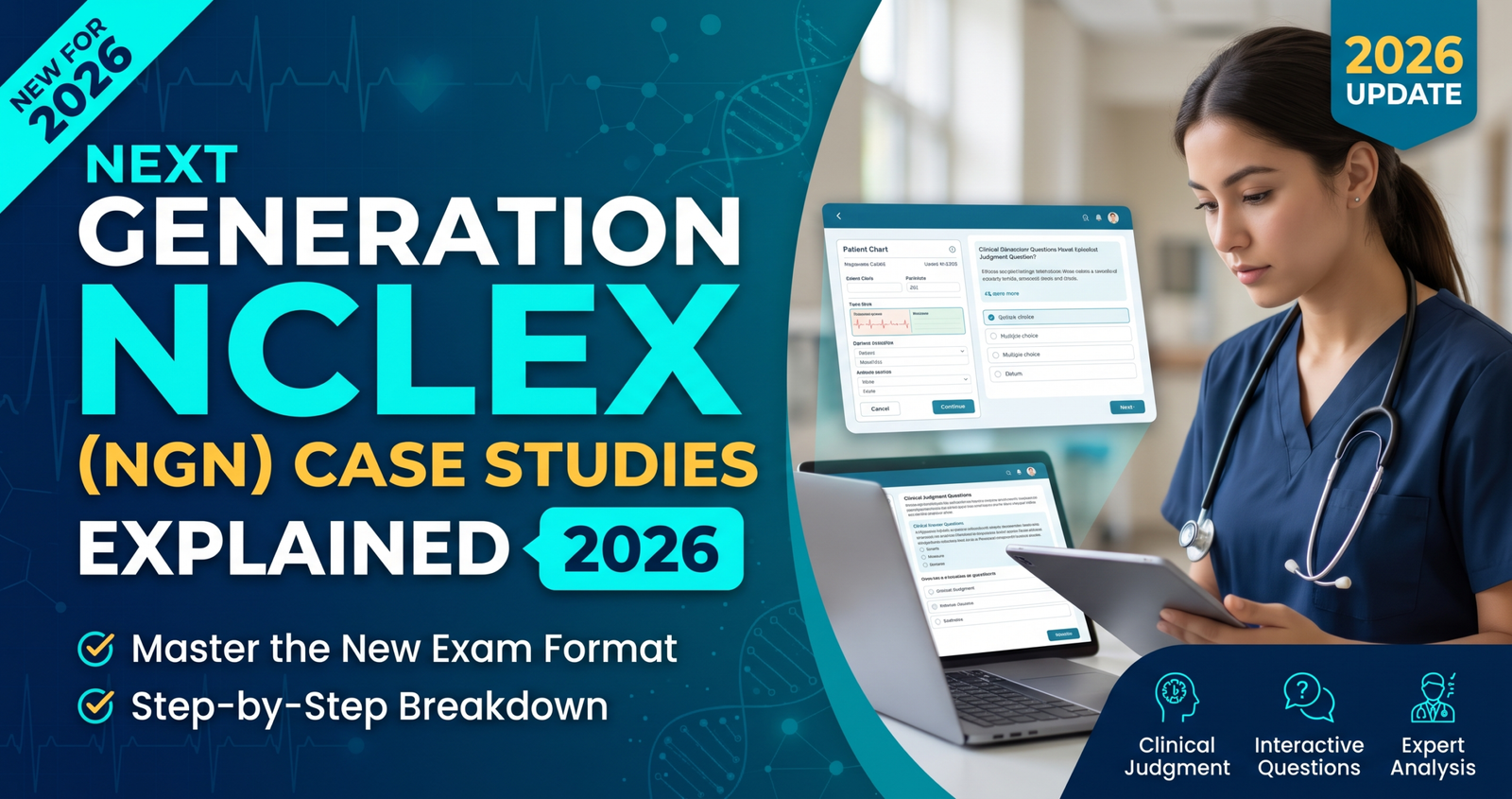
What is Next Generation NCLEX (NGN) Case Studies Explained. Next Generation NCLEX case research explained: research the 6-step layout, the scientific judgment version, scoring, and a laboured instance with rationales.
Explore Next Generation NCLEX (NGN) Case Studies Explained
Introduction
Few components of the brand-new examination fear college students as a good deal because the unfolding affected person scenario. Next Generation NCLEX case research gift one patron tale and ask six connected questions on it. Because every query builds at the last, you must suppose like a nurse from the primary cue to the very last evaluation.
In this guide, you may find out how the layout works, how the scientific judgment version shapes every query, and the way scoring rewards cautious wondering. Moreover, you may stroll via a brief instance with rationales.
What Are Next Generation NCLEX Case Studies?
The Basic Format
A case looks at starts with a patron scenario, which incorporates tabs which includes the nurse`s notes, crucial signs, laboratory results, and company orders. You then solution six questions on the equal patron, and every query makes a speciality of one step of scientific judgment. As a result, the case unfolds the manner actual care does.
Case research additionally uses numerous object types, which includes drop-down cloze, matrix grids, highlighting, and pick out all that apply. Therefore, you must study cautiously instead of depending upon an unmarried strategy.
Why the NCSBN Introduced Them
The NCSBN created the Next Generation NCLEX to degree scientific judgment, now no longer simply recall. Entry-degree nurses must note changes, interpret them, and act safely. Consequently, case research looks at the overall wondering procedure as opposed to remoted facts.
The Clinical Judgment Model Behind Each Question
The Six Cognitive Layers
Each query maps to 1 layer of the NCSBN Clinical Judgment Measurement Model. The six layers are:
- Recognize cues: perceive which findings are relevant.
- Analyse cues: hyperlink findings to the client`s condition.
- Prioritize hypotheses: rank the maximum probable or pressing problems.
- Generate solutions: perceive anticipated consequences and suitable interventions.
- Take actions: pick out the interventions to hold out.
- Evaluate consequences: determine whether care worked.
How the Layers Connect
Each layer relies upon on the only earlier than it. For instance, in case you pass over a key cue, your evaluation and priorities may also flow off course. In addition, new statistics frequently seems because the case advances, so that you should replace your thinking.
Scoring on Next Generation NCLEX Case Studies
Partial Credit Explained
Case looks at questions use partial credit score in place of all-or-not anything grading. Some objects award factors for every accurate selection, at the same time as others subtract factors for wrong ones. Moreover, positive objects rating through “plus/minus” or “zero/one” guidelines, relying at the format.
Because guidelines range through object, continually examine the commands on screen. Selecting precisely the quantity requested, whilst stated, is essential.
What This Means for Your Strategy
Since every query includes weight, keep away from dashing the early ones. Accuracy on each layer matters, so supply the cues your complete attention. Likewise, by no means depart an object uncertain, due to the fact the examination does now no longer permit skipping.

A Worked Example with Rationales
The Scenario
A 68-year-vintage purchaser with coronary heart failure is admitted with growing shortness of breath. The nurse`s notes document crackles in each lung bases, 2+ pitting edema withinside the ankles, and a weight advantage of four kilos in 3 days. Vital symptoms and symptoms display a coronary heart fee of 104, a breathing fee of 26, and an oxygen saturation of 90% on room air.
Question 1: Recognize Cues
Which findings are maximum applicable to the purchaser’s situation? Select all that practice. The applicable cues are the crackles, the edema, the load advantage, the increased breathing fee, and the low oxygen saturation. These findings factor to fluid overload, whilst unrelated info withinside the chart, consisting of an ordinary allergic reaction listing, do now no longer.
Question 2: Analyse Cues
Match every locating with the situation it supports. The crackles and weight advantage help fluid quantity extra associated with worsening coronary heart failure. In addition, the low saturation and tachypnea display decreased fueloline exchange. Linking findings to situations is the coronary heart of this step.
Question 3: Prioritize Hypotheses
Which trouble is the very best priority? The accurate desire is impaired oxygenation, due to the fact respiratory outranks different worries beneath the ABCs. Edema and weight advantage matter, however they do now no longer threaten existence as fast as hypoxia.
Question 4: Generate Solutions
Which effects and interventions match this purchaser? Expected effects encompass progressed oxygen saturation and decreased lung congestion. Appropriate interventions encompass elevating the pinnacle of the bed, giving prescribed oxygen, and looking ahead to a diuretic order. Therefore, you propose for each instant consolation and fluid removal.
Questions 5 and 6: Take Actions and Evaluate Outcomes
For actions, you will function the purchaser upright, practice oxygen, administer the diuretic as ordered, and reveal consumption and output. Later, new statistics display clearer lungs, a saturation of 95%, and a falling weight. This confirms that the plan worked, so the appropriate assessment is that the purchaser’s situation is improving.
Strategies for Success
Read the Whole Case First
Before answering, test each tab, together with notes, orders, and labs. Subtle information regularly seems in a single tab and extrude the that means of another. Furthermore, observe which findings are strange or new, due to the fact those are normally the cues.
Practice With the Model, Not Just Content
Label every exercise query with its scientific judgment layer. Doing this trains you to understand what every query is asking. Over time, you’ll solution extra speedy and extra accurately.
Review Every Rationale
After every case, study the reasoning for each option, together with the best ones. This well-known shows why sure cues remember and others are distractors. Additionally, tune vulnerable layers, together with prioritizing hypotheses, and exercise them extra regularly.
Conclusion
Next Generation NCLEX case research praise nurses who suppose in steps: notice, interpret, prioritize, plan, act, and evaluate. Learn the six layers, study each tab, and deal with every query as a part of one non-stop story. With regular exercise and thorough review, those instances will sense like actual nursing as opposed to a puzzle.
If this manual helped, proportion it together along with you examine group, depart a remark with the NGN step you locate hardest, and discover extra NCLEX assets on our platform.
FAQs
What are Next Generation NCLEX case research?
They are unfolding patron eventualities accompanied with the aid of using six questions, every tied to a step of scientific judgment. The questions use numerous codecs and construct at the identical case. They degree how nicely you understand cues, set priorities, and act safely.
How many questions are in an NGN case examine?
Each case examine incorporates six questions, one for every layer of the scientific judgment model. You solution them so as and can’t bypass ahead. New facts can also additionally seem because the case unfolds.
How are Next Generation NCLEX case research scored?
Most gadgets use partial credit, awarding factors for proper choices and now and again subtracting for wrong ones. The specific rule relies upon at the object type. Always comply with the on-display screen commands for every query.
How can I put together for NGN case research?
Practice complete instances, now no longer simply unmarried questions, and examine the scientific judgment model. Review each intent and tune the stairs wherein you lose factors. Short, regular exercise periods construct each velocity and confidence.
Read More:
https://nurseseducator.com/didactic-and-dialectic-teaching-rationale-for-team-based-learning/
https://nurseseducator.com/high-fidelity-simulation-use-in-nursing-education/
First NCLEX Exam Center In Pakistan From Lahore (Mall of Lahore) to the Global Nursing
Categories of Journals: W, X, Y and Z Category Journal In Nursing Education
AI in Healthcare Content Creation: A Double-Edged Sword and Scary
Social Links:
https://www.facebook.com/nurseseducator/
https://www.instagram.com/nurseseducator/
https://www.pinterest.com/NursesEducator/
https://www.linkedin.com/company/nurseseducator/
https://www.linkedin.com/in/afzalaldin/
https://www.researchgate.net/profile/Afza-Lal-Din
https://scholar.google.com/citations?hl=en&user=F0XY9vQAAAAJ
https://orcid.org/0000-0001-6976-9158