
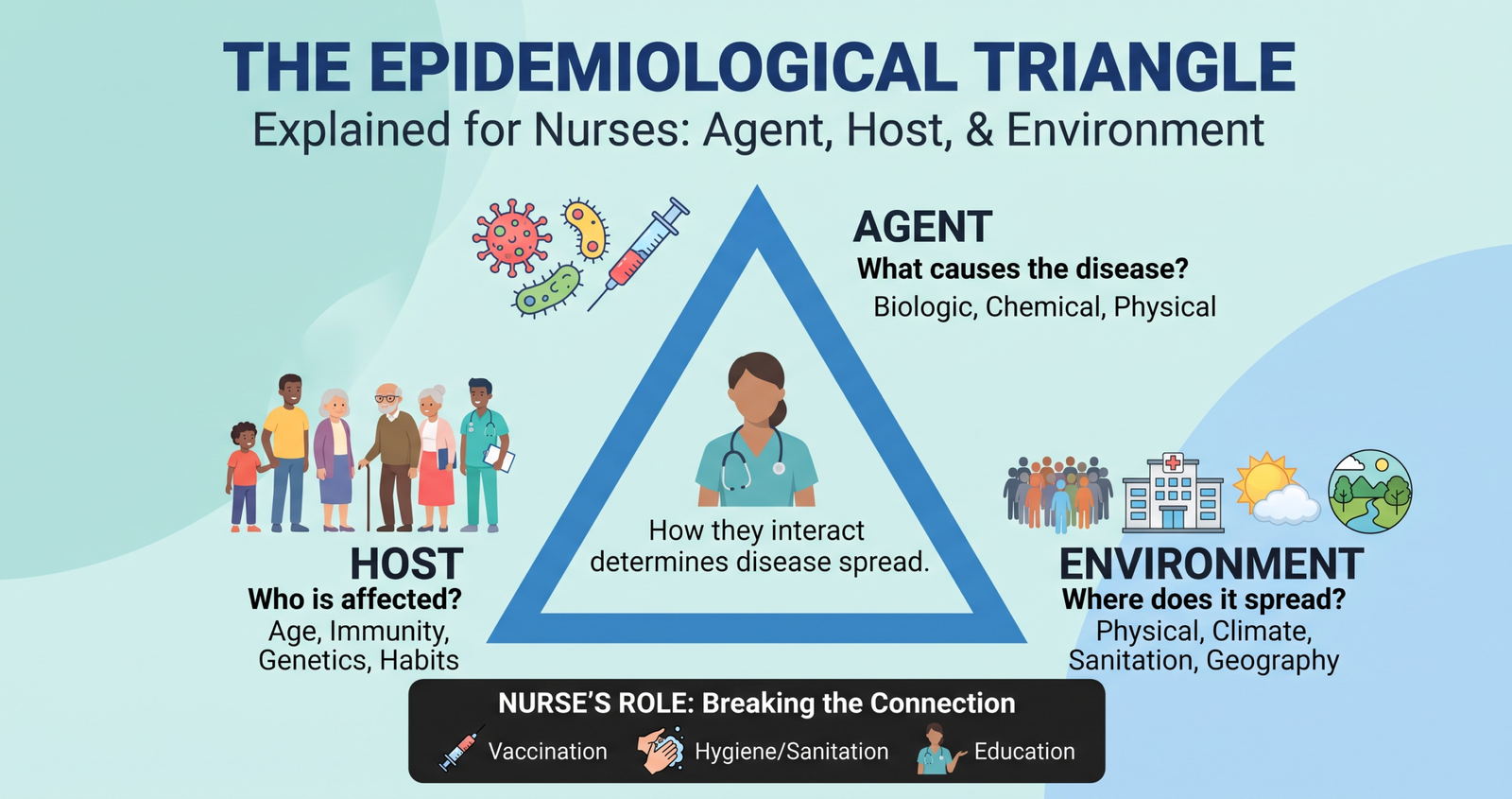
Learn how the Epidemiological Triangle Explained for Nurses: Agent, Host, and Environment. Epidemiological triangles explain sickness unfold through agent, host, and environment, and the way nurses use it to save you contamination.
Agent, Host, and Environment: Epidemiological Triangle Explained for Nurses
Introduction
Every contamination manage selection you are making begins off evolved with one question: why did this affected person get sick? The epidemiological triangle offers nurses a clean framework for answering it. In this guide, the epidemiological triangle is defined little by little for nursing college students and practising experts.
Mastering this version sharpens your scientific reasoning, improves your affected person teaching, and strengthens your function in public fitness. Moreover, it seems often on nursing exams, so information it can pay off twice.
What Is the Epidemiological Triangle?
Definition and Origins
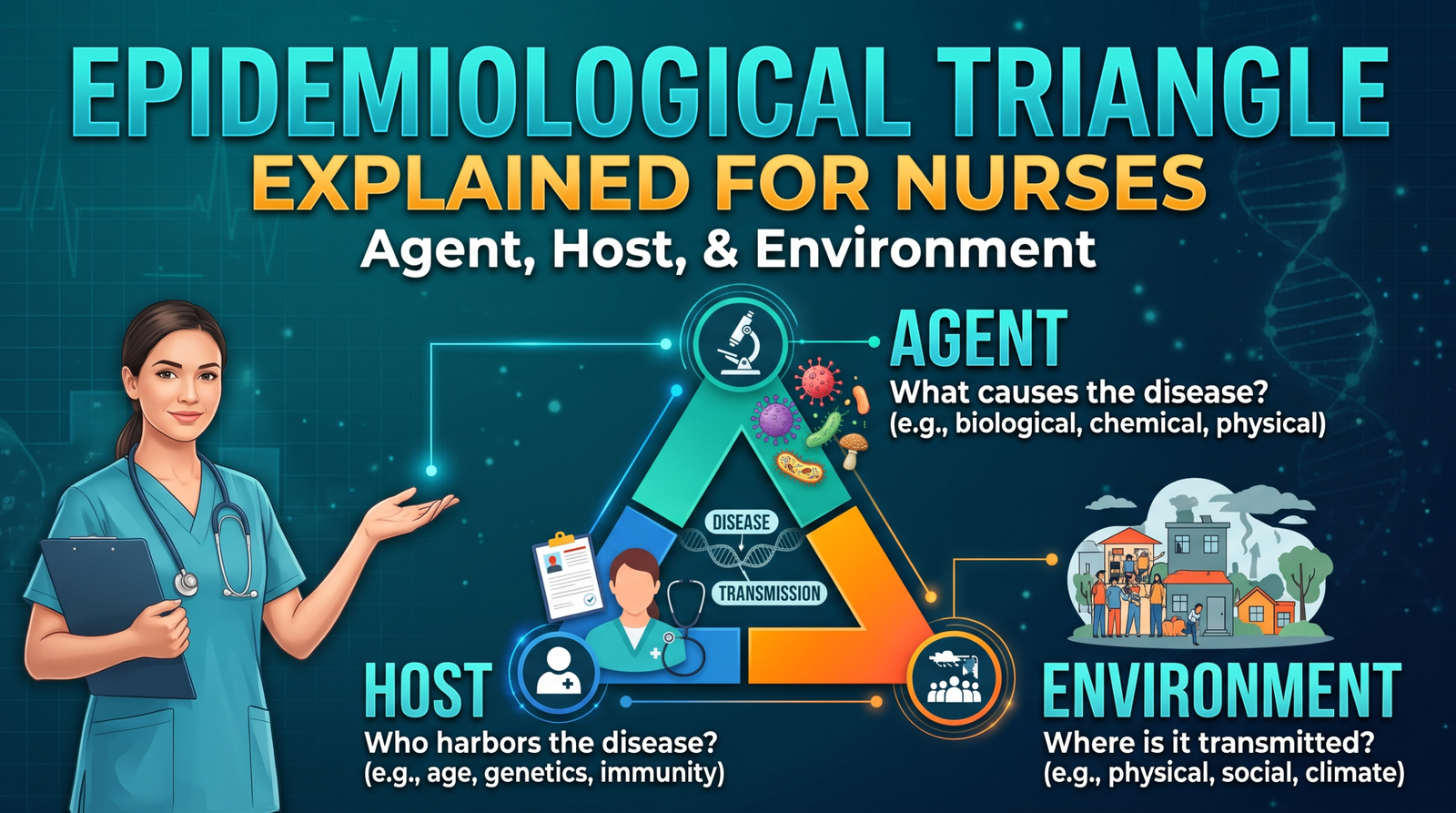
The epidemiological triangle, additionally referred to as the epidemiologic triangle, is a conventional version that explains how sickness occurs. It indicates that infection outcomes from the interplay of 3 factors: an agent, a host, and an environment. Public fitness experts advanced it to look at infectious sickness outbreaks, and it stays a cornerstone of epidemiology today.
Think of it as a 3-legged stool. If you eliminate or weaken anyone leg, the stool collapses, and sickness transmission stop.
Why Nurses Need This Model
Nurses’ paintings on the factor in which patients, pathogens, and care settings meet. Therefore, the epidemiological triangle allows you see dangers early and select the simplest intervention. It additionally offers you a shared language with contamination preventionists, physicians, and public fitness teams.
Furthermore, the version helps evidence-primarily based totally practice. Instead of reacting to infection, you may count on it.
The Three Corners of the Epidemiological Triangle
The Agent
The agent is the element that reasons sickness. Most regularly it’s miles an organic pathogen along with a bacterium, virus, fungus, or parasite. However, dealers also can be chemical, along with lead or asbestos, or physical, along with radiation or intense heat.
Key agent traits encompass infectivity (capacity to invade a host), pathogenicity (capacity to reason sickness), and virulence (severity of that sickness). For example, norovirus has excessive infectivity, at the same time as rabies has intense virulence.
The Host
The host is the person, or population, who can also additionally grow to be inflamed. Host elements consist of age, immunization status, nutrition, genetics, persistent illness, and immunocompromised situations. In addition, behaviours including hand hygiene and smoking influence susceptibility.
Consider an untimely infant, an older person with diabetes, and a healthful younger person uncovered to the identical virus. Each responds otherwise due to the fact host susceptibility varies widely.
The Environment
The surroundings consist of the outside situations that permit the agent to attain the host. These situations can be physical, including crowding, temperature, and sanitation. They will also be social or biological, along with poverty, healthcare access, and the presence of vectors like mosquitoes.
In hospitals, the surroundings consist of shared equipment, ventilation, and staffing levels. As a result, nurses at once form this nook each shift.
The Epidemiological Triangle (or Triad) is a classic model used in public health and nursing to explain how infectious and communicable diseases occur and spread. It states that disease results from the interaction of three primary components: the Agent, the Host, and the Environment, with Time often placed at the center
For disease to happen, all three elements must interact. Nurses use this model to identify infection risks, trace outbreaks, and plan interventions that “break” a side of the triangle.
1. The Agent (The “What”)
The agent is the actual microorganism, substance, or force responsible for causing the disease.
Types of Agents:
- Biological: Bacteria, viruses, fungi, protozoa, and parasites (e.g., E. coli, influenza virus, Plasmodium).
- Chemical: Poisons, toxins, alcohol, smoke, or lead.
- Physical: Trauma, radiation, or extreme temperatures.
- Nutritional: Dietary excess or deficiency.
Key Characteristics of Biological Agents:
- Infectivity: The ability to enter and multiply in the host.
- Pathogenicity: The ability to cause clinical disease.
- Virulence: The severity or lethality of the disease caused.
2. The Host (The “Who”)
The host is the human (or animal) that is exposed to and harbors the disease agent. Host Factors Influencing Susceptibility:
- Demographics: Age, sex, and ethnicity.
- Biological/Genetic: Immune status, genetic resistance, and pre-existing chronic conditions.
- Lifestyle & Behavior: Hygiene habits, sexual practices, nutritional status, and vaccination history.
- Socioeconomic Status: Occupation and access to healthcare.
3. The Environment (The “Where”)
The environment includes all external conditions, surroundings, and influences that-outside the host and agent—allow or promote their interaction.
Categories of Environmental Factors:
- Physical: Climate, weather, geography, and architecture (e.g., crowded housing).
- Biological: Vector populations (like mosquitoes or ticks), animal reservoirs, and sanitation systems.
- Socioeconomic/Cultural: Access to clean water, health policy, poverty, cultural norms, and community healthcare resources.
4. Time (The Center)
Time sits at the core of the triangle, representing the timeline of the event:
- Incubation period: How long between exposure and first symptoms.
- Duration: How long the illness lasts.
- Epidemic threshold/Rate: The speed and scale of spread across a population.
How Nurses Apply the Epidemiological Triangle in Practice
Nurses use the triad to interrupt transmission chains through targeted nursing interventions at each corner of the model:
Targeting the Agent:
- Administering antibiotics or antivirals to destroy pathogens.
- Sterilizing medical equipment and enforcing proper hand hygiene.
Targeting the Host:
- Providing vaccinations to build active immunity.
- Performing health screenings and teaching proper nutrition, hygiene, or lifestyle changes to lower individual vulnerability.
Targeting the Environment:
- Improving sanitation and safe drinking water access.
- Educating communities on vector control (e.g., using mosquito nets or eliminating standing water for dengue/malaria).
You can read more about foundational public health frameworks via the CDC Principles of Epidemiology.
Applying the Epidemiological Triangle in Clinical Practice
Example: Influenza on a Medical Unit
Imagine an influenza outbreak for your unit. The agent is the influenza virus, the hosts are unvaccinated or frail patients, and the surroundings is a shared, poorly ventilated ward. Using the epidemiological triangle, you could goal every nook at once.
You would possibly isolate inflamed patients, provide vaccines to prone hosts, and enhance airflow or restriction visitors. Consequently, transmission drops on numerous fronts.
Example: Foodborne Illness withinside the Community
Now recollect a cluster of Salmonella instances traced to a neighbourhood restaurant. The agent is the bacterium, the hosts are the diners, and the surroundings is a kitchen with negative temperature control. Here, a network fitness nurse can use the triangle to manual interviews, reporting, and education.
Public fitness nurses regularly rely upon this method throughout outbreak investigations. It continues the research prepared and focused.
Using the Epidemiological Triangle for Prevention
Linking the Triangle to Levels of Prevention
The triangle connects obviously to the 3 ranges of prevention. Primary prevention, inclusive of vaccination and handwashing, stops ailment earlier than it starts. Secondary prevention, inclusive of screening and early treatment, catches ailment early, whilst tertiary prevention limits headaches and helps rehabilitation.
Because every degree acts on at the least one nook of the triangle, the version allows you decide wherein your intervention fits.
Breaking the Chain on the Weakest Link
You not often want to get rid of all 3 corners to forestall an outbreak. Instead, pick out the weakest hyperlink and act on it. For instance, removing an agent is difficult, however enhancing sanitation or vaccinating hosts is regularly achievable.
This sensible attitude makes the epidemiological triangle mainly beneficial in resource-restrained settings. Small, focused movements can produce massive results.
Patient and Community Education
Education is one of the maximum effective gears you have. Teach sufferers a way to wash fingers properly, live cutting-edge on vaccines, and take care of meals safely. Likewise, inspire households to apprehend early signs and symptoms and are seeking care promptly.
Clear coaching empowers hosts and improves the surroundings round them.
Limitations and Extended Models
The Epidemiological Triangle vs. the Web of Causation
The epidemiological triangle works nicely for infectious ailment; however, it may oversimplify persistent conditions. Illnesses like coronary heart ailment and most cancers contain many interacting causes, so epidemiologists regularly use the net of causation instead. This version maps a couple of danger elements and their relationships.
Nevertheless, the triangle stays an amazing beginning point. It builds the inspiration for extra complicated thinking.
The Role of Vectors and Time
Some variations of the version upload a vector, that’s a dwelling service that transmits the agent, which include a tick or mosquito. Others encompass time as an aspect, in view that incubation intervals and seasonal styles influence outbreaks. Both additions make the framework extra realistic.
Understanding those extensions prepares you for superior coursework and actual-international surveillance.
Conclusion
The epidemiological triangle suggests that disorder is by no means random. It emerges whilst an agent, a prone host, and supportive surroundings come together. By figuring out and interrupting those connections, you defend person sufferers and whole communities.
To recap, keep in mind the 3 corners, exercise making use of them to actual cases, and continually search for the weakest link. Did this manual assist you? Share it with a classmate, depart a remark together along with your personal scientific example, and discover extra nursing sources on our platform.
FAQs
What is the epidemiological triangle in nursing?
The epidemiological triangle is a version that explains how disorder develops via the interplay of an agent, a host, and surroundings. Nurses use it to discover chance elements and plan prevention strategies. It is specifically precious in contamination manipulate and outbreak investigation.
What are the 3 additives of the epidemiological triangle?
The 3 additives are the agent (the purpose of disorder), the host (the prone person), and the surroundings (the outside situations that permit transmission). Each aspect interacts with the others. Changing anybody of them can lessen or forestall disorder spread.
How is the epidemiological triangle specific from the chain of contamination?
The epidemiological triangle offers a broad, 3-aspect evaluate of why disorder occurs. The chain of contamination is extra detailed, breaking transmission into six hyperlinks from the infectious agent to the prone host. Nurses regularly use the triangle for big-photograph wondering and the chain for unique contamination manipulate steps.
Why is the epidemiological triangle vital for nurses?
It enables nurses apprehend how and why contamination spreads, which courses realistic prevention. With this framework, you could prioritize interventions which include vaccination, isolation, and education. It additionally helps clean conversation with the healthcare team.
Read More:
https://nurseseducator.com/didactic-and-dialectic-teaching-rationale-for-team-based-learning/
https://nurseseducator.com/high-fidelity-simulation-use-in-nursing-education/
First NCLEX Exam Center In Pakistan From Lahore (Mall of Lahore) to the Global Nursing
Categories of Journals: W, X, Y and Z Category Journal In Nursing Education
AI in Healthcare Content Creation: A Double-Edged Sword and Scary
Social Links:
https://www.facebook.com/nurseseducator/
https://www.instagram.com/nurseseducator/
https://www.pinterest.com/NursesEducator/
https://www.linkedin.com/company/nurseseducator/
https://www.linkedin.com/in/afzalaldin/
https://www.researchgate.net/profile/Afza-Lal-Din
https://scholar.google.com/citations?hl=en&user=F0XY9vQAAAAJ
https://orcid.org/0000-0001-6976-9158