
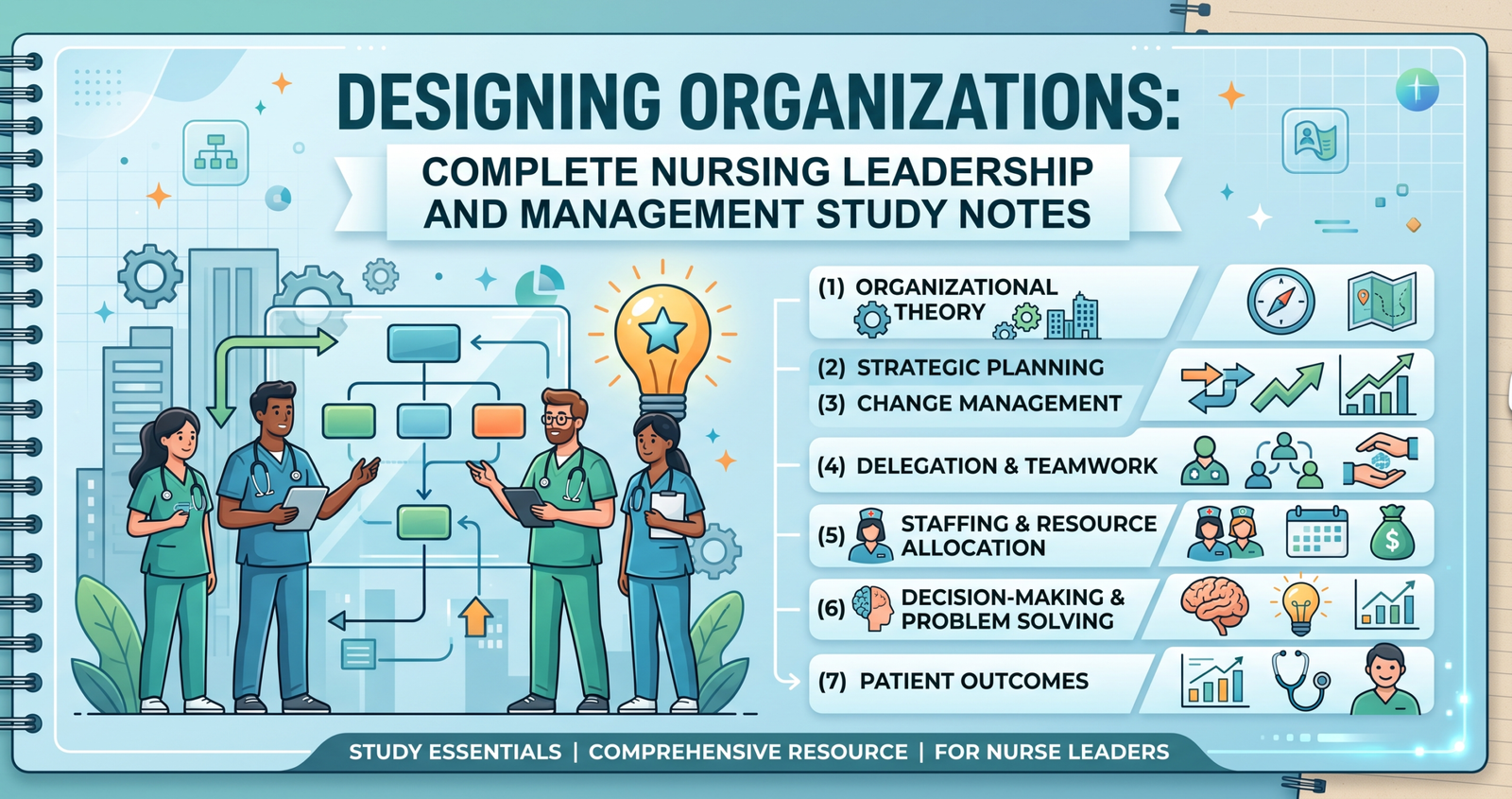
Study complete Designing Organizations: Complete Nursing Leadership and Management Study Notes. Chapter 2: Designing Organizations nursing notes covering organizational theories, structures, shared governance, health-care settings, strategic planning, and organizational culture for BSN and Post-RN students.
Nursing Leadership and Management Study Guide: Designing Organizations
Understanding how health-care organizations are designed and managed is essential for nursing students, particularly in leadership, management, and professional practice courses. This comprehensive study resource covers the major concepts from Chapter 2: Designing Organizations, including traditional organizational theories, organizational structures, service-line structures, shared governance, health-care settings, complex health-care arrangements, strategic planning, and organizational environment and culture.
These notes are designed to help BSN, Post-RN, and nursing students review important concepts in an organized and exam-focused format.
Organizational Theories
This section introduces the major theories used to understand how organizations function and adapt to their environments. The chapter covers Classical, Humanistic, Systems, Contingency, Chaos, and Complexity theories.
Students can review how each theory explains organizational structure, efficiency, human relationships, environmental influences, adaptability, and complexity in health-care organizations.
Important concepts include the Hawthorne Effect, the Input–Throughput–Output model, organizational adaptation, and the relationship between organizational structure and environmental conditions.
Traditional Organizational Structures
Health-care organizations can use different structural arrangements depending on their goals, size, technology, and environment.
This section explains:
- Functional structure
- Hybrid structure
- Matrix structure
- Parallel structure
Students will also learn the differences between line authority and staff authority, the meaning of span of control, and why the parallel structure has a distinctive role in health care.
Service-Line Structures
Service-line structures organize clinical services around patients with specific conditions or areas of care, such as oncology, cardiology, and burn services.
The notes discuss the major strengths and weaknesses of service-line structures, including rapid adaptation, coordination within services, possible duplication of resources, and competition between service categories.
The chapter also explains the importance of service-line structures in Magnet-certified organizations and their relationship with nursing empowerment and participation in decision-making.
Shared Governance in Nursing
Shared governance is an important concept in professional nursing practice because it provides nurses with greater participation in decisions affecting their practice.
This section explains:
- Participative decision-making
- Nursing autonomy
- Accountability
- Unit-based councils
- Divisional councils
- Leadership councils
- Hospital-wide councils
The four major hospital-wide councils discussed in the notes are the Practice, Professional Development, Quality, and Research Councils.
Students can also review the human and structural factors that may interfere with successful shared governance.
Health-Care Organizations and Settings
This section examines different types of health-care organizations and settings, including primary care, acute-care hospitals, home health care, and long-term care.
Important distinctions include:
- Teaching vs. nonteaching hospitals
- Hospitalists vs. intensivists
- Home health services
- Long-term nursing and rehabilitative care
- Challenges associated with transitions between health-care settings
The chapter also discusses different forms of health-care ownership, including private, government, voluntary/not-for-profit, investor-owned/for-profit, sectarian, and nonsectarian organizations.
Complex Health-Care Arrangements
Modern health care involves relationships among multiple organizations and providers. This section explains health-care networks, interorganizational relationships, integration, diversification, joint ventures, managed health-care organizations, and Accountable Care Organizations (ACOs).
Students should pay particular attention to the difference between:
Horizontal integration — organizations providing the same or similar services.
Vertical integration — different but related organizations working together to provide a continuum of services.
The notes also explain HMO, PPO, POS, and ACO models.
Redesigning Health Care
Health care is a dynamic environment that requires organizations to adapt to changing patient needs, technology, quality expectations, and population characteristics.
This section covers major approaches to redesigning health care, including:
- Patient-centered care
- Medical home
- Big-dot focus areas
- Lean thinking
- Flat and decentralized organizational structures
The role of the nurse manager is also emphasized, particularly in initiating change, reducing costs, maintaining quality, coaching and mentoring staff, and building effective teams.
Strategic Planning
Strategic planning helps health-care organizations establish direction and use resources effectively.
Students will learn the relationship between:
Philosophy → Mission → Vision → Strategic Plan → Goals → Objectives → Strategies
The chapter also explains SWOT analysis, including:
- Strengths
- Weaknesses
- Opportunities
- Threats
A major examination point is understanding the difference between goals, objectives, and strategies.
Organizational Environment and Culture
The final section distinguishes between organizational environment and organizational culture.
Organizational environment refers to system-wide conditions that contribute to a positive or negative workplace.
The notes identify six characteristics of a healthy work environment:
- Skilled communication
- True collaboration
- Effective decision making
- Appropriate staffing
- Meaningful recognition
- Authentic leadership
Organizational culture refers to the basic assumptions and values held by members of an organization — the “unstated rules of the game.”
Students should also understand subcultures and countercultures and how participatory management and shared governance can influence professional autonomy and workplace decision-making.
Chapter 2 Quick Revision
For last-minute preparation, remember these high-yield concepts:
- Classical Theory → structure and efficiency
- Humanistic Theory → people and social relationships
- Systems Theory → Input → Throughput → Output
- Contingency Theory → structure depends on the situation
- Chaos Theory → unpredictability and adaptation
- Complexity Theory → randomness and interacting variables
- Matrix Structure → dual authority
- Parallel Structure → hospital and medical staff authority
- Shared Governance → participative nursing decision-making
- SWOT → Strengths, Weaknesses, Opportunities, Threats
- Goal → organization-wide
- Objective → unit-specific
- Strategy → specific action
- Environment → system-wide conditions
- Culture → assumptions, values, and unstated rules
Download the Complete Study Notes
Students can use the complete Chapter 2: Designing Organizations study notes for detailed preparation, revision, and examination review.
Google Drive Study Resource:
[Insert your Google Drive study-notes link here]
The resource can be used alongside the infographic series to make revision easier and more visual.
Study and Share With Other Nursing Students
If these Designing Organizations nursing notes are helpful, students can save the resource for later revision and share it with classmates preparing for nursing leadership and management examinations.
Facebook: Share these study notes with your nursing student groups and classmates.
https://www.facebook.com/share/p/1Ep22a56t6/
LinkedIn: Share the resource with nursing students, educators, nurses, and health-care professionals interested in nursing leadership and management.
https://www.linkedin.com/feed/update/urn:li:activity:7509905300817219584
Google Drive: Keep the complete study material saved for offline or future revision.
Final Note
These study notes are intended to make Chapter 2: Designing Organizations easier to understand and revise. For examination preparation, students should review the detailed concepts as well as the quick-review points rather than relying only on the summary.