
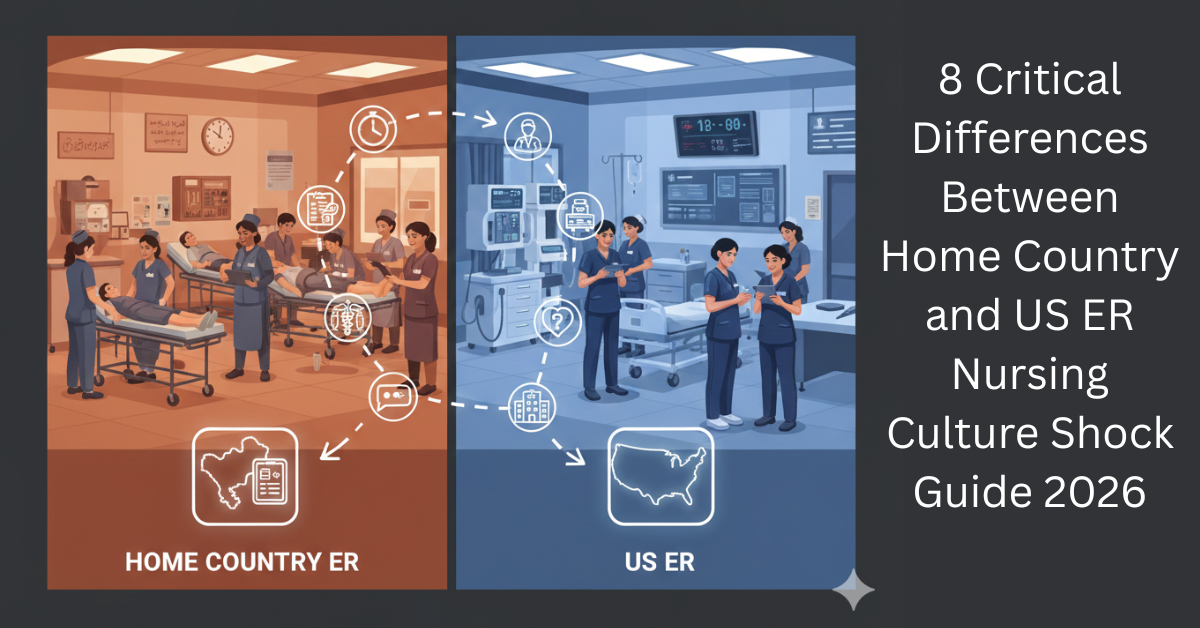
Navigate 8 Critical Differences Between Home Country and US ER Nursing: Culture Shock Guide 2026. ER culture shock: Discover 8 key differences between international and US hospital nursing practices, technology, and patient care in 2026.
Culture Shock Guide 2026: 8 Critical Differences Between Home Country and US ER Nursing
Introduction
Cultural shock in the emergency room represents one of the most jarring professional transitions internationally educated nurses face when entering the United States healthcare system, where fundamental differences in pace, technology, patient expectations, and clinical protocols can feel overwhelming and destabilizing. According to a 2024 study published in the Journal of Emergency Nursing, approximately 78% of internationally educated nurses report experiencing moderate to severe culture shock during their first six months in US emergency departments, with the intensity of adjustment challenges directly correlating with differences between home country and American healthcare systems.
The collision between familiar nursing paradigms and radically different US emergency medicine culture creates cognitive dissonance that impacts clinical confidence, professional identity, and job satisfaction in ways that extend far beyond simple language barriers. Understanding these specific cultural differences systematically, recognizing them as normal adjustment challenges rather than personal inadequacies, and developing targeted adaptation strategies become essential for successfully transitioning into US emergency nursing while maintaining the clinical excellence and compassionate care that motivated your international career journey.
Understanding Healthcare Culture Shock
The Psychological Impact of Professional Disorientation
Healthcare culture shock extends beyond general cultural adjustment because it challenges professional identity and clinical competence simultaneously. Dr. Madeleine Leininger’s Theory of Culture Care Diversity and Universality emphasizes that nursing practices are deeply embedded in cultural contexts, meaning that clinically excellent nurses in their home countries may suddenly feel incompetent when cultural frameworks shift. This professional disorientation triggers profound psychological distress that compounds typical cultural adjustment challenges.
Research from the International Journal of Nursing Studies indicates that professional culture shock activates similar neurobiological stress responses as acute trauma, with internationally educated nurses showing elevated cortisol levels, disrupted sleep patterns, and symptoms consistent with adjustment disorder during initial US hospital employment. Understanding that these reactions represent normal responses to significant professional disruption rather than personal weakness validates experiences and encourages proactive coping strategies before symptoms escalate into burnout or depression.
The Specific Challenge of Emergency Department Culture
Emergency departments amplify cultural differences due to their high-acuity, fast-paced nature where split-second decisions occur within cultural contexts that may feel foreign and disorienting. A 2023 report from the Emergency Nurses Association revealed that internationally educated nurses working in emergency departments experience 45% higher culture shock symptoms compared to those in medical-surgical units, attributed to the compressed timeframes that eliminate gradual cultural learning opportunities available in less acute settings.
Furthermore, emergency medicine in the United States operates within unique medicolegal, autonomy, and patient expectation frameworks that differ dramatically from healthcare systems in the Philippines, India, Nigeria, or other countries contributing significant internationally educated nurse populations. The Joint Commission’s 2024 Hospital Culture Assessment identified emergency departments as having the most distinct organizational cultures within hospitals, requiring specialized orientation and adjustment support for all new staff, with intensified needs for internationally educated nurses navigating simultaneous cultural and professional transitions.
Eight Critical Cultural Differences in US Emergency Departments
Difference One: Unprecedented Speed and Patient Throughput Expectations
US emergency departments operate at speeds that shock internationally educated nurses accustomed to different patient-to-nurse ratios and throughput expectations. The Centers for Medicare and Medicaid Services’ 2024 data shows average US emergency department length of stay targets of under four hours, with continuous pressure to move patients through triage, treatment, and disposition rapidly. This contrasts sharply with healthcare systems in many countries where emergency department’s function more like urgent care clinics with extended patient stays and less aggressive throughput metrics.
Nurses from countries with lower-acuity emergency departments or those functioning primarily for true emergencies may feel overwhelmed by the volume and variety of chief complaints in US emergency departments, which serve as primary care access points for uninsured populations, mental health crises, substance abuse issues, and social problems lacking community resources.
The American College of Emergency Physicians reports that US emergency departments manage over 145 million visits annually, creating relentless pace pressures that feel unsustainable to nurses accustomed to different healthcare delivery models. Adapting requires recalibrating speed expectations, developing efficient workflow strategies, and recognizing that rapid throughput represents systemic design rather than individual nurse inadequacy when you struggle to maintain pace initially.
Difference Two: Advanced Technology Integration and Electronic Documentation
The United States leads globally in healthcare technology adoption, with emergency departments utilizing electronic health records, automated medication dispensing systems, telemetry monitoring, computerized provider order entry, and clinical decision support systems that may be completely unfamiliar to internationally educated nurses. A 2024 survey by the Healthcare Information and Management Systems Society found that 96% of US hospitals use certified electronic health record systems, compared to significantly lower adoption rates in most countries contributing internationally educated nurses.
This technology dependency fundamentally changes nursing workflow, requiring simultaneous patient care and extensive computer documentation that feels like competing priorities rather than complementary activities. Nurses from paper-based systems or those with basic electronic records may feel technologically overwhelmed while learning multiple complex software platforms, barcode medication administration, electronic vital sign documentation, and computerized charting simultaneously with acclimating to US emergency department culture.
The American Nursing Informatics Association emphasizes that technology competency development requires dedicated training time and practice, recommending that internationally educated nurses receive extended orientation specifically addressing informatics skills rather than assuming technological literacy transfers automatically across healthcare systems.
Difference Three: Patient Autonomy and Shared Decision-Making Paradigms
US healthcare operates on patient autonomy principles that may contrast sharply with more paternalistic or family-centered decision-making models common in other countries. American emergency department patients expect detailed explanations, participation in treatment decisions, and the right to refuse interventions that nurses in hierarchical healthcare cultures might find shocking or inappropriate. This fundamental philosophical difference reflects broader US cultural values emphasizing individualism, self-determination, and consumer rights in healthcare relationships.
Internationally educated nurses from cultures where physicians make decisions with minimal patient input, where families rather than individuals serve as primary decision-makers, or where healthcare providers hold unquestioned authority may struggle with US patients who question treatments, demand alternatives, or refuse medically indicated interventions. The American Hospital Association’s Patient Bill of Rights codifies these autonomy principles legally, meaning that practices considered respectful and appropriate in your home country might constitute violations of patient rights in US healthcare settings. Adapting requires philosophical recalibration recognizing that different cultural models of good nursing care exist, with US emergency departments prioritizing patient autonomy even when it conflicts with medical recommendations or nursing judgment.
Difference Four: Direct Communication Styles and Nursing Assertiveness
US nursing culture expects and rewards direct communication, assertiveness in patient advocacy, and immediate speaking up when concerns arise—communication styles that feel aggressive, disrespectful, or inappropriate to nurses from high-context, hierarchical cultures. Research from the Journal of Transcultural Nursing indicates that nurses from collectivist cultures often struggle with American expectations for directness, particularly when addressing physicians, challenging orders, or advocating assertively for patient needs using communication approaches considered rude in their cultural contexts.
Emergency departments especially require rapid, clear, assertive communication during time-sensitive situations where indirect communication or hierarchical deference delays potentially dangerous. The SBAR communication framework (Situation, Background, Assessment, Recommendation) reflects this direct communication expectation, requiring nurses to immediately state concerns and recommendations rather than hinting at problems or waiting for physicians to discover issues independently.
Nurses from cultures where junior staff never question senior colleagues, where indirect communication preserves harmony, or where suggesting alternatives to physician plans shows disrespect must consciously adopt more direct communication approaches despite initial discomfort, recognizing that US patient safety culture prioritizes immediate concern articulation over hierarchical respect.
Difference Five: Informal Workplace Relationships and Flat Hierarchies
US hospitals operate with relatively flat hierarchies and informal interpersonal relationships compared to more status-conscious healthcare systems. Emergency department physicians, nurses, and other staff often interact on first-name basis with minimal attention to rank or seniority, a practice that feels inappropriately casual to nurses from cultures with strict professional hierarchies and formal address conventions. This informality extends to team interactions, where humor, casual conversation, and relaxed social dynamics coexist with serious medical work.
Internationally educated nurses may initially misinterpret this informality as unprofessionalism or lack of seriousness, or alternatively may inadvertently offend colleagues by maintaining excessive formality that Americans perceive as unfriendly distance. A 2024 study in the Journal of Nursing Administration found that relationship-building challenges significantly impact internationally educated nurse integration and job satisfaction, with those who successfully adapted to US informal workplace culture reporting 70% higher team satisfaction scores. Understanding that professional competence and interpersonal informality coexist comfortably in US culture, rather than representing contradictions, facilitates smoother team integration and workplace relationship development.
Difference Six: Medicolegal Awareness and Defensive Practice Patterns
The United States maintains a uniquely litigious healthcare environment where malpractice concerns significantly influence clinical practice patterns and documentation requirements. Emergency departments face particularly high litigation risks, creating cultural emphases on meticulous documentation, explicit informed consent processes, defensive testing, and constant awareness of legal implications that may feel excessive or strange to internationally educated nurses from less litigious healthcare systems.
The American Medical Association’s 2024 Medical Liability Report indicates that 85% of emergency physicians face malpractice claims during their careers, creating departmental cultures where legal protection sometimes appears prioritized over clinical efficiency or resource conservation. Nurses must document exhaustively, witness and record patient refusals meticulously, and understand that phrases like “patient refused” require specific documentation language protecting against future litigation. This defensive practice paradigm, while frustrating for nurses accustomed to trust-based patient relationships, reflects genuine legal risks requiring adaptation rather than representing American paranoia or inefficiency.
Difference Seven: Mental Health, Substance Abuse, and Behavioral Emergency Integration
US emergency departments function as de facto mental health crisis centers and substance abuse treatment access points due to inadequate community mental health resources, a role that may feel inappropriate or overwhelming to nurses from countries with separate psychiatric emergency services or more robust community mental health systems. The Substance Abuse and Mental Health Services Administration’s 2024 data shows mental health and substance abuse complaints constitute 12% of all US emergency department visits, requiring nurses to manage psychiatric crises, violent patients, intoxication, withdrawal, and behavioral emergencies alongside traditional medical emergencies.
Many internationally educated nurses receive minimal psychiatric nursing training or come from cultures where mental illness carries significant stigma, leaving them unprepared for the volume and complexity of behavioral health presentations in US emergency departments. Additionally, managing aggressive or violent patients using de-escalation techniques rather than physical restraint or security-focused approaches requires skills that may not transfer from home country practices.
The Emergency Nurses Association’s 2023 Workplace Violence Survey reported that 82% of emergency nurses experienced workplace violence, with internationally educated nurses particularly vulnerable due to unfamiliarity with US de-escalation protocols and patient rights frameworks governing behavioral emergency management.
Difference Eight: Insurance-Based Care Limitations and Resource Allocation
Healthcare delivery in the United States operates within complex insurance-based systems that directly impact which treatments, tests, and medications emergency departments can provide to individual patients. This contrasts with single-payer or out-of-pocket systems in many countries where treatment decisions follow purely clinical criteria rather than insurance authorization requirements. Internationally educated nurses often express frustration and moral distress when insurance limitations prevent medically indicated treatments or when uninsured patients receive only emergency stabilization rather than comprehensive care.
The American College of Emergency Physicians reports that emergency department nurses spend significant time navigating insurance requirements, obtaining authorizations, explaining coverage limitations to patients, and managing the emotional impact of insurance-based care denials. This represents fundamental healthcare system differences requiring philosophical adjustment rather than problems individual nurses can solve. Understanding that US emergency nurses advocate within systemic constraints while maintaining excellent care despite insurance limitations helps reconcile clinical training emphasizing comprehensive care with American healthcare realities involving significant access barriers and resource allocation based on payment rather than purely medical need.
Practical Strategies for Navigating ER Culture Shock
Develop Systematic Cultural Competency in US Healthcare
Treat learning US emergency department culture as seriously as clinical skill development, dedicating intentional effort to understanding unwritten rules, communication norms, and workflow expectations that Americans absorb through cultural immersion but internationally educated nurses must learn explicitly. Seek mentorship from experienced internationally educated nurses who successfully navigated this transition, as they possess unique insights into specific adjustment challenges and effective coping strategies that American-educated colleagues may not recognize.
Request extended orientation periods specifically addressing cultural adjustment beyond clinical skills, advocating for your need to understand not just what to do but why US emergency departments operate differently from your home country. Many hospitals now offer transition-to-practice programs for internationally educated nurses addressing cultural differences, communication styles, and healthcare system navigation. Additionally, the National Council of State Boards of Nursing provides resources specifically supporting internationally educated nurse integration, including cultural competency modules addressing US healthcare paradigms.
Build Support Networks and Normalize Adjustment Struggles
Connect with other internationally educated nurses experiencing similar culture shock, creating peer support networks where you can discuss confusing experiences, share coping strategies, and normalize adjustment struggles without judgment. Research from the Journal of Immigrant and Minority Health demonstrates that peer support reduces internationally educated nurse stress by 62% and significantly improves retention rates. These colleagues understand your specific challenges in ways that well-meaning American colleagues cannot, providing validation and practical guidance during difficult adjustment periods.
Communicate openly with supervisors and preceptors about your adjustment challenges, framing them as learning opportunities rather than inadequacies. Most US emergency departments recognize internationally educated nurse transition difficulties and appreciate proactive communication about specific support needs. If you encounter unsupportive environments dismissing culture shock as excuses or expecting immediate cultural fluency, recognize that this reflects poor leadership rather than confirmation that you should already understand everything, and advocate for the resources and time necessary for successful integration.
Practice Self-Compassion During the Adjustment Process
Recognize that culture shock represents normal responses to significant professional and personal disruption rather than personal failure or insufficient competence. Dr. Kristin Neff’s self-compassion research demonstrates that healthcare professionals who practice self-compassion during difficult transitions experience 40% lower burnout rates and maintain higher patient care quality compared to those who respond to struggles with self-criticism. Treat yourself with the same kindness you would offer colleagues experiencing similar challenges, acknowledging that adaptation requires time and that temporary struggles do not predict long-term success.
Celebrate small victories and incremental progress rather than expecting immediate mastery of US emergency department culture. Successfully completing your first shift, learning a new electronic health record module, or confidently communicating with a physician using direct US communication styles all represent significant accomplishments deserving recognition. Maintain realistic timelines recognizing that cultural adjustment typically requires 12-18 months for substantial comfort, with most internationally educated nurses reporting feeling culturally competent in US emergency departments after approximately two years of consistent practice and intentional cultural learning.
Conclusion
Cultural shock in US emergency departments represents one of the most significant professional challenges internationally educated nurses face, stemming from fundamental differences in pace, technology, patient autonomy, communication styles, workplace hierarchies, medicolegal awareness, behavioral health integration, and insurance-based care systems that collectively create overwhelming adjustment demands.
The eight critical differences explored—unprecedented speed expectations, advanced technology integration, patient autonomy paradigms, direct communication requirements, informal workplace relationships, defensive practice patterns, mental health crisis management, and insurance-based care limitations—illuminate specific areas requiring conscious adaptation and cultural learning beyond clinical competence alone.
Remember that culture shock follows predictable adjustment timelines with significant improvement occurring as you systematically learn US healthcare culture, build support networks, and practice self-compassion during inevitable struggles. Your clinical excellence and commitment to nursing transcend cultural contexts, and the adjustment challenges you currently experience do not diminish your professional worth or predict future success.
As you implement targeted adaptation strategies and allow time for natural cultural learning processes, you will discover that initial disorientation gradually transforms into bicultural competence, positioning you as a valuable bridge between diverse healthcare paradigms while providing exceptional emergency care grounded in both your unique international perspective and growing mastery of US emergency nursing culture.
FAQ Section
FAQ 1: How long does ER culture shock typically last for internationally educated nurses?
Most internationally educated nurses report significant improvement after 6-12 months with peak adjustment challenges in months 3-6. Full cultural comfort typically develops after 18-24 months of consistent US emergency department practice and intentional cultural learning.
FAQ 2: Should I explain my cultural background when colleagues seem frustrated with my adjustment?
Yes, brief explanations help colleagues understand that your challenges stem from different healthcare system training rather than incompetence. Most US nurses appreciate cultural context and adjust expectations when they understand your transition challenges.
FAQ 3: Is it normal to question whether I should continue emergency nursing during culture shock?
Absolutely normal—78% of internationally educated nurses experience this during peak culture shock periods. These doubts typically resolve as adaptation progresses. Seek support and avoid permanent decisions during acute adjustment phases.
FAQ 4: Will my home country nursing experience be valued in US emergency departments?
Yes, when you learn to translate it into US cultural contexts. Your international perspective, diverse clinical experiences, and cross-cultural competence represent significant professional assets once you develop US emergency department cultural fluency.
Read More:
https://nurseseducator.com/didactic-and-dialectic-teaching-rationale-for-team-based-learning/
https://nurseseducator.com/high-fidelity-simulation-use-in-nursing-education/
First NCLEX Exam Center In Pakistan From Lahore (Mall of Lahore) to the Global Nursing
Categories of Journals: W, X, Y and Z Category Journal In Nursing Education
AI in Healthcare Content Creation: A Double-Edged Sword and Scary
Social Links:
https://www.facebook.com/nurseseducator/
https://www.instagram.com/nurseseducator/
https://www.pinterest.com/NursesEducator/
https://www.linkedin.com/company/nurseseducator/
https://www.linkedin.com/in/afzalaldin/
https://www.researchgate.net/profile/Afza-Lal-Din
https://scholar.google.com/citations?hl=en&user=F0XY9vQAAAAJ